Conflict victims ask new government to ensure credible transitional justice
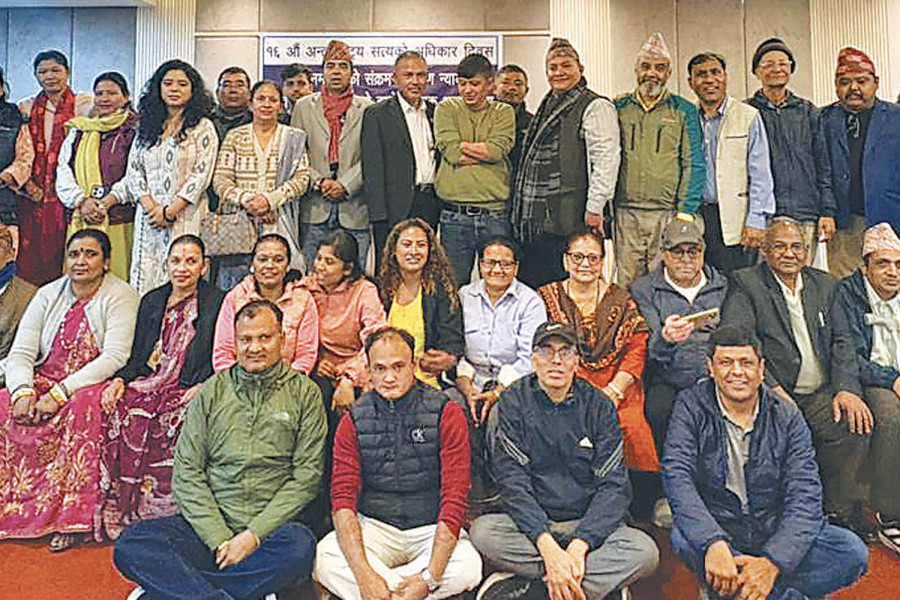
On the International Day for the Right to the Truth, they called for transparent, victim-centred commissions and comprehensive reparation programmes. Conflict victims pose for a photo after the event on the occasion of the International Day for the Right to the Truth in Kathmandu on Monday. Photo: Courtesy of Conflict Victims Common Platform
A section of victims from the decade-long Maoist conflict has urged the newly elected Parliament and the incoming government to ensure credible and victim-centred transitional justice for survivors of human rights violations and to end impunity.
Organising an event on the occasion of the International Day for the Right to the Truth in the capital on Monday, the Conflict Victims Common Platform said the conflict victims’ community is awaiting coordination and cooperation with the incoming government, which is expected to be formed with a strong public mandate, to conclude the transitional justice process through a credible and trustworthy mechanism.
The gathering demanded amendments to the flawed provisions of the Enforced Disappearances Enquiry, Truth and Reconciliation Commission Act, 2014, in line with international standards and Supreme Court directives. It also called for the immediate dissolution of the existing commissions formed through opaque political bargaining, and the formation of independent, competent, and victim-centred commissions through credible, transparent processes based on the open, public selection of capable individuals who meet international standards.
The group further urged the adoption of victim-centred, gender-sensitive, disability-inclusive and inclusive commissions, while calling for the formulation and implementation of comprehensive reparation programmes that address both immediate and long-term needs.
It also demanded the publication of reports of commissions formed to investigate human rights violations during various movements, including the Gen Z movement and the Madhesh movement. It called for ensuring justice and reparations for victims, legal action against perpetrators, and establishing a system of accountability for all human rights violations to end impunity.
Additionally, it called for the introduction of policy provisions on vetting eligibility for public office, urging that individuals accused or convicted of serious human rights violations, corruption, moral turpitude or criminal activities should not be appointed, nominated, promoted or politically protected in security agencies, the civil service, public institutions or political parties.
The statement recalled that Clause 5.2.3 of the Comprehensive Peace Accord, signed on November 21, 2006, between the Government of Nepal and the then rebel Communist Party of Nepal (Maoist), had committed both sides to make public, within 60 days, the real names, surnames and addresses of those disappeared or killed during the conflict and to inform their families.
During the decade-long armed conflict, hundreds of thousands of citizens were victimised by serious human rights violations, including killings, enforced disappearances, torture, rape, property seizure and forced displacement. However, even as the world marks the 16th International Day for the Right to the Truth and nearly two decades since the peace accord, conflict victims in Nepal continue to struggle for their fundamental right to know the truth about these violations.
The statement said victims have repeatedly been ignored in the name of addressing truth, justice and reparations, and their suffering has been used for political and vested interests. Laws have been enacted and amended through political agreements, and commissions have been formed three times with controversial appointments based on political sharing.
According to the platform, the commissions were formed through opaque processes that sidelined victims’ participation and concerns, as well as clear criteria and transparent public selection procedures. Loyal individuals who would not question political parties and leaders were recommended through a compliant recommendation committee, leading to party-controlled commissions.
Victims have consistently opposed these opaque recommendations and appointments, and a writ petition filed by 334 conflict victims from 67 districts is currently under consideration at the Supreme Court.
The platform stressed that the failure to investigate past incidents and manage transitional justice in a timely and appropriate manner has further entrenched impunity within the state system. To ensure that sacrifices made in the fight against corruption, misuse of public resources, nepotism and favouritism are not wasted, the newly elected Parliament and the incoming government must immediately adopt principles of transparency, accountability, competence, impartiality and inclusive governance.
The statement also called on current office-bearers of commissions, appointed through opaque and politically driven processes that ignored victims’ sentiments, to step aside in light of the changed political context.
“The failure to make public and implement reports of past commissions, including the [Janardan Lal] Mallik, [Krishna Jung] Rayamajhi, [Girish Chandra] Lal and [Gauri Bahadur] Karki commissions, and delays in managing transitional justice have further deepened impunity within the state system,” reads a statement issued by the platform.
Stressing that the rights to truth, justice and reparations for victims of human rights violations across all movements and periods are a shared concern, the platform called for collective efforts to address these issues.
It also appealed to political parties, the National Human Rights Commission, civil society, the human rights community, the media and the international community to extend solidarity and cooperation to the conflict victims’ movement for credible transitional justice.




 17.6°C Kathmandu