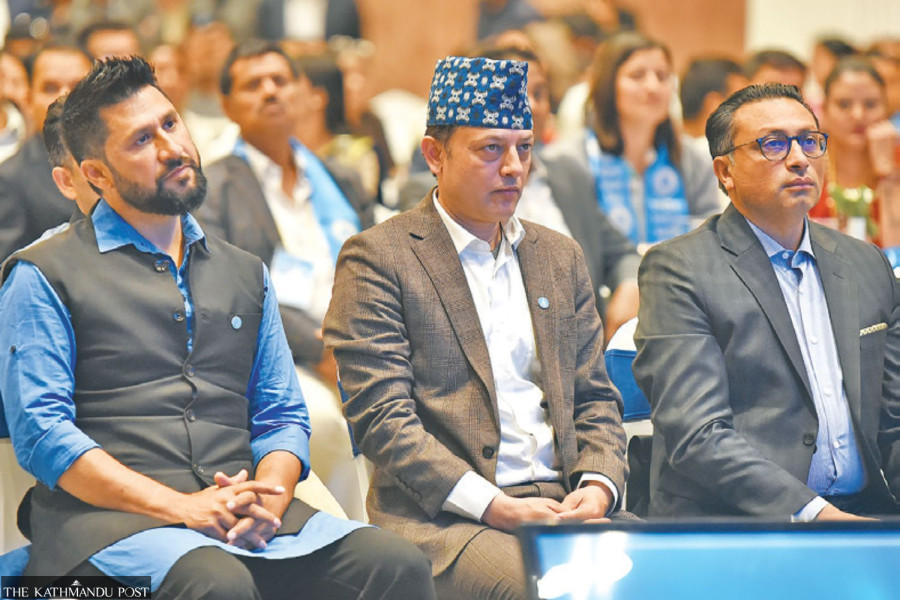
Experts say past hung parliaments were due more to uninspiring candidates and vague agendas of parties. Rastriya Swatantra Party leaders (from left) Rabi Lamichhane, DP Aryal and Swarnim Wagle. POST PHOTO
Nepal has adopted a mixed electoral system, under which 60 percent of lawmakers are elected through the first-past-the-post (FPTP) system and 40 percent through proportional representation (PR).
Before the March 5 snap elections, there had been repeated arguments that the current electoral system should be changed, as it was believed to prevent any single party from securing a clear majority and instead produce a hung parliament.
However, the Rastriya Swatantra Party (RSP), has proved this narrative wrong. Within the current system, it not only secured a majority in the 275-member House of Representatives but fell just two seats short of a two-thirds majority.
Does this result suggest that the problem lies not with the electoral system, but with the political parties and the candidates they field—since in all previous elections under this system failed to deliver a clear majority? Or, alternatively, does it imply that judging the system on the basis of a single election is premature?
Padam Giri, former law minister from the CPN-UML, believes the recent election was an exception as it was influenced by September’s Gen Z protests and public disenchantment with traditional political parties.
“Future elections may not be held under the same conditions,” he said, adding, “therefore, I believe the mixed electoral system may still produce fractured results, which needs to be addressed by the new RSP government,” Giri said.
But, newly elected RSP lawmaker Yagyamani Neupane rejects the notion that this election is an anomaly and dismisses calls for electoral reform.
“Earlier elections produced hung parliaments since the public had no choice other than the traditional political parties,” Neupane argues.
Senior advocate Purna Man Shakya also does not see any defect in the existing mixed electoral system. He argues that if political parties field credible candidates with clear agendas, a single party can win a majority as seen in the recent elections.
“The earlier fractured results were due to political parties forming alliances with ideologically incompatible groups,” Shakya said. “It was not the system’s fault, but the parties’ candidates and agendas.”
According to Shakya, the mixed electoral system can produce either a fractured parliament or a two-thirds majority, depending on public trust in parties and candidates.
Nepal first adopted the mixed system in the 2008 Constituent Assembly elections after the second people’s movement in 2006. At the time, the Communist Party of Nepal (Maoist), which had joined mainstream politics after a decade-long insurgency, emerged as the largest party with 220 seats in the 601-member assembly, but fell short of a majority.
Similarly, the second Constituent Assembly elections in 2013 saw the Nepali Congress become the largest party with 196 seats, still short of a majority.
Following the promulgation of the constitution in 2015 through the second Constituent Assembly, Nepal held parliamentary elections in 2017 for the 275-member House of Representatives. In that election, UML emerged as the largest party, winning 80 seats under the FPTP system and 41 PR seats. Nevertheless, it also fell short of a clear majority. Although the UML later unified with the CPN (Maoist Centre)—with whom it had contested the election in alliance—to form a joint party that commanded a majority in parliament, the unity did not last.
The 2022 elections also produced a fractured mandate.
Before the Gen Z movement in September 2025 toppled the Congress-UML government, the two parties envisioning the constitutional amendment had reached a seven-point agreement and formed the coalition government in July 2024. With constitutional amendment as its central agenda, the coalition also aimed to revise the electoral system.
Congress General Secretary Pradip Paudel says the recent election results show that the mixed electoral system has no fault and can deliver a clear mandate. However, he suggests reforms in the PR system, arguing that it has become a tool for party leaders to pick candidates without fully adhering to the system's core principles.
“Adhering to the principle of inclusivity, the PR system can be revised, though governance reforms may be needed as federalism has become financially costly,” Paudel said. “The recent poll results have settled earlier debates on the electoral system.”




 14.82°C Kathmandu