Dalawa residents waiting for land ownership certificates for over six decades
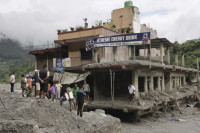
Every monsoon, they are forced to seek higher ground and live under tarpaulins for months to escape floods. Residents of Dalawa in Hanumannagar Kankalini Municipality-14, Saptari. POST PHOTO: Bidyananda Ram
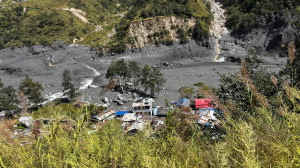
More than a hundred families displaced by the Koshi river over the decades were relocated to Dalawa in Hanumannagar Kankalini Municipality-14 of Saptari district. Despite enduring annual floods for more than 60 years, they remain distressed by their inability to secure land ownership certificates. Before the Koshi Agreement, signed between Nepal and India in 1954, and the subsequent construction of the Koshi Barrage in 1962, their settlement was situated 500–600 metres east of its current location.
After the construction of a new embankment on land leased by the Indian government 60 years ago, the villagers were shifted to the western side.
Sukadev Yadav, 75, said they were moved to Dalawa in 1963 after being displaced. “Although we were promised land titles at the time, no one took the initiative,” Yadav said. “I was only a child then. We built houses here, but without the land ownership certificates, we cannot take bank loans for business or even for our daughters’ weddings.”
When the embankment was further east, the villagers farmed 700 bighas of land.
Ramkrishna Yadav, another resident of Dalawa, complained that the westward shift of the embankment buried their fertile fields under sand. “Daily life is a struggle,” he said. “While the land deeds are important, our lives would have been much easier if the embankment had remained at its original site.” He noted that around 500 residents of wards 1, 2, 3 and 4 of the former Rampura Malhaniya Village Development Committee have lived in such pitiable conditions for decades.
The situation is even grimmer for more than 400 landless squatter families living east of the embankment. Every monsoon, they are forced to seek the ground slightly higher than before and live under tarpaulins for months to escape the floods. Ramu Paswan, 65, of Sakhuwa, lamented the lack of progress. “My life is nearly over, but I worry that my children will suffer the same fate,” he said. “No one has stepped in to relocate us to a safer area.”
Sobit Paswan, 69, said the settlements stretching from Sakhuwa to Yoginiya, Sakardahi and Hanumannagar remain inaccessible to ambulances and fire engines. Having lost his parents to the same cycle of poverty, Paswan fears he too will die a squatter.
Birendra Majhi, mayor of Hanumannagar Kankalini Municipality, explained that as the land in Dalawa falls under the jurisdiction of the Bihar state government of India as per the Koshi Agreement signed between Nepal and India, local efforts to issue land ownership certificates have reached a standstill.
“It is not for lack of trying, but this is a bilateral issue that requires high-level diplomatic intervention,” Majhi said. He added that the municipality is working with the district committee of the National Land Commission to address the grievances of the landless squatter families.




 12.64°C Kathmandu