Study of 2,905 respondents by Sharecast Initiative, in collaboration with The Kathmandu Post, finds personality, track record and development plans outweigh party ideology, with clear divides by economic status and province
In the run-up to the elections, almost all parties contesting the polls last week unveiled their plans for the next five years. Compared to previous elections, parties have presented these plans under different labels this time. Their agendas for the next five to 10 years have been released under various names such as pratigyapatra (pledge paper), wachapatra (commitment paper), manifesto, and sankalpa (resolution).
But how closely do these publicly announced plans align with the actual priorities of ordinary citizens?
In our recent study, we conducted face-to-face interviews with 2,905 people and asked an open-ended question: “When deciding whether to support a political party or vote for a candidate, what factors do you primarily prioritise?” We did not pre-code possible responses. Respondents answered in their own words. We then grouped similar responses under separate headings and analysed them.
Most respondents said that this time they give greater priority to a candidate’s personality, qualifications and competence, as well as the candidate’s vision and plans for development and infrastructure, and honesty and good conduct, rather than the party’s name and flag or its ideology and doctrine.
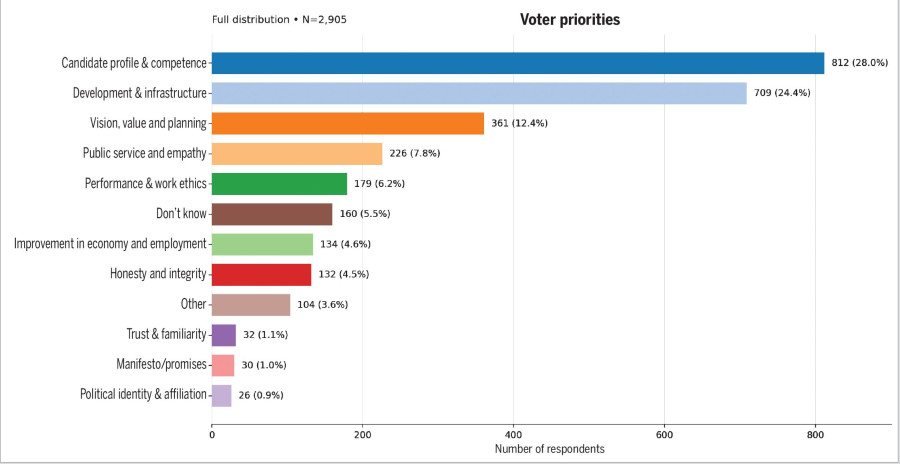
Nearly two thirds of respondents in the study said they decide whom to vote for primarily by looking at the candidate’s personality and competence, and the candidate’s vision and plans for development and infrastructure.
Among the 2,905 respondents, the largest share, 28 percent (812 people), said a candidate’s personality, qualifications, and competence are their main priority when deciding whom to vote for. Around 24 percent (709 people) said they prioritise candidates who can deliver development and infrastructure. Around 12 percent (361 people) said they make their decision by assessing the candidate’s long-term vision and plans.
An analysis of the data suggests that most voters are looking less at party ideology and more at a basic question: Who can actually deliver?
What stands out is a strong search for leadership that is trustworthy, capable of getting things done, able to make decisions, and accountable. Most respondents also appear conscious of the need to prevent state power from falling into the wrong hands.
Likewise, voters are looking for candidates who can improve citizens’ access to services and development, such as roads, drinking water, and other basic facilities, and make daily life easier.
On candidates’ vision and plans, respondents appear to prefer those who can lay out a long-term development roadmap for the country, offer practical ways to solve problems, and build an overall development strategy rather than merely talk about piecemeal projects. Responses referring to “serving the people” point to expectations that candidates should listen to public grievances, make government services more accessible, expedite public service delivery, and treat everyone equally, without favouritism or patronage.
Respondents also identified, as an important consideration, a candidate’s prior work experience, past background, and even the party’s track record—what the party has actually done in the past.
This suggests that in this election, voters are placing greater trust in past performance than in party or candidate manifestos, promises or speeches.
The responses cluster strongly around candidate-centred considerations rather than party-linked identity markers.
The smaller categories include manifesto/commitments, trust/personal familiarity, political identity/ideology, and those unwilling to respond.
Two voter mindsets
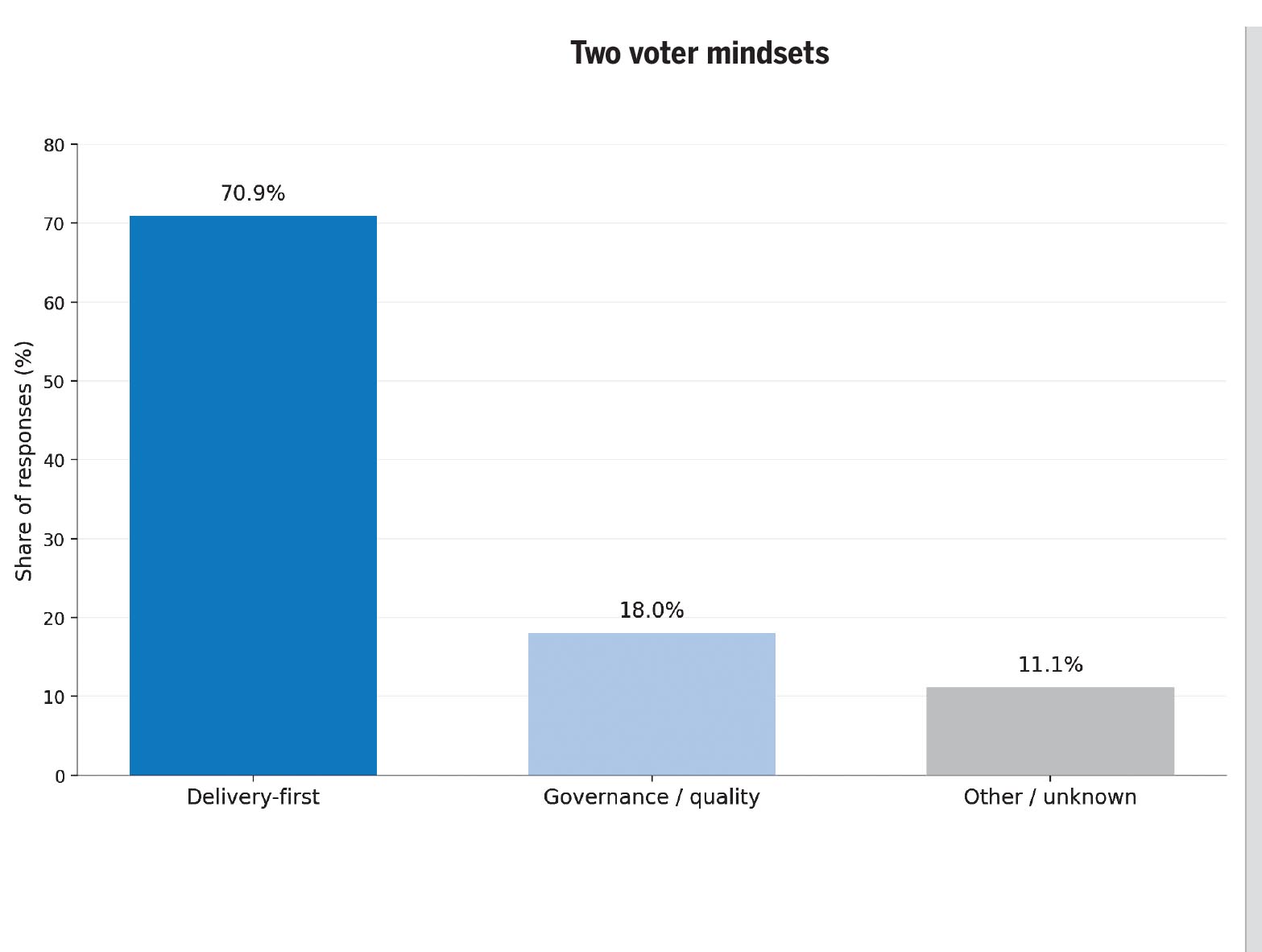
Broadly, two voter mindsets appear to be at work: a larger delivery-first bloc that prioritises capacity, development, track record, and service, and a comparatively smaller but still significant bloc that seeks quality of governance, including vision and planning, anti-corruption, and manifesto commitments. The data also shows a clear divide by economic status. Better-off groups appear more inclined towards vision/planning, track record, and anti-corruption, while economically insecure groups are more likely to prioritise service/empathy and jobs/economic improvement. This can be read as a distinction between stability-driven priorities and necessity-driven priorities.
Provincial patterns also appear to reflect lived experience more than ideology. The stronger emphasis on development and infrastructure in Sudurpaschim, and the greater focus in Madhesh on jobs, the economy, and anti-corruption suggest that political priorities are being shaped primarily by different forms of everyday hardship and problem exposure.




 21.31°C Kathmandu