Declining academic quality in Karnali make election pledges hollow
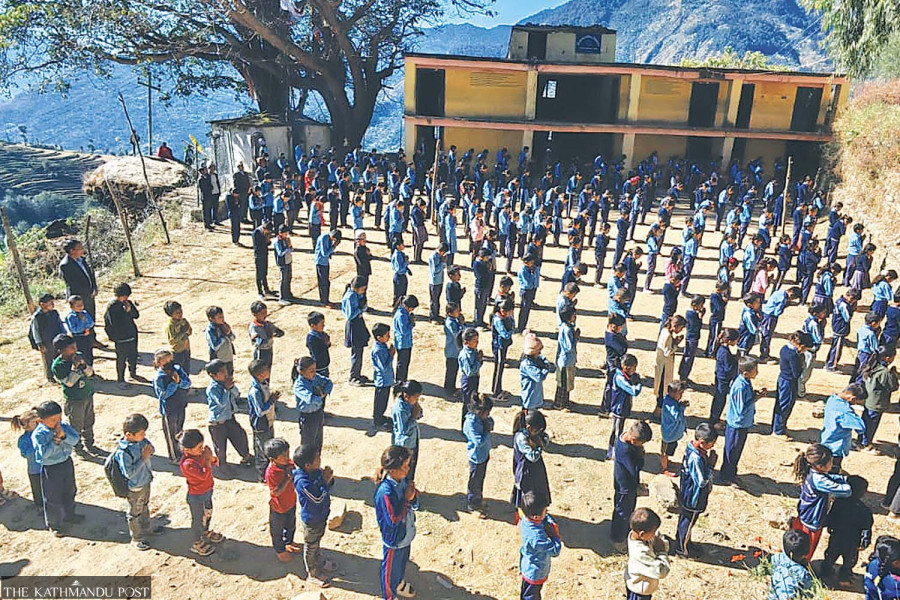
Teacher shortages, mass dropouts and migration undermine learning despite rising investment in the province. Children stay in line for their morning assembly at Kalika Secondary School in Hima Rural Municipality, Jumla recently. Tularam Pandey/TKP
Karnali Province’s education system is facing a deepening crisis, marked by declining learning outcomes, poor Secondary Education Examination (SEE) results and chronic teacher shortages, even as political candidates continue to repeat long-standing pledges of education sector reform.
Official data from the Ministry of Social Development shows that Karnali’s literacy rate stands at 76.1 percent. The gross enrolment rate in early childhood development is 77.80 percent, while the net enrolment rate at basic level (Grades 1–8) is 97.09 percent. However, the net enrolment rate at secondary level (Grades 9–12) drops sharply to 42 percent. The student retention rate in Grade 1 is 97.3 percent, but the average learning achievement in school education is only 46 percent.
Ground realities illustrate the crisis starkly.
At Kalika Secondary School in Tilagufa Municipality–4, Rachuli, Kalikot, most of the students of grade 10 left for Surkhet after Tihar to attend private tuition classes. 33 students are appearing in the SEE from the school this year. “We have no subject teachers and lower-level teachers are handling secondary classes. Even half the course had not been completed,” said headteacher Chakra Bahadur Shahi. “After Tihar, classes had to be halted. It has become almost a fashion for students to go to Surkhet or the district headquarters for extra tuition classes. They return only to sit the SEE in April.” Last year, only one out of 34 SEE candidates from the school passed. The school has no permanent secondary-level teacher.
In Mugum Karmarong Rural Municipality–2 of Mugu, Pemba Chhiring Lama has sent his two sons to a monastery in Kathmandu for Buddhist education and his daughter to a private school in Birendranagar, Surkhet. “What is the point of having a school in the village if teaching is neither regular nor quality?” he asked. In his village’s Janajagriti Basic School, only 16 students are enrolled.
Around 80 percent of children from Mugum Karmarong, and Namkha rural municipalities in Humla, and Shey Phoksundo, Chharkatangsong and Dolpobuddha rural municiapality in Dolpa leave for monastic education in Kathmandu or India. Most of the people in these areas are from Tamang and Lama communities. Local schools stand nearly empty.
The province’s SEE performance reflects the strain. Of 31,773 students who appeared in last year’s SEE from Karnali, only 18,042 (56.78 percent) passed, compared to the national average of 62 percent. Of the 730 community and private schools whose students sat the exam, 46 schools recorded zero passes. Failure rates were highest in Dailekh (82.6 percent), Surkhet (66.4 percent), Kalikot (61.65 percent), Dolpa (57.2 percent), Mugu (56.7 percent), Humla (53.81 percent), Salyan (50.85 percent), Jumla (40.31 percent) and Jajarkot(44.57 percent). The pass rate has fallen from 64.8 percent two years ago.
Yet, as parliamentary elections approach, candidates continue to recycle promises. Janardan Sharma, repeatedly elected from Rukum West since 2008, has once again pledged internet connectivity and “smart classrooms”, though 35 percent of students failed SEE in the district last year and 14 of its 77 secondary schools lack electricity.
Candidates Mahendra Bahadur Shahi in Kalikot, Shakti Bahadur Basnet in Jajarkot and Dhan Bahadur Budha have renewed calls for fully free education up to secondary level and expansion of technical education. Others promise model schools, ICT classes and upgraded infrastructure.
However, community schools across Karnali are grappling with dwindling enrolment. In Surkhet alone, 45 schools have fewer than 25 students. Across the province’s 3,026 community schools, 1,152 have fewer than 45 students. According to the 2021 census, 18,543 children aged 5–12 in Karnali are out of school. Nearly 400,000 residents are estimated to be working in India, often taking their children along, leading to irregular attendance or dropout.
Balbir Sunar, an officer at the Education Development Directorate operating under the Ministry of Social Development in Karnali pointed out that the Teacher vacancies are severe in the province. Of 11,865 sanctioned posts in 2,931 community schools, 4,993 remain vacant. Shortages are acute in English, Mathematics and Science. In Kalikot’s Narharinath–7, Rupadevi Secondary School has advertised 19 times for a Mathematics teacher without a single applicant. Many schools rely on temporary or privately funded teachers.
With courses often incomplete in the schools, tuition centres in Birendranagar are crowded with students from Kalikot, Mugu and Jumla. Fees reach Rs3,500 per subject per month. “Without subject teachers, we cannot stop students leaving for tuition,” said Shankar Prasad Upadhyay, mayor of Tilagufa municipality, noting that families spend Rs10,000–12,000 per month despite widespread poverty.
Studies show that by the end of the academic year, only around 60 percent of the curriculum is completed in many schools. In high mountainous settlements, heavy snowfall forces seasonal migration for up to five months. During monsoon and harvesting periods, classes are also disrupted. In Namkha, Humla, entire villages relocate in winter, leaving schools closed.
Dropout rates remain alarming. Of every 100 students enrolled in Grade 1, only 80 reach Grade 5. Only 49 percent reach Grade 8. Child marriage, child labour and disability further compound exclusion. Karnali has over 137,000 child labourers and an estimated 15,000 children with disabilities out of school. Around 40 percent of girls reportedly marry before completing schooling.
Investment in education has increased. Since 2018–19, the provincial government has allocated between 2.5 and 4.9 percent of its budget to education, spending Rs8.98 billion out of Rs11.28 billion allocated. Local governments spend between Rs10 million to Rs50 million annually, while NGOs contribute up to Rs460 million each year.
Despite this rising expenditure, education quality and learning outcomes have not improved proportionately. Karnali’s literacy campaign, launched in 2019, has stalled midway despite spending nearly Rs60 million.
Education officials cite teacher shortages, irregular attendance, delayed textbooks, poverty and geographical hardship as structural barriers. Yet for many parents and students, the issue is more immediate: incomplete courses, weak instruction and mounting costs.
As candidates campaign on promises of digital classrooms and technical institutes, thousands of Karnali’s children continue to prepare for crucial examinations after studying only half the syllabus — or leave school altogether.
For a province striving to bridge decades of marginalisation, the classroom remains its most fragile front line.




 14.7°C Kathmandu