Illegal riverbed mining on Kaligandaki persists despite regulations and Supreme Court order
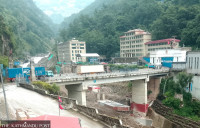
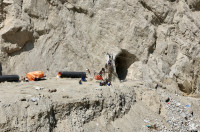
Contractors accused of using heavy machinery in breach of agreements; activists demand firm political commitment to protect natural heritage. Excavators extracting riverbed materials from Kaligandaki River. Photo: Courtesy of RK Adipta Giri
The issue of the extraction of riverbed materials from the Kaligandaki River in Parbat continues to draw attention, with crusher operators and some contractors accused of indiscriminate mining in violation of standards.
Locals complain that large excavators are being used in the middle of the river to extract stones, gravel and sand.
Although local governments have awarded contracts for the collection of river-based materials from the Kaligandaki, contractors and crusher operators have been using machinery in contravention of the terms of their agreements.
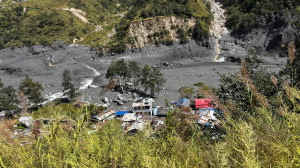
Taking advantage of the busy election period, when administrative bodies are preoccupied, extraction has reportedly continued day and night. Mining activities can be seen along the stretch from Maldhunga to Waribeni, areas that fall within Kushma Municipality and Jaljala Rural Municipality of Parbat. The extraction has also continued in Phalewas Municipality of the same district.
Kushma Municipality and Jaljala Rural Municipality have awarded contracts for the extraction of river materials from the Kaligandaki. Critics say the arbitrary practices of contractors and crusher operators have increased due to neglect in monitoring and enforcement by the local authorities, including the district coordination committee, the district administration office and local bodies.
“Even a contract must have its own standards. Are they allowed to enter the middle of the river and extract materials?” asked Raj Shrestha of Waribeni. “Just because the local government awards a contract, they can not extract the river-bed materials, taking the machines wherever they like in the river”
The Supreme Court issued an interim order on July 13, 2021, in the name of Gandaki and Lumbini provincial governments to halt extraction from the Kaligandaki. The order, issued by then Chief Justice Cholendra Shumsher Rana, directed that any decisions or activities that could affect the river’s beauty, alter its natural flow, construct dams, or illegally export shaligram stones, gravel and sand be suspended until a final verdict on the writ petition.
Due to this order, local governments had been unable to award contracts for four years. However, on October 27, 2024, a division bench of Justices Dr Kumar Chudal and Binod Sharma dismissed the writ petition. Following the decision, Jaljala Rural Municipality and Kushma Municipality allocated designated extraction sites and awarded contracts last October.
There are currently four registered crusher industries in Parbat district—one in Jaljala Rural Municipality, two in Kushma Municipality and one in Modi Rural Municipality. Except for the crusher operating in Modi, the remaining industries are located along the banks of the Kaligandaki River, which is against the prescribed standards.
According to the “Standard for Extraction, Sale and Management of Stone, Gravel and Sand” introduced by the government on July 20, 2020, crusher industries may only operate at least 500 metres away from riverbanks, concrete bridges, highways, and historical lakes and reservoirs.
However, Bishnuram BK, chief of the district coordination committee, Parbat, claimed that there is no excessive exploitation of the Kaligandaki River as alleged. He said monitoring of extraction at designated contract sites has been completed.
“We have completed the first phase of monitoring at the sites awarded through contract by local governments,” he said. “After reviewing all the details, we did not find indiscriminate river exploitation.” He added that as the contracts were awarded through legal procedures, revenue collection has also been satisfactory.
Meanwhile, no political party candidate in Parbat has spoken publicly about the issue of Kaligandaki extraction. The matter had not featured prominently in previous elections either. However, some activists and youth groups have consistently called for the issue to be included as an agenda item aimed at resolving the ongoing exploitation.
Amid the election environment, campaigners under the Kaligandaki Conservation Campaign have intensified pressure, urging that commitments to halt the exploitation of natural resources and protect the Kaligandaki River be clearly mentioned in election manifestos.
RK Adipta Giri, an activist working on Kaligandaki conservation issues, said that conservation of the river would be possible if political candidates prioritised long-term environmental sustainability over short-term electoral gains. “We do not want to see the Kaligandaki in a distorted form,” he said.




 13.64°C Kathmandu