Youth and members of civil society question exclusionary systems, call for democratic reform in Nepal
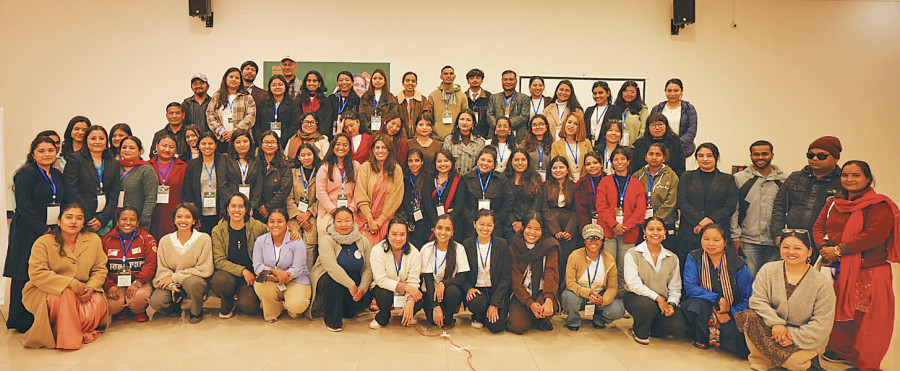
Participants at a national dialogue in Kathmandu highlight structural barriers to political participation and call for reforms to include marginalised groups in decision-making. Participants of the public dialogue titled ‘Samabeshita Sambad: A National Dialogue on Inclusive Democracy’. Photo provided to the Post
Civil society leaders, youth representatives and community advocates have called for stronger inclusion and accountability in Nepal’s democratic system, saying structural barriers continue to shape who participates in politics and who remains excluded.
Speaking at a public dialogue titled ‘Samabesita Sambad: A National Dialogue on Inclusive Democracy’, panellists said that while youth engagement is growing, political participation and representation remain uneven, particularly for historically marginalised groups.
The one-day symposium was organised by the Ujyalo Foundation with support from the Canada Fund for Local Initiatives and in partnership with Nepal Mahila Ekata Samaj, Dalit with Disabilities Association Nepal, Kalpa Empower Women Nepal, Accountability Lab Nepal, Project Abhaya and Days for Girls Nepal. More than 100 participants attended the programme in Kathmandu.
The panel discussion highlighted a gap between constitutional rights and everyday realities, noting that young people and marginalised communities are often expected to be seen and not heard in academic institutions and political parties. Speakers said this reflects systemic barriers rather than a lack of capability.
The symposium featured three thematic plenary sessions, each lasting nearly one and a half hours, allowing panellists and participants to engage in extended discussions on political representation, merit and access.
The first panel, ‘Missing Voices, Broken Mandates,’ examined structural barriers in political representation. Shailee Chaudhary, a human rights advocate and proportional list candidate from Gatisheel Loktrantik Party, linked these challenges to the “Brahmanical patriarchal system, a mindset practised for 3,000 years.” She questioned who benefits from quotas: “Is it those with social, financial, and political capital, or someone who lacks basic access?”
Adding to this, Krishna Gahatraj, an expert in disability-inclusive development, brought lived experience, sharing it took him 15 years to realise his societal placement was due to caste. “Even today, a Dalit has a hard time finding a room to rent in Kathmandu,” he said. “This is not just a reaction; it is living pain.”
The second panel shifted focus to the very meaning of representation itself, with speakers challenging conventional notions of merit and demanding a fundamental redesign of political access.
Monika, a queer intersectional feminist and member of the GenZ Movement Alliance, argued that until there is reparative representation, “there is no fair competition on unequal footing.” She offered a compelling example to illustrate her point, comparing political design to universal design: ‘‘If every bus is designed in an accessible way for people with disabilities, it can still be of use to able-bodied people. Why can’t the design be made universal? Can’t policies be made by keeping historically marginalised groups at the centre?’’
She concluded by stating, ‘‘We certainly hold the right to vote, but we should also have the right to see ourselves as an election candidate."
Meanwhile, Man Bahadur BK, former government secretary, presented an assessment of the country’s trajectory in ensuring inclusion for marginalised groups. ‘‘There is limited freedom of choice among elected lawmakers in expressing their viewpoints publicly,’’ he said, adding that even constitutionally guaranteed proportional inclusion faces legal and political obstacles in practice.
He also linked exclusion to economic loss. “Nepal is losing 29 percent in human development every year. This translates to around 10 percent in GDP,” he said, attributing the decline to systemic inequality. Calling for reform in proportional representation, he said repeated occupation of the same seats restricts broader participation. “The path to inclusion remains very difficult,” he said.
The programme also featured poster exhibitions and CIA Group Presentations by 20 fellows of the Samabesita Fellowship, a two-month initiative focused on political literacy and awareness. The event marked the completion of the fellowship, with fellows and participants receiving certificates of participation.
Concluding the programme, Bhagvati Adhikari, executive director of Nepal Mahila Ekata Samaj, said democratic reform requires public accountability.
“We are not trying to make things difficult for any caste, but rather questioning the privileges that the caste system brings,” she said. “Our democracy is weakening because we only question from behind the scenes. To keep democracy alive, we must start questioning.”




 14.69°C Kathmandu