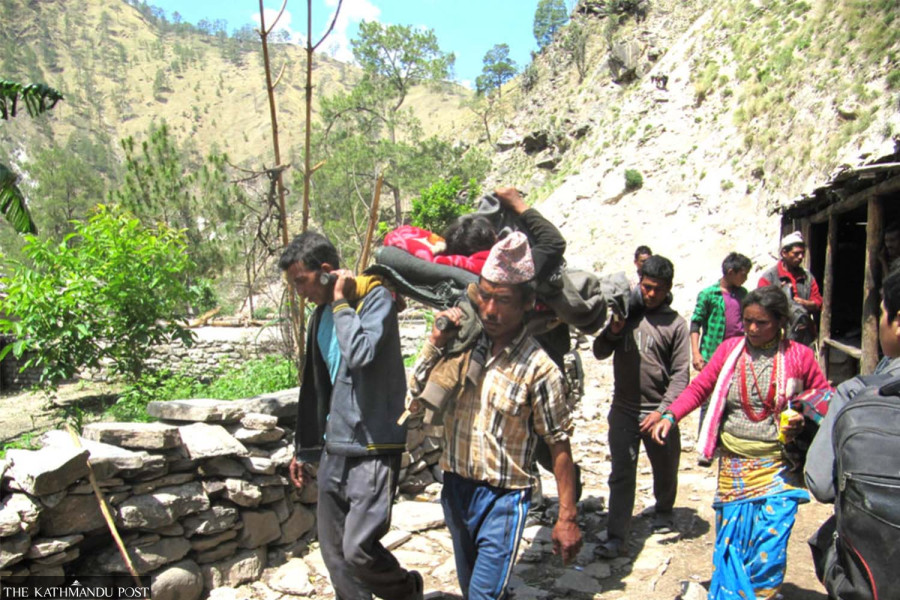
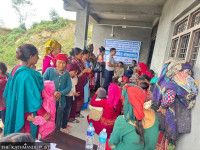
172 women have died in nine years due to delayed maternal care. Staff shortages have left most specialist posts vacant and ICU equipment unused. A patient from Mugum Karmarong, Mugu, is carried to Gamgadhi, the district headquarters, for treatment. Post file photo
Two weeks ago, 27-year-old Ramita Thapa went into labour in Upper Khopri, a tiny village in ward 9 of Tila Rural Municipality, Jumla. Her family carried her on a stretcher towards Rasa Health Post, but she gave birth halfway through at Chayapatan, where snow lay two feet deep.
Khopri, home to just 60 households, is the rural municipality’s most isolated village. Reaching the nearest health post requires a five-hour trek, including a 4,000-meter-high mountain pass. “When someone goes into labour here, they have to be carried on a stretcher, but most give birth along the way,” said local health volunteer Tulsa Thapa. Ramita had previously delivered two daughters on the same journey.
On Monday, 18-year-old Karuna Dangi of ward 8 in Thuli Bheri Municipality in Dolpa, and her newborn were airlifted to Sukhet by the Nepali Army after the baby, born at Juphal Health Post, struggled to breathe. The infant is now receiving treatment in the neonatal intensive care unit at the Provincial Hospital, Sukhet.
Last year, on January 7, Dhanrupa BK of Jiula, ward 10 of Chhayanath Rara Municipality, gave birth at home. After two days of bleeding, her family was preparing to take her to the district hospital when she died.
“The path to the hospital is extremely difficult, and there were no young people in the village to carry a stretcher,” said her husband, Ram Bahadur BK. The district hospital in Gamgadhi, the headquarters, is a two-hour trek from Jiula.
Over the past nine years, 172 women have died in Karnali due to delayed or inaccessible maternal care. The Provincial Health Service Directorate said 14 died last fiscal year and nine have already passed away this year.
Padam Bahadur KC, information officer at the Provincial Health Service Directorate, said most mothers in Karnali are aged 15 to 25, with nearly 80 percent of maternal deaths in this group. A study by the provincial Ministry of Social Development last year found that only 23.6 percent of families can reach a health facility within 30 minutes. The province has 371,125 households.
A system hollowed out
Karnali province has 184 sanctioned doctor positions for a population of 1.69 million, of which 152 remain vacant. Of 70 specialist posts, 60 are unfilled. Even if all posts were staffed, there would be only one doctor per 9,200 people.
Across the province, there are 359 birthing centres. Until the fiscal year 2017–18, the federal health ministry arranged airlifts for high-risk pregnant women. Under the President’s Women Upliftment Programme, 26 women were airlifted in fiscal year 2018–19, 33 in 2019–20, 28 in 2020–21, and 48 in 2021–22. Over three years, the Nepal Army airlifted 158 women, according to the directorate.
Neonatal mortality in Karnali is high. Over the past four years, 777 infants have died, including 199 last fiscal year. “Pregnant women are forced into heavy physical labour,” said paediatric specialist Dr Navaraj KC. “Many try to give birth at home unsafely and seek hospital care only after complications arise, raising maternal and neonatal deaths.”
The Karnali Province Planning Commission’s first five-year plan reports a neonatal mortality rate of 29 per 1,000 live births, compared with 32 nationally. Under-five mortality is 58 per 1,000 in Karnali, versus 39 nationwide. Only 72 percent of pregnant women in the province deliver at health facilities, compared with 79 percent nationally. The provincial health policy notes that home births and early-age pregnancies contribute to higher maternal, neonatal, and under-five mortality. Remote and disadvantaged communities face limited access to healthcare. Severe illness often results in financial hardship or death at home.
While 33 percent of Nepal’s population has health insurance, only 29 percent of people in Karnali are enrolled. Shortages of healthcare workers remain a major challenge. Of 908 sanctioned positions, only 463 are filled, including just 32 permanent doctors.
Directorate Director Dr Rabin Khadka said only five percent of 11th-level specialist posts and 20 percent of 10th-level positions are filled, leaving most district hospitals dependent on contract doctors. Despite higher pay to retain staff, shortages persist. “Without doctors, patients must travel to other provinces,” Khadka said.
Karnali offers doctors allowances ranging from 75 to 150 percent to encourage retention. The province has 12 government hospitals and 13 primary health centres, but regular doctors are rare outside the Province Hospital in Surkhet and the Karnali Health Science Academy in Jumla. According to the directorate, senior health workers—those above the eighth level—are largely absent, including anaesthetists and radiographers.
The provincial health policy cites shortages of doctors and staff, weak infrastructure, and difficulties in retention as major challenges. Medicine shortages are also severe. Three months ago, a seasonal flu outbreak affected about 400 people in Chhayanath Rara Municipality and nearby rural areas in Mugu. Local authorities had not procured medicines for the fiscal year; once supplies arrived from the district, the outbreak was controlled in two weeks, said Dr Dipendra Jung Shahi of the Mugu District Hospital. Lack of proper storage, cold chain facilities, and timely distribution hampers the quality.
Post File Photo
Staff shortages also leave expensive equipment idle. Rukum West District Hospital has a two-bed ventilator and a six-bed ICU, but only two specialist doctors and eleven medical officers are available for 250–300 patients daily. Up to ten critically ill patients are referred weekly, said hospital management committee chair Tek Bahadur Kusari.
At Salyan Hospital, a ventilator and ICU installed for Rs25.8 million have remained unused for nearly three years. “Even a week of training for two medical officers and two nurses was insufficient,” said hospital chief Dr Arjun Budha. During the Covid pandemic, some ventilators and ICU beds were used, but currently, up to ten critical patients are still referred elsewhere every week, he said.
Equipment without experts
Karnali government invested nearly Rs400 million to set up 62 ICU beds and 26 ventilators across its 10 districts during the pandemic, yet most high-end equipment remains unused outside Sukhet and Jumla. “Ventilators require 24/7 staff and proper medicines, but staffing is insufficient,” Dr Budha said.
The Provincial Hospital in Sukhet has 25 ICU beds and 10 ventilators; the Karnali Academy of Health Sciences in Jumla has 10 ICU beds and six ventilators. ICU facilities allow oxygen therapy, monitoring, and complex surgeries, but need specialists and trained nurses, said Dr Khadka. The Sukhet hospital has performed two kidney transplants, but major operations require surgeons from Bhaktapur. “External doctors perform operations, we only assist,” said director Dr Ganesh Thapa.
Of Karnali’s 79 local units, only 31 operate basic hospitals. The province has 25 municipalities, 54 rural municipalities, and 718 wards. Health posts are absent in 117 wards.
Some municipalities have very few hospitals: five in Kalikot, four each in Rukum West and Dailekh, three in Jajarkot, four in Surkhet, and two in Salyan. Dolpa, with eight local bodies, Mugu with four, and Humla with seven, still have no municipal-level hospitals. Dolpa has 23 health posts, Mugu 24, and Humla 26.
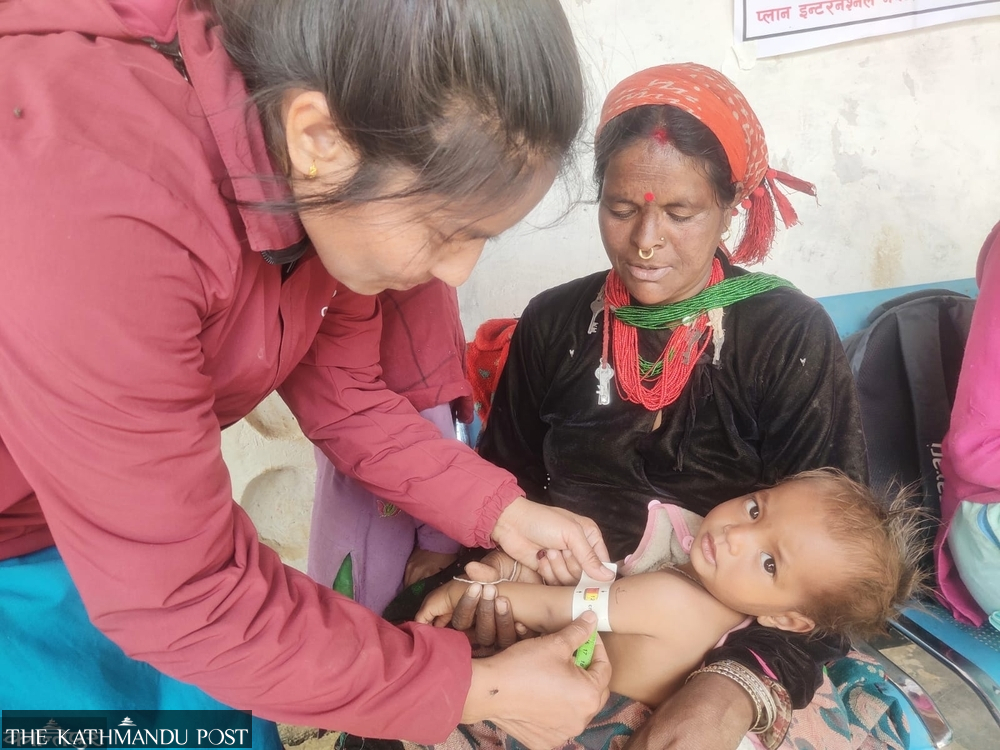
Child malnutrition is rising. In ward 4 of Kanakasundari Rural Municipality, Jumla, 21-year-old Samjhana BK, married at 15, has two daughters, aged five and one. A health camp three months ago found both malnourished; her youngest is under medical supervision. Samjhana said her own health is deteriorating due to limited care during childbirth and dietary restrictions.
In ward 7 of Chaukune Rural Municipality of Surkhet, 22-year-old Manju Nepali’s two children are malnourished. “Our grain barely lasts a month. My husband sends 4–5 thousand rupees monthly from India. How can I feed them nutritious food?” she said.
The Health Service Directorate reports 6.8 percent of children in Karnali are born underweight. Last fiscal year, 2,511 children received outpatient care for severe malnutrition; six died. Hatsija Health Post in Jumla noted mothers’ poor nutrition and cultural practices limiting salt, vegetables, ghee, and animal protein during pregnancy as key causes.
Home births and reliance on traditional healers remain common. In ward 1 of Kalimati Rural Municipality in Salyan, 19-year-old Keshari Roka went into labour last year. With no local maternity services, her family first sought care from a ‘dhami-jhankri’ (traditional healer). “After two days, her condition worsened. By the time we reached the district hospital, the baby had already died in the womb,” said her husband, Khal Bahadur.
Ward chair Rabilal Basnet said about one-third of patients still consult dhami-jhankri first, only seeking hospital care in extreme situations, endangering mothers and newborns.
The Provincial Hospital in Sukhet and Karnali Health Science Academy in Jumla carry the province’s healthcare burden. Director Dr Ganesh Thapa said patient pressure is rising daily, with many coming from other districts and even the far west.
The Karnali Health Science Academy reported nearly 400,000 patients treated this year, including 4,385 major operations, with 280 operational beds. Information Officer Binod Basnet said most services are run by contractual staff. Only eight permanent doctors are in place, while 75 percent of staff work on contracts. The provincial government plans to upgrade the facility into a full health sciences academy, with ongoing infrastructure development, said Director Dr Ganesh Thapa.
The Academy, with 300 beds, is a regional hub for orthopaedic surgery. Most patients come from Humla, Kalikot, Mugu, and Dolpa. Vice-Chancellor Dr Pujan Rokaya said around 75 outpatients visit daily, and 520 orthopaedic patients have recovered this fiscal year.
Nepal’s constitution guarantees health as a fundamental right, including free basic care and emergency services. Yet limited infrastructure keeps many Karnali residents from accessing even basic services.
Never-ending election pledges
Ahead of elections, candidates continue to promise healthcare improvements.
In Dolpa, Nepali Communist Party (NCP) candidate Dhan Bahadur Budha pledged to modernise the district hospital with advanced equipment, specialist services, and a 500-bed hospital for upper and lower Dolpa.
Shey Phoksundo Rural Municipality resident Chhiring Lama highlighted chronic shortages of staff and medicine, noting that helicopter evacuation is often the only option. The rural municipality’s deputy chair, Pemma Bangcheng Gurung, said 10 people were airlifted in three months; the journey by foot takes at least two days.
In Kalikot, NCP candidate Mahendra Bahadur Shahi pledged free basic services, hospitals in all local bodies, and fully equipped health posts in every ward. Nepali Congress candidates Deep Bahadur Shahi of Jumla and Khadga Bahadur Shahi of Mugu promised free checkups, 50-bed hospitals, and accessible health insurance. Pragatisheel Loktantrik Party candidate Janardan Sharma of Rukum West proposed a medical college in Chaurjahari to serve the surrounding districts as a healthcare hub.
Previous manifestos from Congress, UML, and then Maoists also promised free basic healthcare, establishment of hospitals in every municipality, staffing, infrastructure improvements, telemedicine expansion, and maternal nutrition programmes. Despite repeated government terms by all parties, healthcare access in Karnali has seen little improvement.




 14.7°C Kathmandu