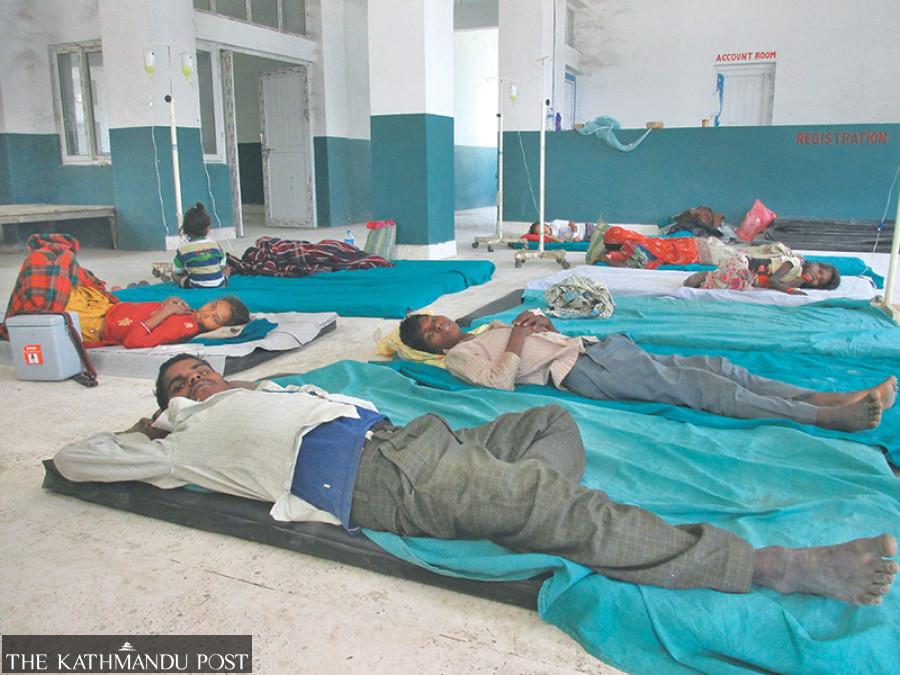
Kala-azar, a persistent public health challenge in Nepal, is on track to be declared eliminated this year, thanks to a significant drop in new infections in recent years.
Health officials said the new infection rate has fallen to less than one case per 10,000 people, while deaths from the disease have also remained below one percent of those infected over the past two years—a key threshold for elimination.
“If we succeed in maintaining the threshold of infections and deaths this year, we will be eligible to achieve disease elimination status,” said Dr Gokarna Dahal, chief of the Vector Control Section at the Epidemiology and Disease Control Division under the Department of Health Services. “We have been implementing intensive surveillance and disease control programmes to achieve elimination status.”
Kala-azar, also known as visceral leishmaniasis or black fever, is transmitted through the bite of an infected female phlebotomine sandfly.
Nepal is among the countries that endorsed a memorandum of understanding at the World Health Assembly in May 2005 to bolster regional collaboration to eliminate kala-azar as a public health concern.
The country, along with Bangladesh and India, committed to eliminating kala-azar as a public health problem in the Indian subcontinent by 2015.
The elimination goal defines the diseases as having fewer than one case per 10,000 population at the district level. However, sporadic cases in previously non-endemic districts delayed the progress. Even Dolpa, a mountain district, reported infection in 2017.
In 2018, 53 percent of the total kala azar cases reported were from districts considered non-endemic for kala-azar, which posed a challenge in the efforts to eliminate the disease
By 2021, the number of reported kala-azar cases dropped by over 95 percent, compared to 2007.
Health officials say the spread of kala-azar cases in districts like Kalikot, located at an elevation of up to 4,000 meters, and infection in children pose new challenges to the country’s disease elimination goal.
In the past, it was believed that female phlebotomine sandflies, which transmit the disease, could not survive at altitudes higher than 650 meters above sea level. But the Health Ministry’s data show that the vector has been found in places at altitudes of up to 2,000 metres, such as Bajura, Dailekh, Pyuthan and Kalikot.
Officials say that cases of kala-azar still remain high in the districts of Kalikot, Palpa, Kailali, Makwanpur, Banke, Dailekh, Bardia, and Pyuthan.
The disease is transmitted through the bite of the infected female phlebotomine sandfly. Common symptoms include loss of appetite, weight loss, weakness, cough, persistent fever, and enlargement of the spleen and stomach. If not treated on time, the disease has a fatality rate of up to 95 percent.
Of the two types of sandflies—Phlebotomus adlerious and Phlebotomus major—experts attributed phlebotomus adlerious as responsible for the surge in infections among children.




 17.29°C Kathmandu