Marginalised youth candidates carry lived struggles into polls
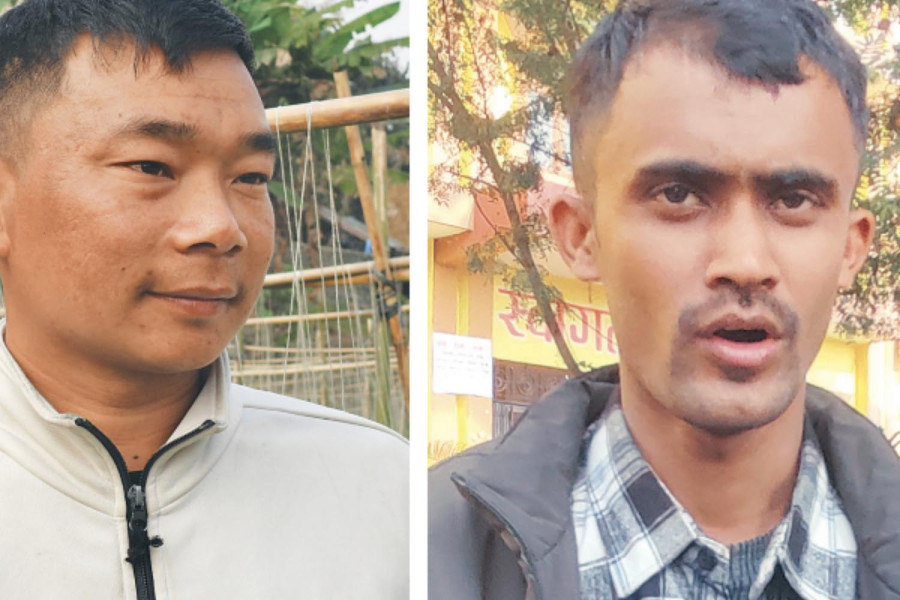
Chitwan’s Arjun Chepang and Bikash Kami convert personal experiences of injustice, discrimination and exclusion into political campaigns for dignity and change. Arjun Chepang (left), 29, represents Nepal Workers and Peasants Party, and Bikash Kami, 25, the Pragatisheel Loktantrik Party. Ramesh Kumar Paudel/TKP
Among the 64 candidates contesting across Chitwan’s three constituencies, two youths in Chitwan–1 stand out not because of political background or organisational backing, but because of the personal suffering and social injustice that shaped their entry into politics.
Arjun Chepang, 29, representing the Nepal Workers and Peasants Party, and Bikash Kami, 25, contesting under the banner of the Pragatisheel Loktantrik Party, come from communities that have long remained at the margins of Nepal’s social, political and economic life. Their candidacies reflect not only political ambition but also a determination to challenge 'discrimination' rooted in identity.
Chepang, a resident of Ichchhakamana Rural Municipality–5, is the district’s only candidate from the Chepang indigenous community, one of Nepal’s most marginalised indigenous groups. For him, politics is inseparable from the memories of fear and injustice that defined his childhood.
He grew up in Chipleti, a remote Chepang settlement where villagers lived under constant suspicion from state authorities. Security personnel frequently entered the village searching for alleged rhino poachers, often arresting residents without clear evidence.
“The state came to our village only to punish us,” Chepang said. “They never came with development, education or opportunities. They came with accusations.”
One of the most painful incidents involved his elder brother, Dip Bahadur Chepang, who was arrested and imprisoned on charges related to rhino poaching. Although he had already served a previous sentence, he was detained again, and remains in prison. Another relative, Dal Bahadur Chepang, spent nearly nine years behind bars before being acquitted due to lack of evidence.
“These incidents left deep scars on our family and community,” Chepang said. “We lived in constant fear, not knowing who would be taken next.”
According to Chepang, such experiences were not isolated but reflected broader structural discrimination against the Chepang community, which numbers more than 84,000 people nationwide. Despite constitutional recognition, Chepangs continue to face severe deprivation in education, health care, employment and political representation.
He recalls how poverty forced him to struggle even for basic schooling. He walked long distances to attend classes and lacked access to essential educational resources. Yet he remained determined to continue studying, believing education could offer a path out of marginalisation.
However, education alone did not shield him from discrimination. He said Chepangs were often vilified as criminals or incapable of progress.
“This perception needs to change,” he said. “We are citizens like everyone else, and we deserve dignity and equal opportunity.”
Chepang later became involved in student activism where he began advocating for indigenous rights, education access and social justice. His political awareness grew through participation in protests and campaigns addressing inequality and state neglect.
To sustain himself, he took up vegetable farming, embracing self-reliance while continuing social activism. He believes economic independence strengthens political voice and credibility.
“I did not enter politics to gain power,” he said. “I entered to ensure that communities like mine are no longer invisible.”
Kami’s journey reflects a different but equally painful picture of marginalisation—caste-based discrimination.
Born into a Dalit family, Kami experienced exclusion from an early age. One of his earliest memories of discrimination occurred when he was still a schoolboy. A fire broke out in a neighbour’s house, and he rushed inside the kitchen to help extinguish it. Instead of appreciation, he was scolded and insulted for entering a “higher caste” space.
“They did not see my intention to help,” he said. “They saw only my caste.”
Another incident occurred during his school years, when he took roasted maize to class and offered it to a teacher. After learning that the maize came from a Dalit student, the teacher spat it out.
“That moment stayed with me,” Kami said. “It made me realise how deeply discrimination is rooted in our society.”
Such experiences extended beyond childhood. He said discrimination persisted in subtle and overt ways even among educated and politically aware individuals.
“Caste discrimination is not limited to villages,” he said. “It exists in cities, schools and institutions.”
Despite these obstacles, Kami pursued education with determination. He later travelled abroad briefly for further studies but returned to Nepal, convinced that social transformation required political engagement at home.
He became active in student movements and social campaigns, participating in protests against economic injustice, discrimination and governance failures. These experiences shaped his belief that political participation was essential to challenge systemic inequality.
“I realised that unless people like us enter politics, our voices will never be heard,” he said.
Kami argues that political representation is not only about winning elections but about reshaping social attitudes.
“When marginalised communities see someone like themselves in leadership, it gives them confidence,” he said.
Both candidates emphasise that their campaigns are grounded in lived experience rather than abstract ideology. They say their priorities include improving education access, addressing economic inequality and ensuring dignity for marginalised communities.
Chitwan–1, where they are contesting, has 149,621 registered voters. A total of 18 candidates are competing for the seat, including representatives from major political parties such as the Nepali Congress, Communist Party of Nepal (Unified Marxist–Leninist) and the Rastriya Swatantra Party.
Despite limited resources and organisational strength compared to larger parties, both Chepang and Kami say their candidacies represent something larger than electoral victory.
“Our campaign is about awareness,” Chepang said. “Even if we do not win, we want people to understand the realities faced by marginalised communities.”
Kami echoed similar sentiments, emphasising the symbolic importance of participation.
“If citizens no longer face discrimination because of caste or identity, that itself will be the greatest success,” he said.
Observers say their candidacies reflect a broader shift in Nepal’s political landscape, where individuals from historically excluded communities are increasingly asserting their right to representation.
Nepal’s constitution guarantees equality and prohibits discrimination based on caste, ethnicity and identity. However, implementation remains uneven, and social hierarchies continue to influence access to opportunities and justice.
For Chepang and Kami, the election represents an opportunity not only to seek office but to challenge entrenched inequality and inspire others.
Their journeys—from villages marked by suspicion and discrimination to the political arena—highlight the continuing struggle for dignity and inclusion in Nepal’s evolving democracy.
As voters prepare to cast their ballots, their candidacies serve as reminders that democracy is not only about political competition but also about expanding participation and ensuring that every voice, including those long silenced, is heard.




 23.65°C Kathmandu
1.jpg)