UK not in a mood to address demands of Gurkha veterans
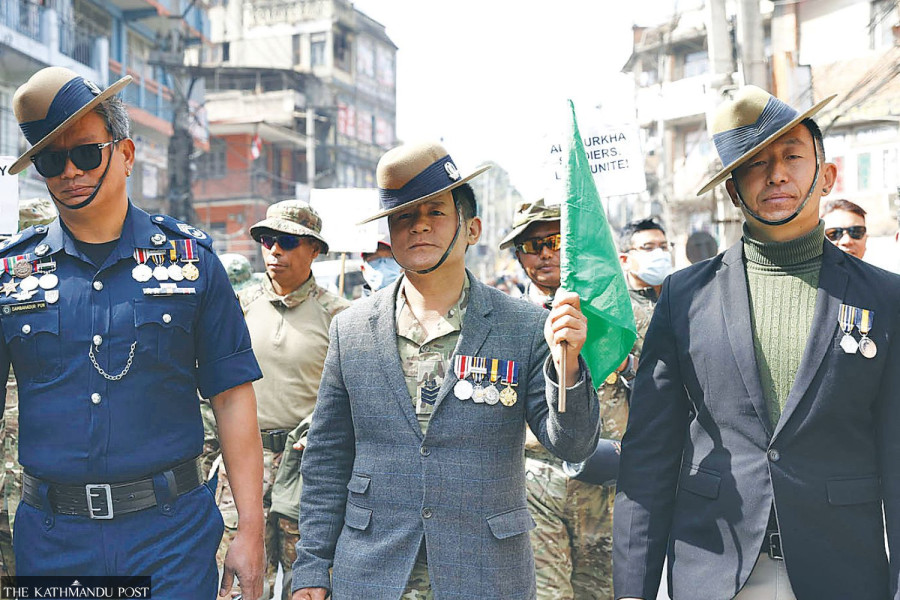
The veterans have given until March end to address their demands. But remarks of UK Defence Minister Louise Sandher-Jones suggest she considers the current level of pensions enough. British Gurkha veterans staging a demonstration in Kathmandu in February last year. POST FILE PHOTO
The Gurkha veterans, who have been agitating for years for pay and pensions on par with those of British nationals who served in the British Army, have issued a fresh ultimatum, setting the end of March as the deadline to address their demands.
On January 16, Krishna Bahadur Rai, chief coordinator of the British Gurkha Satyagraha United Struggle Committee, wrote to British Prime Minister Keir Starmer, asking him to fulfil their demands by March 31.
If not, Rai warned, they would be compelled to resume protests and strikes in both Nepal and the United Kingdom. Rai stated that they were compelled to issue a new ultimatum due to the lack of progress in political and diplomatic dialogue on Gurkha grievances between Nepal and the UK.
“For over 35 years, campaigns for justice have echoed the calls of Gurkha veterans who have served with unwavering loyalty to the British Crown. The Gurkhas’ commitment to the Crown is not only enshrined in history spanning over 200 years, but also solidified by the 100-year 1923 Britain-Nepal Friendship Treaty,” states the letter to the British prime minister.
Despite a centuries-long legacy of service and brotherhood, Gurkhas have faced systemic discrimination and exploitation, in stark contrast to the principles of fairness and equality that underpin British values, as per the letter.
It claims that the treatment of Gurkhas in the British Army violated the 1947 Tripartite Agreement, which stated that Gurkhas “should be treated on equal footing as other units in the parent army.”
For over four years, the UK and Nepal governments have engaged in bilateral talks aimed at resolving grievances, ending the fast-unto-death hunger strike undertaken by Gyanraj Rai, Dhan Gurung, and Pushpa Rana Ghale in 2021.
It was agreed that discussions would be guided by the points outlined in the 2018 Technical Committee Report on Gurkha Veterans. Former Secretary of State for Defence, Ben Wallace, on 8 September 2021, had also emphasised the need to address all Gurkha grievances comprehensively.
However, Rai further stated in his letter that, despite bringing all grievances to government-to-government talks, substantive action has been lacking to develop solutions and reach compromises to address pensions and other key issues.
The Ministry of Defence has continued to reiterate its policy of no retrospective pensions, despite two previous instances in which pensions were changed retrospectively: the 1999 John Spellar report on Gurkha Pensions and Gratuities and the 2015 Armed Forces Pensions Scheme. The defence ministry has shown reluctance to investigate maladministration or enact meaningful changes, as per the letter.
Throughout the long history of peaceful campaigns, over 20,000 Gurkhas have already passed away, and elderly pensioners continue to die by the day, according to Gurkha veterans.
“By 31 March 2026, we urge the UK Government to present a schedule of solutions to address all demands outlined from our talks based on the 2018 Technical Report,” reads the letter. “Failure to do so will regrettably compel us to resume protests and strikes, both in Nepal and the United Kingdom, with your government held accountable. This ex-British Gurkha issue is 26 years old, and hence a deadline to conclude is highly critical to bring a closure to the grievances.”
Rai, in his letter, stated that the affordable solution should be forthcoming from the Ministry of Defense as it happened in 2000 in the John Spellar Report.
The report followed a 1999 incident in which Sergeant Balaram Rai and Lieutenant Gareth Evans were killed while attempting to defuse a bomb in Kosovo. Since then, the 2004 and 2009 UK settlements have meant that the cost of living must be evaluated for the UK, not Nepal. Ex-British Gurkhas suggest the affordable solution is like ‘putting the cart before the horse’.
In 2022, all Gurkha recruitment into the Indian Army ceased after the Indian government enforced a law that set 75 percent of personnel being discharged after four years of service without a pension. However, there is no discrimination as this applies to the Indian soldiers too, Rai said in his letter. In the 1960s and early 1970s, over 8,000 British Gurkhas were sent home without pensions, yet no one spoke up at the time.
“As you are aware, the Nepal government has suspended the Gurkha recruitment into the Indian army, as a result of their unilateral and unacceptable changes to Indian Gurkha terms of service. A similar option to suspend Gurkha recruitment to the British army must be seriously considered unless the Gurkha grievance is addressed with the importance that it deserves at the highest level, rather than the Defence Ministry level,” said Rai.
Rai has questioned if the 80-year-old Tripartite Agreement is justiciable in English law; the question arises as to the basis on which the UK has recruited Nepali men into the British army since 1948.
“We humbly request a political and diplomatic resolution leading to an amicable and mutual solution to honour the commitments outlined in the 1947 Tripartite Agreement that states that ‘the terms and conditions’ at the final stage do not prove detrimental to the interest and dignity of the Nepal Government,” reads the report.
Responding to Rai's letter to the British prime minister, Louise Sandher–Jones (MP), Minister for Veterans and People, who is responsible for the matter, stated that the UK holds the service and sacrifice of Gurkha soldiers in the highest regard.
For more than two centuries, the Gurkhas have played a distinguished and honourable role in the defence of the UK, and, as I saw during my own Army service, their contribution remains a source of profound respect and appreciation, she said in the letter dated February 10.
“We recognise the strength of feeling within the Gurkha community on the issues you have raised, and work continues across government to identify and resolve welfare concerns brought to the Bilateral Gurkha Veteran Welfare Committee. As you will appreciate, this is a complex area involving several departments and legal considerations, and it is important that we consider the proposals thoroughly and responsibly. My officials will be engaging with the Nepal Embassy to arrange a meeting to discuss them further,” reads her letter to Rai.
She has also stated that her government remains committed to maintaining constructive engagement with Gurkha representatives and firmly believes that progress is best achieved through continued dialogue within established channels.
Even with her commitment to resolve the matter through talks, the British government does not seem to be in the mood to provide equal pensions to ex–Gurkahs.
According to the UK Defense Journal, on February 5 Defence Minister Louise Sandher-Jones responded to questions from Liberal Democrat MP Will Forster on whether the government plans to bring forward proposals for equal pension benefits, and whether any assessment has been made of the impact of not doing so.
In response, Sandher-Jones said the government values Gurkha soldiers’ contributions and that changes to pension schemes were introduced nearly two decades ago.
“Since 2007, Gurkhas have received the same pension under the Armed Forces Pension Scheme as the rest of the UK Armed Forces,” she said.
For Gurkha veterans who served prior to 2007, Sandher-Jones stated that the 1948 Gurkha Pension Scheme generally provides comparable or better pension outcomes.
“For those who served prior to 2007, for the large majority, the 1948 Gurkha Pension Scheme provides a pension at least as good, and in many cases better, than that given to their British counterparts with identical periods of service,” she said.




 25.92°C Kathmandu