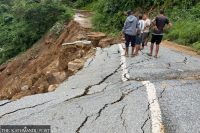
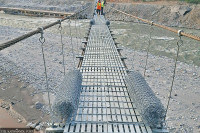
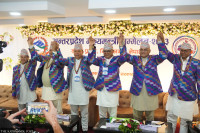
With less than three weeks left for the House of Representatives elections, voters in remote parts of Jumla and upper Dolpa say candidates have yet to reach their villages, forcing many to vote without meeting them or hearing their agendas firsthand.
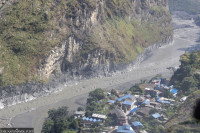
In Khopri village, which lies in ward 9 of Tila Rural Municipality in Jumla, residents said they rarely get to meet candidates. Locals say they cast their ballots based on party affiliation or what they hear about candidates from others.
“We have elected several lawmakers, but after they became MPs, we neither saw development nor had any contact with the candidates afterwards,” said Kali Bahadur Thapa. “Our hardships remain the same. Their status changed, ours did not.”
On Wednesday, Rastriya Prajatantra Party candidate Gyan Bahadur Shahi visited Khopri village. Locals shared their issues related to roads, electricity, drinking water, health and education. Shahi urged them not to expect development directly from him, explaining that he was heading to a policy-making forum and coordination with provincial and local governments would be needed to address demands.
Jumla has a single constituency for the House of Representatives, with 10 candidates, including one independent in the fray. Candidates have intensified campaigning in accessible settlements, visiting some areas repeatedly, but only a few have reached geographically remote villages.
Upper Khopri has 35 households and lower Khopri 21, with around 200 voters in total. Chhabilal Thapa said that with the elections drawing near, most candidates have yet to visit. “We have pressing problems here. Roads, electricity, drinking water, health and education are lacking. We are eager to present our issues when candidates come,” he said.
Election activity is also minimal in Shifti of Kankasundari Rural Municipality and Marphan and Huri Mohari of Patarasi Rural Municipality, where road access is lacking. Voters in these settlements remain busy with farming and their occupations, with little sign of campaign outreach.
Health facilities in Khopri are limited. A community health unit operates in the village, but the Ransamalapani Health Post, which has a birthing centre, lies about nine kilometres away.
In the second week of January, 27-year-old Ramita Thapa gave birth to a baby girl on the snowy trail at Chhayapatan while being carried to the birthing centre. In the past year, more than six women have delivered on the way to the facility. School buildings in the village are old and dilapidated.
“There are many problems in this village,” Thapa said. “We had hoped to raise these issues and demand solutions once the candidates came to the village. But so far, most of the candidates have not reached us.”
A similar situation has been reported in upper Dolpa. In the northern region, including Shey Phoksundo, Dolpobuddha and Chharkatangsong rural municipalities, election activity remains absent, locals say.
Seven candidates from different parties are contesting the Dolpa seat. However, they are largely focused on lower Dolpa, engaging in door-to-door campaigns and voter meetings there.
“No candidate has come to seek votes in Dho village so far,” Pema Chhewang Gurung, a youth from Takshe in Dolpobuddha Rural Municipality, told the Post, adding that many residents remain unaware of the elections due to limited communication access. “Election day is near, but there is no campaign activity here. Candidates should be meeting people and asking for votes,” he said.
“Everyone wants the votes of upper Dolpa residents. But no one seems in a hurry to meet them. Those who have time to repeat door-to-door campaigns in lower Dolpa appear to be ignoring upper Dolpa,” he added.
Dho Tarap, regarded as one of the world’s highest human settlements, has also seen no campaign visits. Residents say leaders have long treated upper Dolpa as a vote bank while neglecting education, health, transport, electricity and communication services.
Upper Dolpa’s three rural municipalities have a total of 4,366 voters, many of whom say they have yet to see a single candidate in person as the election approaches.




 14.4°C Kathmandu