Poll body has no legal power over parties and candidates skipping manifestos
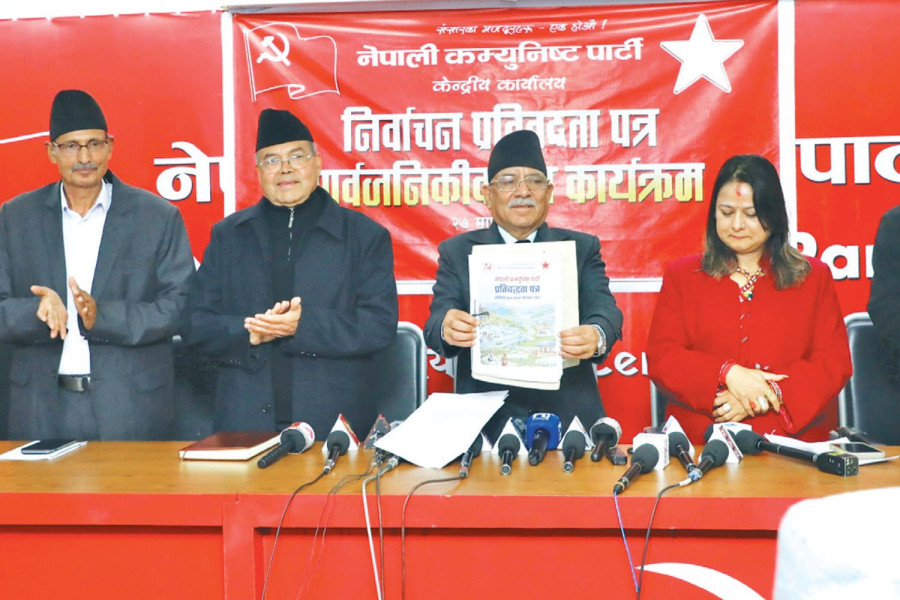
Although code requires manifesto submission, there’s no law to punish those who ignore it. Nepali Communist Party unveiled its election manifesto on Tuesday. RSS
With just four days remaining before full-fledged election campaigning begins, the Election Commission has directed all political parties and independent candidates to unveil their poll manifestos by Sunday.
The commission issued directives in accordance with the election code of conduct, which states that political parties or candidates should begin campaigning only after unveiling their manifestos and commitment papers. Section 37 of the code of conduct requires parties to submit their policy blueprints to the commission and candidates to their respective election offices.
Even as candidacies were registered on January 20, the commission has allotted only a 15-day window for full-fledged electioneering, which begins on Monday. Contesting parties and candidates have until March 3 to campaign before the 48-hour silent period comes into force.
“It is necessary for parties and independent candidates to make their manifestos public before going to people requesting votes,” Yagya Bhattarai, chief at the legal department at the commission, told the Post. “People vote for those whose agendas appeal to them.”
The commission has asked provincial and constituency election offices to maintain records of submitted manifestos and provide it with details. As of Thursday, only a few parties, including the Nepali Communist Party, have published their manifestos, while others say they are still working on them. As many as 68 parties are in the race for the March 5 polls. Of the total 3,406 candidates, around 1,160 are contesting for 165 first-past-the-post seats as independents.
As per the commission, while party candidates may use their respective parties’ dossiers, those vying independently must have separate manifestos.
Even as the commission has directed that manifestos be ready before poll campaigning begins, it is unclear what action will be taken against those who defy the directive. There is no specific law requiring parties and their candidates to publish manifestos.
Asked what actions the commission would take if parties and candidates started campaigning by flouting its directive, Bhattarai said, “The commission will decide after the complaints are filed. It will make decisions based on the code of conduct.”
Those who have long been monitoring Nepal’s elections say that, in the absence of legal backing, the commission is unlikely to take concrete action. They say asking for votes without presenting agendas and roadmaps for the next five years amounts to cheating voters. Manifestos allow voters to make informed comparisons; therefore, parties and candidates campaigning without manifestos must be held accountable.
“However, if history is any guide, I don’t expect the commission to take punitive action. Code of conduct is largely self-obligatory, and the commission has been treating it accordingly,” said Gopal Krishna Siwakoti, chair of the National Election Observation Committee. “On several occasions, we have appealed to the commission to take strong action, at least in some emblematic cases, which would serve as a deterrent.”
He added that given the commission’s reluctance to act against code of conduct violators, even this time, it will end up simply taking note and seeking clarifications on violation incidents.
Records at the commission show it has sought clarifications from 51 individuals and institutions since the code of conduct was enforced on January 19. However, only 30 of them have furnished written clarifications in response. Even as it has been three weeks since clarifications were sought in some cases, the commission is still undecided on what action to take.
“We are studying the clarifications and evidence. The commission will come up with the right decision after a thorough study,” said Bhattarai without specifying a timeline.
Binod Ghimire covers parliamentary affairs and human rights for The Kathmandu Post. Since joining the Post in 2010, he has reported primarily on social issues, focusing on education and transitional justice.




 14.82°C Kathmandu