Global rights groups urge Nepal to unveil report on Gen Z protest crackdown
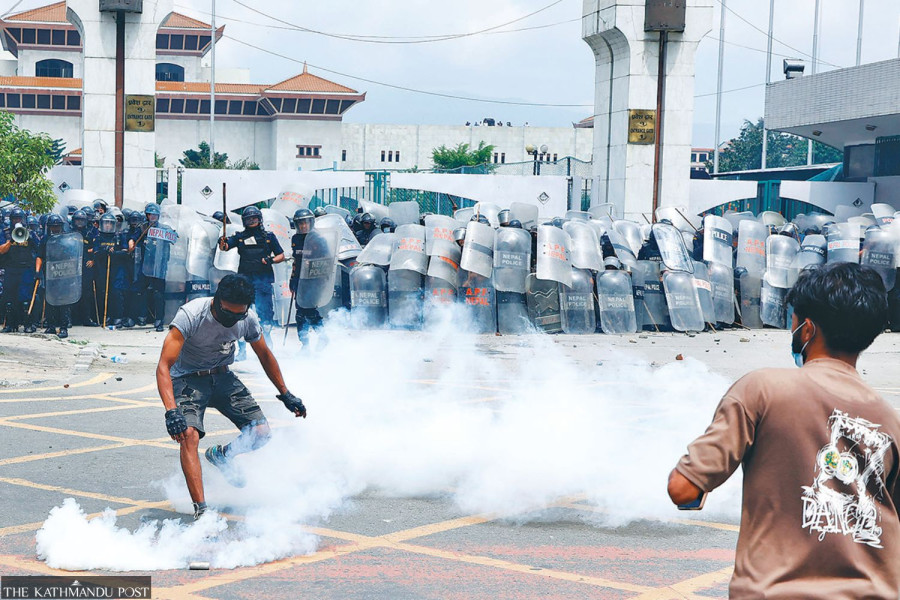
Human Rights Watch, Amnesty International and ICJ say withholding inquiry findings since 1990 has entrenched a cycle of impunity.A youth pictured amid tear gas fumes in front of parliament at New Baneshwar on September 8. Seventeen people were killed in the vicinity that day. POST FILE PHOTO
Amid delays in finalising the probe of killings and violence in the Gen Z protests, three international human rights organisations have called on Sushil Karki’s government to release Gauri Bahadur Karki’s report, along with all previous inquiry reports on human rights violations.
In a joint statement on Thursday, Human Rights Watch, Amnesty International and the International Commission of Jurists said the government should publish the report of the commission probing deadly violence during the September 2025 protests, along with earlier inquiry reports on human rights abuses that were never released.
The organisations also urged all political parties contesting the March 5 parliamentary elections to commit to ending impunity for rights abuses and corruption by upholding the rule of law, including by completing Nepal’s long-stalled transitional justice process.
At least 76 people were killed — most unlawfully — during protests on September 8 and 9, 2025, after police opened fire on young demonstrators protesting government corruption and a social media ban, according to rights groups. Violence escalated on the second day, with killings attributed to both security forces and protesters, alongside widespread arson targeting public and private property. On September 9, then Prime Minister K.P. Sharma Oli resigned.
Former chief justice Karki was appointed interim prime minister on September 12 with a mandate to steer the country to elections. Her government formed a commission led by former justice Gauri Bahadur Karki — who is not related to the prime minister — to investigate the September violence. However, on February 9, the panel’s deadline was extended beyond election day, citing concerns that its findings could provoke friction involving security forces or political actors.
“Successive Nepali governments have buried a series of reports with recommendations that could have led to justice and reform, and ignored the findings,” Meenakshi Ganguly, deputy Asia director at Human Rights Watch, was quoted in the statement. Publishing the reports, she said, would signal a break from entrenched impunity.
Rights groups argue that withholding the findings of inquiries has contributed to a culture of non-accountability since the restoration of democracy in 1990. They cited several commissions whose reports were never made public, including the Malik Commission set up after the 1990 people’s movement, the Rayamajhi Commission formed after the 2006 uprising, and the Lal Commission created following deadly protests over the 2015 constitution.
In October, Prime Minister Karki described the Gen Z protests as reflecting public frustration over corruption, economic stagnation and weak governance — sentiments widely shared by young Nepalis who spearheaded the demonstrations.
“One of the reasons Nepal has been trapped in cycles of governance marked by weak accountability and human rights violations is that impunity has been hard-wired into elite politics,” said Isabelle Lassée, deputy regional director of Amnesty International. She urged election contenders to commit to advancing transitional justice in line with international standards, particularly addressing accountability gaps related to abuses committed during Nepal’s decade-long insurgency.
The 1996–2006 armed conflict between Maoist rebels and state forces left more than 20,000 people dead amid widespread violations by both sides. Although the 2006 peace accord promised truth-seeking, reparations and accountability, the justice process has repeatedly stalled due to political interference.
Parliament amended transitional justice legislation in 2024 to remove provisions that could have allowed amnesty for serious crimes under international law. While some victims’ groups accepted the revisions as a step forward, disputes over 2025 appointments to the transitional justice bodies have left the process deadlocked.
Victims and survivors of conflict-era abuses continue to await justice and reparations. The repeated shielding of alleged perpetrators has cast a long shadow over post-conflict Nepal, the organisations said.
“To break the cycle of impunity and help build a future based on the rule of law, the interim government should publish all of the reports by official commissions into past human rights violations before it leaves office,” said Mandira Sharma of the International Commission of Jurists, urging political parties to pursue accountability while centring victims’ voices.




 17.6°C Kathmandu