80.7 billion cubic metres of natural gas confirmed in Dailekh
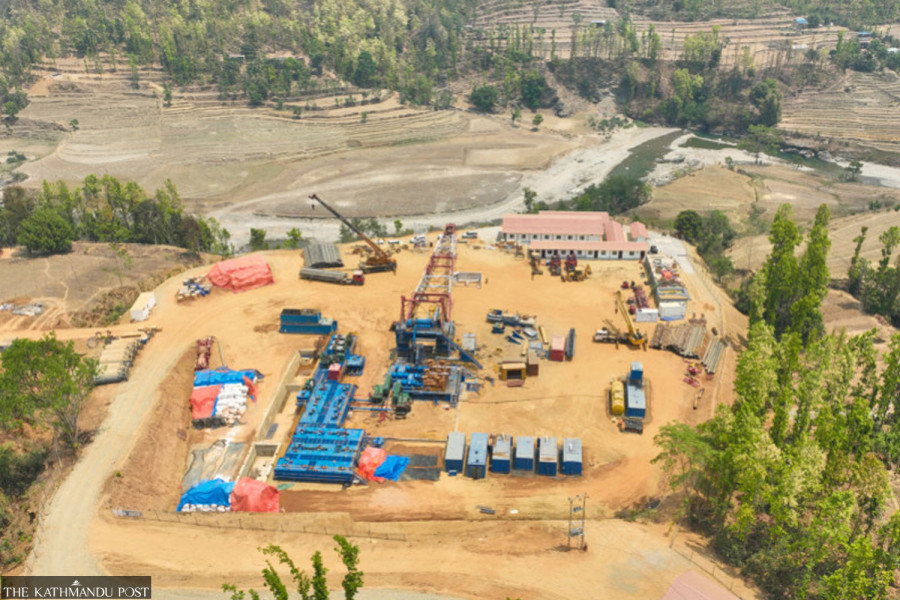
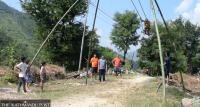
Commercial production hinges on well testing, say officials. The exploration drilling site at Jaljale in Bhairavi Rural Municipality, Dailekh. Post file photo
A total of 80.7 billion cubic metres of natural gas has been confirmed at Jaljale in ward 1 of Bhairavi Rural Municipality, Dailekh, according to a report submitted by the China Geological Survey to the Department of Mines and Geology.
The department said well testing is required before moving towards commercial production. Well testing is a process that evaluates the quantity, quality, and flow characteristics of gas or oil in a reservoir to determine its commercial viability before full-scale production.
An earlier preliminary report had estimated reserves of up to 112 billion cubic metres. Dharmaraj Khadka, spokesperson for the department, said a significant volume of methane gas has been identified, but further testing is needed to determine the condition of the gas and the appropriate extraction technology.
He said well testing would assess the characteristics of the reservoir, including whether additional equipment is required at the existing drill site or whether the gas needs to be displaced by other substances. Commercial production will proceed only after analysing the composition of the gas.
After receiving the Chinese team’s report, the government has requested the Chinese authorities to carry out the second phase of work, including well testing, Khadka said.
China Geological Survey conducted surveys in multiple phases for petroleum exploration in Dailekh, while CNPC Xibu Engineering Company carried out drilling and studies for around one and a half years from May 11, 2023.
“We drilled up to 4,013 metres and sent one-metre interval samples for testing,” said Dinesh Kumar Napit, director general of the department. “Further procedures, including well testing, will move ahead after additional agreements between the two governments.”
A bilateral understanding on petroleum exploration was reached between the prime ministers of Nepal and China in March 2016. Based on that, a preliminary study was conducted for nearly six months by the department and a Chinese technical team.
In 2019, the Department of Mines and Geology and China Geological Survey entered into a formal Rs2.4 billion agreement for the exploration and drilling. However, progress was delayed due to multiple factors, including the Covid pandemic, transport issues, road constraints, and land acquisition disputes. The initial three-year agreement signed in February 2019 expired and was extended in 2022.
The Chinese team returned with samples after concluding the drilling work.
“Initially, Covid pandemic created problems. Later, narrow roads prevented the transport of heavy drilling equipment,” Khadka said. “Time was also spent resolving land disputes. Had everything proceeded on schedule, commercial production would have started by now.”
The first phase included seismic, geological, magnetotelluric and geochemical sampling surveys. The second phase involved drilling to extract subsurface samples. Around 45 ropanis (2.29 hectares) of land were acquired at Jaljale for drilling, where nearly 70 technicians worked for 19 months. About 100 local workers were also employed.
Padam Bahadur Shah, president of the Karnali Province chapter of the Federation of Nepalese Chambers of Commerce and Industry, said commercial gas production in Dailekh could make the country self-reliant.
“If commercial production begins, Nepal’s economic burden will decline, and foreign currency will be saved, contributing significantly to the national economy,” he said. “It will generate substantial revenue, attract foreign investment and open avenues for technology transfer.” He added that large-scale local employment and infrastructure development would follow.
Kamal Lamsal, associate professor at Mid-West University, said commercial production could offer Nepal strategic geopolitical leverage between India and China.
“By building refining facilities, Nepal could emerge as a regional energy hub, helping import substitution and reducing the trade deficit,” he said. “It could also spur auxiliary industries and innovative enterprises, creating jobs for a large population in Karnali.”
Chemist Bijay Sharma said methane is considered a cleaner alternative to petrol and diesel.
“Methane can be used to run vehicles, generate electricity and for household lighting,” he said. “Hydrogen can be separated from methane to produce ammonia gas for use in fertiliser plants.”
The department said drilling has so far been conducted only within a three-kilometre radius of Shiristan, Nabhisthan and Paduka in Dailekh.
“There are three identified sites with potential petroleum deposits,” Napit said. “Exploration at those sites could increase the estimated reserves.”
Two Chinese technicians are currently stationed in the Jaljale area, while the Armed Police Force is providing security at the exploration site.




 13.87°C Kathmandu