Kantipur Conclave ends with calls for better governance, balanced foreign relations
Two-day event saw debates on various issues of national and international concerns. Gen Z representatives (from left) Rakshya Bam, Ajay Kushwaha, Majid Ansari and Pradip Gyawali at a session moderated by journalist Daya Dudraj. Dipen Shrestha/TKP
The Kantipur Conclave 2026, which brought together political leaders, thinkers, policymakers, entrepreneurs, journalists, and young activists for two days of debate on Nepal’s political, social, and economic challenges, concluded on Tuesday.
The flagship event of the Kantipur Media Group aimed to examine how Nepal should move forward amid political instability, institutional weakness, and growing public dissatisfaction in the aftermath of September’s Gen Z uprising.
Experts from Nepal, China, India, and the United States said Nepal’s geopolitical position has grown more complex as global power centres compete for influence. They argued that Kathmandu still has room to balance competing interests through economic cooperation and connectivity.
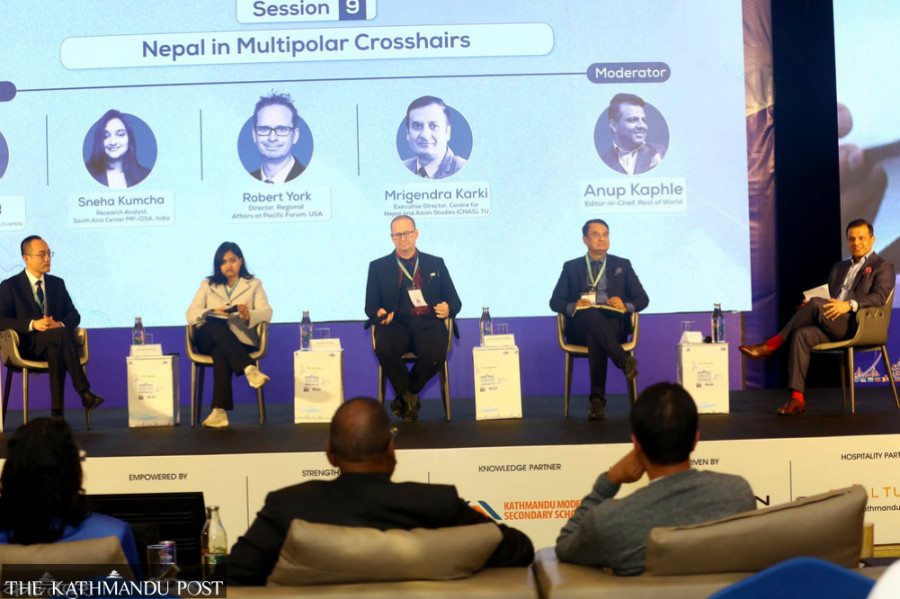
Speaking at the session “Nepal in Multipolar Crosshairs,” moderated by Anup Kaphle, editor-in-chief of Rest of World, panellists examined how Nepal is engaging major powers amid shifting regional and global dynamics.
Mrigendra Karki, executive director of the Centre for Nepal and Asian Studies at Tribhuvan University, said Nepal must frame its foreign relations by asking fundamental questions about its identity and interests. He noted that relations with India have long been described in broad and abstract terms, but now require clearer theorisation as they evolve beyond tradition into economic and strategic domains.
Karki said China’s engagement has expanded significantly since President Xi Jinping came to power, particularly through the Belt and Road Initiative (BRI) and related projects. He added that the United States has positioned itself globally around democracy, human rights, and individual freedoms, placing Nepal at the intersection of multiple ideological and strategic approaches.
Dipen Shrestha/TKP
Gao Liang, deputy director of the Nepal Study Centre at Sichuan University, said China views Nepal’s development as closely tied to stability in Tibet and western China. Regions bordering Nepal remain among China’s least developed, he said, making cross-border prosperity interconnected. Promoting connectivity under the BRI, he added, could support Nepal’s development while ensuring a positive external environment for China’s border regions.
Sneha Kumcha, a research analyst at India’s MP-IDSA, said New Delhi has historically been cautious about Nepal’s engagement with China and the US, given the open border and deep socio-economic ties. However, she described India’s current approach as one of “managed pragmatism”.
Nepal–India relations, she said, are increasingly rooted in hydropower cooperation, power trade, connectivity, and institutional engagement. India recognises that multiple external players will remain active in South Asia and seeks to remain relevant rather than dominant, trusting Kathmandu to maintain balance.
Robert York, director of regional affairs at the Pacific Forum, said Nepal’s relatively low priority in US strategic thinking could be advantageous. He noted that the current US administration appears more focused on short-term gains than broad international commitments, making it harder for smaller countries to attract sustained attention.
York said Nepal is unlikely to cross US red lines and should engage Washington pragmatically, particularly through economic and transactional cooperation. Connectivity, he added, has emerged as a key area where geopolitics intersects with Nepal’s development needs, as the country weighs competing visions linked to China’s BRI and India’s regional connectivity priorities.
Public Discourse in the Age of Algorithms
Experts warned that public discourse in the digital era is becoming increasingly chaotic, with the rapid spread of often unverified information blurring the line between truth and rumour. They said this creates a challenging environment for meaningful dialogue.
Speakers urged journalists, politicians, and technology platforms to prioritise ethics, accountability, and critical engagement over click-driven sensationalism and unchecked algorithms. Responsible practices, they emphasised, are essential to ensure digital spaces serve the public interest rather than deepen misinformation and social division.
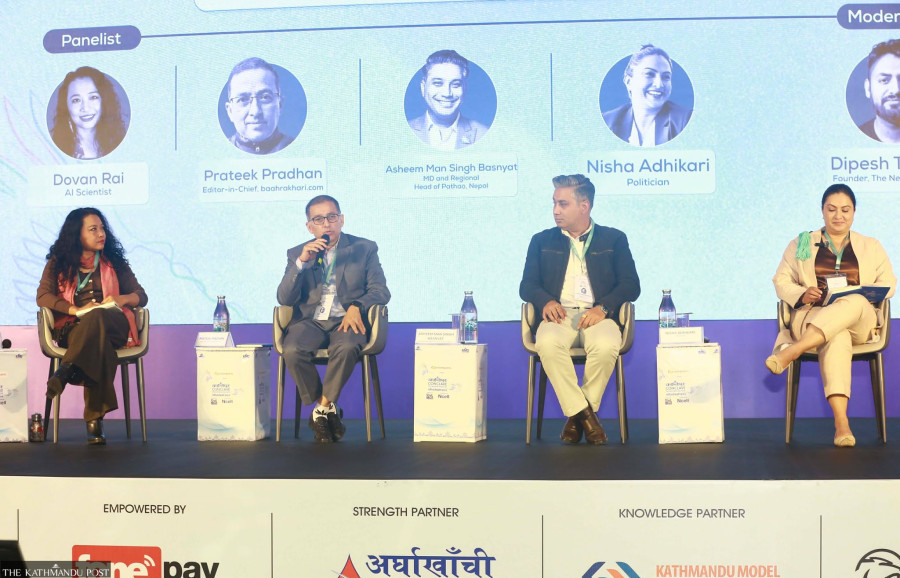
Dipesh Tripathi, founder of the YouTube channel The Nepali Comment, moderated the session “Public Discourse in the Age of Algorithms,” featuring AI expert Dovan Rai, Bahaarkhari.com editor-in-chief Prateek Pradhan, Pathao Nepal managing director Asimman Singh Basnyat, and political leader Nisha Adhikari. Tripathi said distinguishing truth from misinformation online has become increasingly difficult, describing digital spaces as saturated with rumours.
Dipen Shrestha/TKP
Pradhan argued that journalism is drifting away from its public service role. “Journalism is failing by chasing crowds instead of amplifying the public’s voice,” he said, noting that traditional media once led ideas and shaped understanding but is now increasingly driven by clicks and follower metrics.
He warned that algorithms have reshaped print, broadcast, and online media alike, often rewarding sensationalism. Journalism, he said, must uphold freedom of expression while deciding what content serves society. He also cautioned against deepfakes and manipulated engagement metrics, stressing the need for public awareness and editorial discipline.
Adhikari said politicians can communicate effectively without resorting to theatrics or misleading campaigns. She advocated clearer social media guidelines for candidates and called for stronger institutional capacity to address technology-related national security challenges, suggesting the need for a technically driven information and technology ministry.
Rai said algorithms are constantly evolving and should not be treated as fixed or neutral systems. She argued that digital disorder stems as much from institutional failures as from technological design. Big technology firms, she warned, may grow even more aggressive, prioritising profit and engagement—often amplifying anger—over responsible design.
Basnyat cautioned that chasing views and emotional reactions could produce long-term consequences. Engagement-driven content without grounded discussion, he said, risks undermining meaningful public discourse.
The People’s Panel: Shifting Trust and Unconventional Voices
Speakers in “The People’s Panel” session said frustration with traditional politics and media has pushed non-traditional voices into the mainstream, reshaping public debate and political engagement in Nepal.
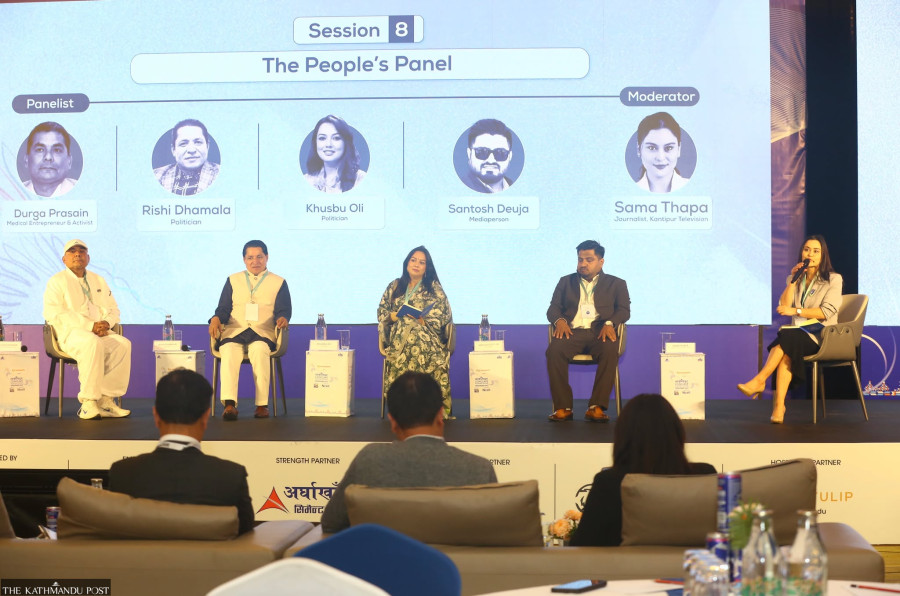
Medical entrepreneur and activist Durga Prasain, political commentator Rishi Dhamala, Rastriya Prajatantra Party leader Khushbu Oli, and journalist Santosh Deuja discussed how public trust has shifted away from established institutions. Sama Thapa of Kantipur Television moderated the session.
Deuja questioned long-standing assumptions about who gets to participate in public discourse, arguing that Nepal historically maintained a narrow definition of journalism. He emphasised supporting capable individuals over party labels, citing his backing of a candidate based on personal merit.
Dipen Shrestha/TKP
Dhamala said his transition from journalism to politics was motivated by a desire to reform governance and make politics more people-centred. While acknowledging past leaders’ roles in political movements, he criticised failures in governance and corruption, which he said prompted him to contest elections and draw attention to conditions in marginalised regions.
Oli warned that social media generates waves of popularity but does not necessarily produce accountable leadership. She expressed concern about misinformation and questioned how parliamentary maturity might evolve if popularity eclipses ideology and responsibility.
Prasain said he speaks candidly because he believes mainstream politics has failed to address fundamental issues. He described his advocacy positions as part of a broader critique of governance, arguing that distrust in institutions has opened space for alternative voices.
The discussion underscored how declining confidence in leadership, media credibility, and governance structures is enabling unconventional actors to shape national conversations.




 15.26°C Kathmandu