Experts from Nepal, China, India and the United States said Nepal’s geopolitical position has become more complex as global power centres compete for influence. They argued that Kathmandu still has room to balance interests through economic cooperation and connectivity.
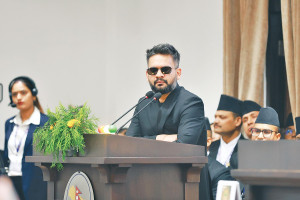
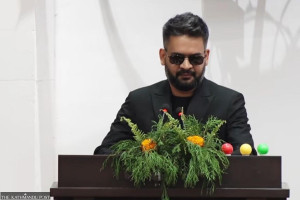
Speaking at the session “Nepal in Multipolar Crosshairs”, on the second day of the Kantipur Conclave 2026, panellists discussed how Nepal is engaging major powers amid shifting regional and global dynamics.
Mrigendra Karki, executive director of the Centre for Nepal and Asian Studies at Tribhuvan University, said Nepal must frame its foreign relations by asking fundamental questions about its identity and interests. He said relations with India have long been described using broad and abstract terms, but now require clearer theorisation as the relationship evolves beyond tradition into economic and strategic domains.
Karki said China’s engagement has expanded significantly since Chinese President Xi Jinping came to power, particularly through the Belt and Road Initiative and its variants. He added that the United States has positioned itself globally around democracy, human rights and individual freedoms, placing Nepal at the intersection of multiple ideological and strategic approaches.
Gao Liang, deputy director of the Nepal Study Centre at Sichuan University, said China views Nepal’s development as closely linked to stability in Tibet and western China. He said the regions bordering Nepal are among China’s least developed and that prosperity on both sides of the Himalayas is interconnected. Promoting cross-border connectivity under the BRI, he said, could support development in Nepal while ensuring a positive external environment for China’s border regions.
Sneha Kumcha, a research analyst at India’s MP-IDSA, said New Delhi has historically reacted anxiously to Nepal’s engagement with China and the US, given the open border and deep social and economic ties. However, she said India’s approach has shifted towards what she described as “managed pragmatism”.
She said current Nepal–India relations are increasingly rooted in hydropower cooperation, power trade, connectivity and institutional engagement. India, she added, recognises that multiple external players will remain active in South Asia and aims to stay relevant rather than dominant, trusting Kathmandu to maintain balance.
Robert York, director of regional affairs at the Pacific Forum, said Nepal does not feature prominently in US strategic priorities, which could be advantageous. He said the current US administration is more focused on short-term benefits rather than broader commitments to international norms, making it harder for smaller countries to attract attention.
York said Nepal is unlikely to cross US red lines and should approach Washington pragmatically, particularly by framing engagement in economic and transactional terms. He added that connectivity has emerged as a key area where geopolitics intersects with Nepal’s development needs, as the country weighs competing visions linked to China’s BRI and India’s regional connectivity priorities.
The session was moderated by Anup Kaphle, editor-in-chief of Rest of World.




 21.13°C Kathmandu