Chief ministers debate future of federalism on the second day of Kantipur Conclave 2026
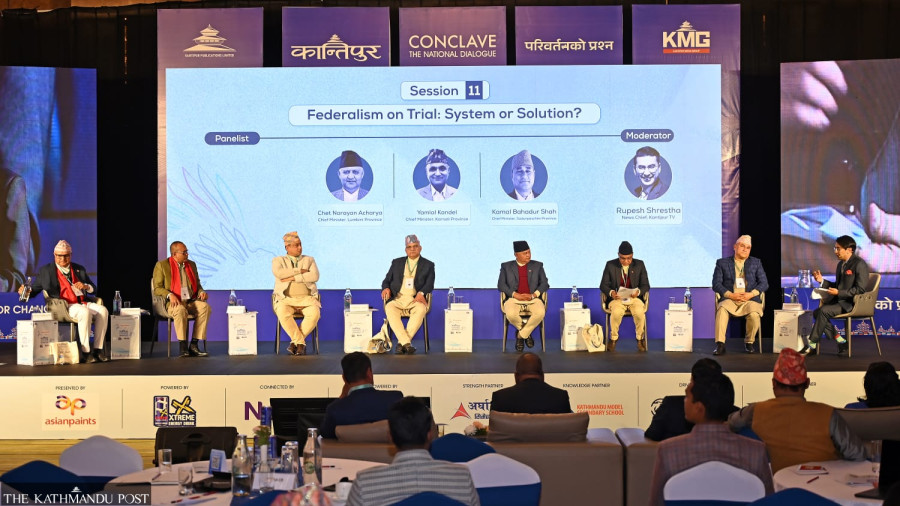
Provincial leaders stress legal reform, coordination and accountability, rejecting claims that federalism is merely a costly structure.Panelists of Kantipur Conclave's Tuesday's session titled ‘Federalism on Trial: System or Solution?’ Angad Dhakal/TKP
Chief ministers from all seven provinces came together on a single platform on the second day of the Kantipur Conclave 2026 to debate whether federalism in Nepal is merely a structure or a driver of governance and development.
The discussion took place during the fifth session of the day titled ‘Federalism on Trial: System or Solution?’, moderated by Kantipur Television news chief Rupesh Shrestha. The session focused on the achievements, challenges and future of federalism through direct engagement among provincial political leaders.
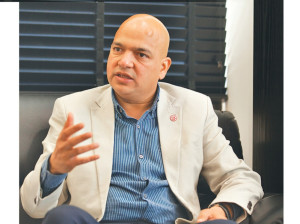
Taking part in the Conclave on Tuesday, Yamlal Kandel, chief minister of Karnali Province, said that provinces could deliver far better results if outdated laws were revised. He said eight years after the implementation of federalism, structural and policy reforms were still overdue.
Stressing the need for continuity, Kandel argued that the constitution should be amended to allow the direct election of chief ministers with a fixed five-year tenure. “The laws are outdated. Unless they are changed, provinces cannot function effectively,” he said, adding that decisions taken in Kathmandu should not be imposed uniformly across provinces.
Lumbini Province Chief Minister Chet Narayan Acharya complained that there was a deliberate attempt to create a narrative portraying provinces as unnecessary, expensive and burdensome. He argued that people had experienced development because of provincial governments and were largely satisfied with their performance.
“Investments by provinces in infrastructure, education and health have transformed villages,” he said. Referring to the Gen Z movement, Acharya noted that provincial structures in Lumbini were not targeted, which he said reflected public support for federalism.
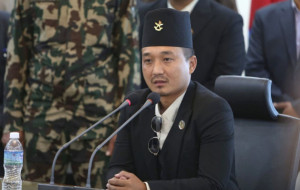
Bagmati Province Chief Minister Indra Bahadur Baniya said that despite eight years of implementation, provinces had yet to gain the authority of a full-fledged government. He cited the lack of control over police, civil servants, land and forest resources as major weaknesses.
Describing the Gen Z movement as unexpected, he said it exposed deeper flaws in the electoral system. “This system does not allow any party to secure a clear majority,” he said, noting that coalition governments had become unavoidable at both the federal and provincial levels.
Gandaki Province Chief Minister Surendra Raj Pandey emphasised the need for stronger coordination and cooperation among the three tiers of government. He warned that provincial and local laws were often nullified when they conflicted with federal legislation and said some constitutional provisions needed reform to stabilise federalism.
Pandey also criticised the media, including social media, for ignoring positive provincial achievements. “Only failures become news, while successes are ignored,” he said, adding that this had fuelled public frustration and contributed to the Gen Z movement. He noted that Gandaki Province had reduced its offices from 32 to 19 and cut staff positions even before the protests.
Madhesh Province Chief Minister Krishna Prasad Yadav said three governments had changed in the province following the Gen Z movement, with the current government formed under his leadership with full support. He said the provincial government had embraced demands for good governance and anti-corruption.
Yadav also complained that Madhesh received the lowest budget allocation among the seven provinces, adding that development spending had declined due to political instability and frequent changes in government.
Koshi Province Chief Minister Hikmat Kumar Karki said provincial leaders were confident that provinces would continue as long as the constitution remained intact.
“We were not worried about losing office; we were worried about people suffering,” he said. Karki added that after the incidents of September 8–9, there was fear and uncertainty among chief ministers about the future direction of governance.
He also highlighted his government’s focus on agriculture and livestock, citing programmes on animal vaccination, honey production, coffee zones and preparations to export buffalo meat to China.
Sudurpaschim Province Chief Minister Kamal Bahadur Shah said debates on provincial expenditure were being used to discredit federalism.
He argued that federalism had strengthened local development and provided citizens with a platform to voice their concerns.
“The focus should be on solutions, not on weakening the system,” Shah said.
The fifth session of Tuesday underscored a broad consensus among provincial leaders that federalism requires legal reform, fiscal empowerment, stronger coordination among governments and better communication of provincial achievements to remain effective and credible.




 20.12°C Kathmandu