Political rivals watch Baburam Bhattarai’s next move in Gorkha-2
The former prime minister and chief of Pragatisheel Loktantrik Party has withdrawn from the race, but his support could prove decisive in the constituency.
Gorkha Constituency 2 has remained one of the country’s most closely watched electoral constituencies in every election since the first Constituent Assembly polls in 2008. The upcoming House of Representatives election has once again drawn national attention with the candidacy registration and subsequent withdrawal of former prime minister Baburam Bhattarai, who served as second-in-command of the 1996-2006 Maoist insurgency. The poll result is wide open as rival parties are closely watching which of his party, the Pragatisheel Loktantrik Party (PLP) will ultimately support.
Thirteen candidates, including two independents, are contesting for the snap parliamentary elections scheduled for March 5. Yet, more than the candidates themselves, local discussions continue to revolve around Bhattarai’s political legacy and the possible direction of his support base. While activists from the Rashtriya Swatantra Party (RSP) and Nepali Communist Party (NCP) [which is led by Pushpa Kamal Dahal, the leader of the Maoist insurgency] have claimed on social media that Bhattarai’s backing may favour their candidates, the PLP itself has not announced any formal decision, making its stance a key factor in determining the election winner.
After the April uprising in 2006, Gorkha-2 has largely been dominated by Bhattarai and candidates aligned with the then Maoist movement. The constituency gained national prominence again in 2022 when then CPN (Maoist Centre) Chairman Dahal contested and won the seat with 26,101votes, defeating RSP’s Kabindra Burlakoti who secured 12,636 votes. Earlier, in 2017, Bhattarai had won from the same constituency, defeating senior Maoist leader Narayan Kaji Shrestha in a high-profile contest.
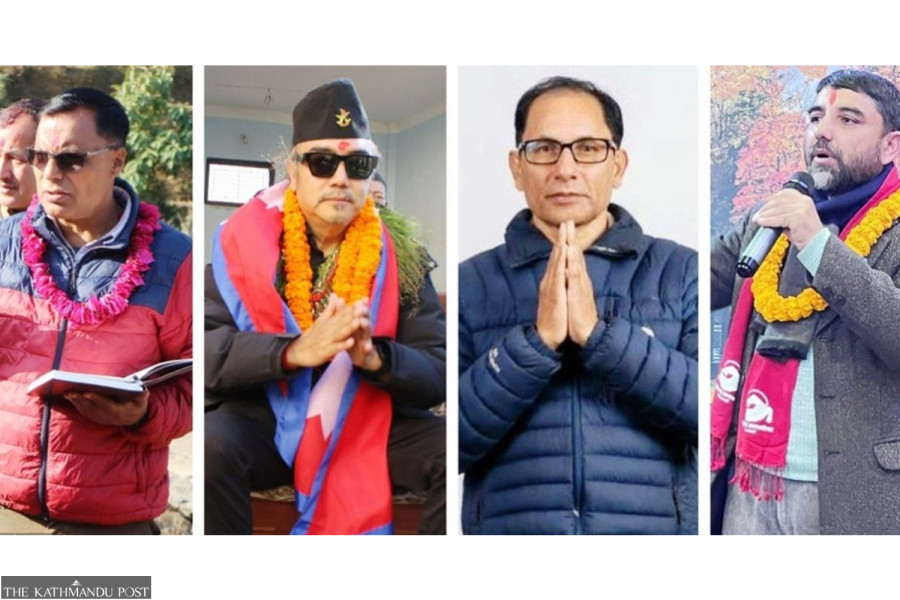
With neither Bhattarai, Dahal nor Shrestha in the election fray this time, the contest appears wide open. The NCP has fielded young leader Lekhnath Neupane, who emerged from student politics and is contesting his first parliamentary election. The Nepali Congress has nominated social worker-turned-politician Prakash Chandra Dawadi, while the RSP has once again fielded its general secretary, Burlakoti. The CPN-UML has nominated gangster Milan Gurung, known as Chakre Milan. Other candidates represent fringe parties, including the Aam Janata Party, CPN (Maoist), Mongol National Organisation, Nepal Workers and Peasants Party, Ujyalo Nepal Party and National Republic Nepal.
Local voters say the shifting loyalties of party cadres have made the poll predictions quite difficult. “Former Maoist supporters and even Congress activists seem to have moved towards newer parties, especially the RSP. When the cadres from rival parties begin changing sides, it becomes hard to say which candidate is stronger. Older parties cannot assume that their traditional vote banks will remain intact this time,” said Shiva Shrestha of Palungtar.
According to election officials, Gorkha-2 has a total 108,533 registered voters, an increase of more than 3,000 compared to the 2022 election. The constituency includes wards 8 to 14 of Gorkha Municipality, Palungtar Municipality and Siranchok, Ajirkot and Barpak Sulikot rural municipalities. For the upcoming polls, 94 polling stations and 150 polling centres have been set up.
Historically, the constituency has delivered decisive mandates. In the 2008 Constituent Assembly election, Bhattarai secured 83 percent of the total votes cast, winning by a margin of around 40,000 votes, one of the largest margins recorded nationwide. Bhattarai contested the second Constituent Assembly election from Gorkha-1 and emerged victorious, while Maoist candidate Hitaraj Pandey was elected from Gorkha-2.
Bhattarai later split from the Maoists and formed the Naya Shakti Party and contested the 2017 general election from Gorkha-2. He defeated the Maoist senior leader Narayankaji Shrestha by around 3,000 margins.
The candidates of major political parties remain confident about their prospects. The NCP leaders argue that the constituency’s left-leaning voter base will favour their candidate. NCP leader Parashuram Ramtel claimed that Neupane’s long involvement in student politics and his clean image have strengthened his appeal among voters. “Gorkha-2 has always been politically aware, and voters tend to choose ideological clarity,” he said.
RSP candidate Burlakoti has his own claim. He believes the national mood for change is working in his favour. He said public expectations for political reform align with his party’s agenda. “People want change, and we entered politics with that promise. The growing organisational strength compared to the last election is our biggest advantage,” he said.
Nepali Congress leaders also express confidence, arguing that this election has energised party workers because they are campaigning under their own election symbol after years of poll alliances with other parties. District secretary Kishor Jung Thapa said that since 2013, Congress supporters in Gorkha-2 had largely voted for alliance candidates. “This time, our supporters feel ownership of the campaign. The candidate selection process was smooth, and that has added enthusiasm,” he said.
Despite competing claims, attention remains fixed on Bhattarai’s next move. After withdrawing his candidacy, Bhattarai said he chose to remain above electoral competition and play a broader advisory role rather than become merely a member of parliament. His decision has left supporters divided but has heightened speculation about where his influence may ultimately flow.
The PLP has formed a political dialogue committee under district coordinator Yan Prasad Bhatta to decide whether to support any candidate in the direct election. At the same time, the party has been mobilising voters to seek proportional representation votes under its own banner. In Palungtar alone, three ward chairs are close to Bhattarai, reinforcing perceptions that his legacy continues.
For now, Gorkha-2 remains a constituency defined by uncertainty. With traditional alliances weakened, new political forces emerging, and the PLP yet to declare its position, local voters say the election is more competitive than in the past.




 24.79°C Kathmandu