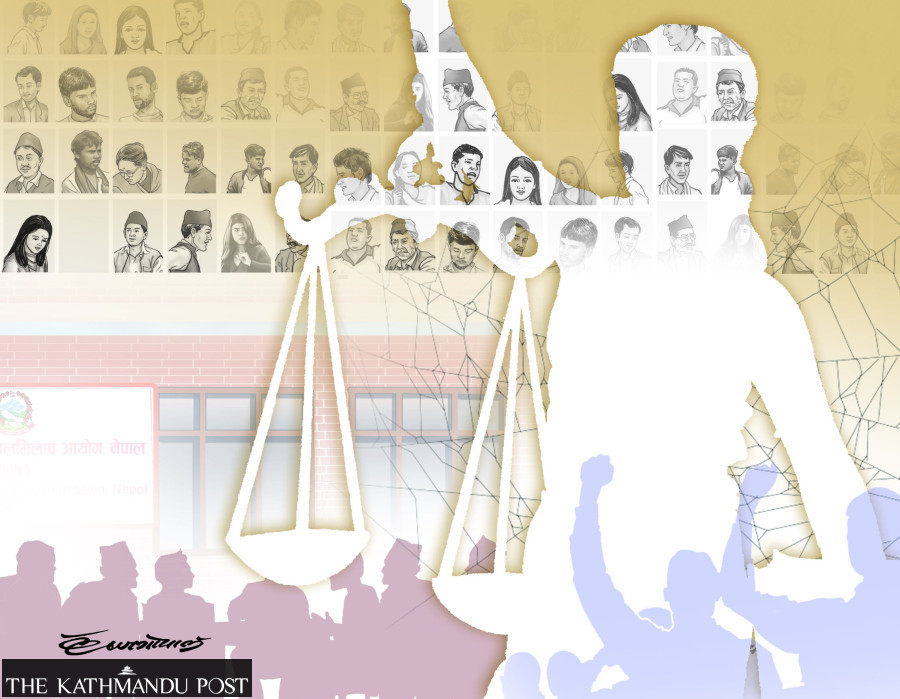
The Accountability Watch Committee (AWC), a network of human rights defenders in Nepal, has called on all political parties registered with the Election Commission to prioritise transitional justice in their upcoming election manifestos.
Issuing a public appeal on Monday, the committee urged political parties to include a commitment to adopt a policy of zero tolerance against serious violations and abuses committed during the armed conflict and the Gen Z movement, among others. It also appealed to parties to agree on amendments to the transitional justice law to correct serious flaws in the definition of violations, provisions on sentence reduction, and statutes of limitation, in consultation with conflict victims.
Through their manifestos, the committee has also demanded assurances that the controversial, unreliable, and non-transparent appointments of office-bearers to the Truth and Reconciliation Commission and the Commission of Investigation on Enforced Disappeared Persons will be reversed. It has called for the reappointment of officials to both commissions through an independent, transparent and credible process.
In its statement, the rights group further sought the incorporation of provisions for the formulation and implementation of an integrated reparation programme that appropriately addresses the immediate and long-term reparative needs of victims of the armed conflict and the Gen-Z movement, while ensuring a dignified living environment. It also stressed the need to enact vetting-related laws that would declare individuals involved in serious human rights violations ineligible to be appointed to public office or to hold public responsibility.
Recalling that serious human rights violations—including killings, enforced disappearances, torture, rape and forced displacement—were committed during the decade-long conflict, the committee urged political parties to be sensitive in addressing these issues. Despite the end of the conflict two decades ago and repeated commitments to end impunity and ensure victims’ rights to truth, justice and reparation, transitional justice remains unresolved, the statement said.
According to the committee, successive governments and major political parties have failed to fulfil this national responsibility and instead used transitional justice as a tool for political interests. As a result, thousands of conflict victims continue to seek justice at both national and international levels.
The statement warned that the mere passage of time does not heal the deep pain caused by serious violations. It noted that instead of justice being delivered across generations, suffering has been transferred, leading to growing anger, frustration and a sense of rebellion among younger members of victims’ families.
The committee also expressed concern that many perpetrators of serious human rights violations have evaded accountability, with some reaching high political or administrative positions, while victims continue to live under their authority.
Referring to the failures of past transitional justice commissions, the statement said that repeated commissions were unable to ensure truth, justice, or reparation, allowing impunity to flourish. It added that the state failed to address the structural causes of the conflict, such as poor governance, corruption, and deprivation of economic and social rights.
Had transitional justice fulfilled its two objectives of establishing the truth about violations and holding perpetrators accountable, and addressing root causes to prevent the recurrence of conflict, the country would have taken a different course, the statement said. However, this has not happened due to the lack of political integrity, leaving the country caught in another conflict without resolving the consequences of the previous one.
Victims, the statement noted, have raised serious objections to the existing transitional justice law, particularly regarding the definition of serious violations, statutes of limitation and provisions on sentence reduction. It also highlighted strong dissatisfaction with the recent appointment of commission officials under party-based power-sharing for the third time, noting that the commissions lack credibility and face ongoing legal challenges.




 17.6°C Kathmandu