



 22.73°C Kathmandu
Thu, Oct 22, 2026
National
Quake-hit families struggle in flimsy huts as politicians make election promises
Families have endured freezing winters, rising debts, and reconstruction delays for over two years.
bookmark![]()
Krishna Prasad Gautam/TKP
Krishna Prasad Gautam
Published at : January 30, 2026
Updated at : January 31, 2026 07:20
Jajarkot
Earthquake-affected families in Bheri and Nalgad municipalities in Jajarkot are struggling with worsening living conditions, while election candidates promise to prioritise reconstruction if elected.
In ward 1 of Bheri Municipality, resident Dhan Bahadur Mahar said his family of seven has been living in a temporary hut for over two years. “Politicians always make promises during elections, but after winning, they never return. Our hut is leaking, and food and clothes have all been ruined,” he said. Mahar’s two sons, Om Prakash and Pankaj, work in India, leaving him, his wife, two daughters-in-law, and three grandchildren to cope in a shelter on the verge of collapse. Recent rainfall further damaged their belongings.
Similarly, Bir Bahadur BK of ward 1 in Nalgad Municipality, said his family returned to their quake-damaged home after temporary shelters failed to protect them from cold and rain. “We endured two winters in temporary shelters, but there is still no sign of reconstruction. We had no choice but to return to the damaged house,” he said. His two sons work in India.
Residents and community leaders recently submitted a memorandum to Chief District Officer Raju Prasad Paudel, demanding immediate disbursement of the first tranche for families with signed reconstruction agreements, prompt implementation of earlier agreements for eligible beneficiaries, correction of errors in detailed damage assessments (DDA), and revision of ‘impractical’ procedures.
“We have decided not to vote until the candidates commit to starting reconstruction work within this time,” said Surendra Shahi, a local politician. “By now, all families should have moved into new homes, but not a single house has even begun construction in the past two and a half years.”
The earthquake has disrupted livelihoods, forcing many families to take loans or migrate for work. Gyan Bahadur Mahar, 42, of ward 1 of Nalgad, said his family has incurred nearly Rs250,000 in debt since the quake. “I couldn’t even leave for India for work as the authorities require the house owner to be present to proceed with the reconstruction process. We rely on borrowing from neighbours to survive,” he said. His eight-member family spent around three and a half months under a tarpaulin before moving to the temporary hut.
Local officials said some families have started rebuilding on their own, while most remain in damaged houses. Badri Panta, ward 4 chair of Nalgad, said about 50 families have rebuilt their homes independently out of roughly 450 registered households in the DDA report. “Snowfall in surrounding hills has made living in temporary shelters even more difficult,” he said.
Authorities report increasing health issues among earthquake survivors, including cold-related illnesses, fever, diarrhoea, body aches, and fatigue. Sunil Pun, head of the District Health Office, said up to 150 patients visit the district hospital daily, while health institutions across the district are experiencing high patient loads. He added that medicine and health staff are available.
Municipal leaders criticised the federal government for delays in reconstruction. Dambar Bahadur Rawat, mayor of Nalgad Municipality, said, “Without permanent houses, earthquake-affected families are forced to live in temporary shelters without basic facilities, struggling to earn a livelihood. If responsibility had been delegated to us earlier, reconstruction could have been completed across the district, but work has yet to start.” He added that agreements for roughly 3,252 beneficiaries in his municipality have not yet begun.
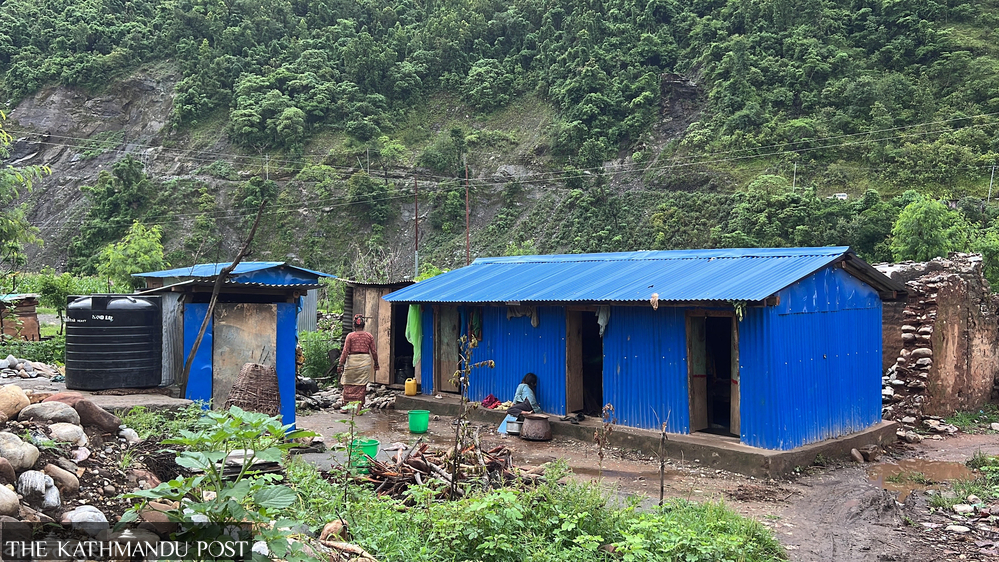
The November 2023 quake, with epicentre in Barekot, measured 6.4 on the Richter scale and killed 154 people in Jajarkot and Rukum West. Subsequent floods and landslides claimed 51 more lives. According to the District Administration Office, 26,557 houses were fully damaged and 35,455 partially damaged in Jajarkot. Of these, 14,245 need full reconstruction and 12,744 require repair, officials said.
For reconstruction, procedures allow a maximum of Rs400,000 per house and Rs300,000 for repairs. So far, around 4,652 beneficiaries in Bheri and Nalgad municipalities have begun the process, with only 641 in Bheri signing agreements. Delays from the National Disaster Risk Reduction and Management Authority have prevented the first instalment of Rs50,000 from being released.
Candidates from major parties have made reconstruction a key promise. Nepali Communist Party candidate Shakti Bahadur Basnet said he had effectively managed relief and rehabilitation during his previous term, ensuring most affected families received funds for temporary shelters. CPN-UML candidate Dambar Bahadur Singh said reconstruction and livelihood support will be his first priority if elected. Nepali Congress candidate Khadak Bahadur Budha also pledged to expedite rebuilding.
All three major candidates are conducting house-to-house visits in quake-affected communities. Basnet visited Juni Chande, Chedagad, Shivalaya, and Nalgad, while Budha toured Shivalaya and Chedagad, and Singh visited Barekot.
Meanwhile, Rukum West, with 34,997 registered beneficiaries, is also facing delays due to insufficient funds, according to Assistant Chief District Officer Keshav Prasad Oli.
Residents say they hope the candidates’ promises translate into action, as prolonged delays have left many in debt, without shelter, and struggling to survive in harsh weather.
Krishna Prasad Gautam
Gautam is the Karnali bureau coordinator of the Kantipur Publications.

Most Read from National

Flood sweeps away houses, bridges in Gorkha

What to know about the US trial over Mamta Kafle’s disappearance

Torrent of black mud and rocks engulfs settlements along Budhigandaki

From blankets to handmade dolls, two foreign women bring comfort to flood survivors

Budhi Gandaki flood washes away three bridges in Gorkha
Editor's Picks




E-PAPER | October 22, 2026

×