Polling centres for March 5 vote classified based on security alert
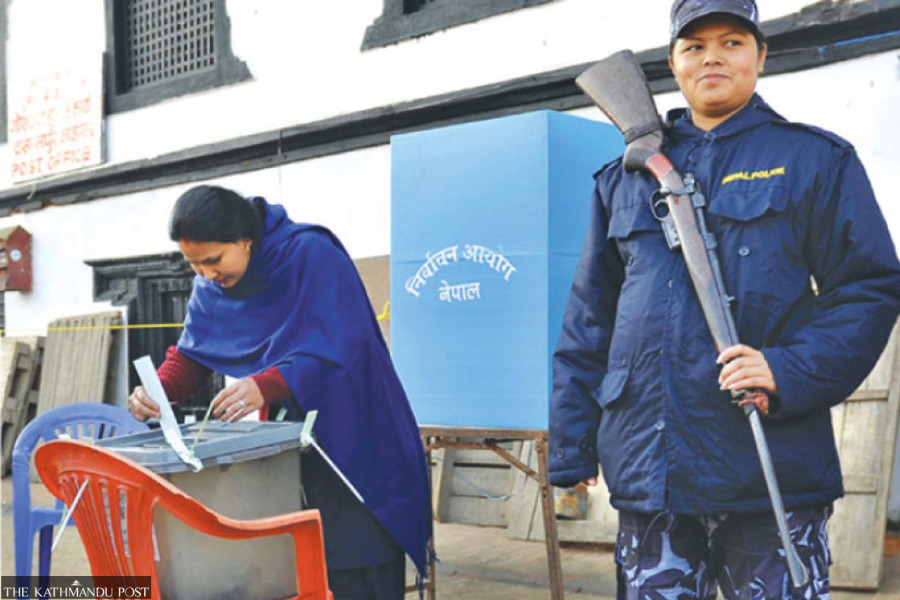
Election police will be appointed on February 1 and deployed from February 10 to provide security for the House of Representatives election. Post file photo
With Nepal holding a high-stakes snap parliamentary election in five weeks, security agencies are ramping up preparations by mobilising a 150,000-strong election police and placing thousands of polling stations under heightened surveillance.
For the parliamentary elections, declared after the September Gen Z uprising, the Election Commission has classified 10,967 polling booths into three security categories.
According to Deputy Inspector General Abi Narayan Kafle, 2,845 polling booths have been placed in the “normal” category based on the level of security risk, while 4,442 have been designated as “sensitive” and 3,680 as “highly sensitive”.
A senior Nepal Police officer said that among the booths thus categorised, locations where heavyweight candidates are contesting have been placed under heightened surveillance. According to the official, more than half a dozen such locations are currently under close watch.
During the filing of nominations on January 20 under the first-past-the-post category of the March 5 House of Representatives vote, clashes broke out in Jhapa constituency-5 between supporters of the CPN-UML and the Rastriya Swatantra Party (RSP).
The situation escalated after RSP senior leader Balendra Shah’s supporters shouted provocative slogans against Oli, triggering tensions and scuffles at the site. Both Oli and Shah are contesting the election from the same Jhapa constituency.
“To prevent a repeat of such incidents, areas where high-profile candidates are contesting including Sarlahi, Chitwan, Gorkha and eastern Rolpa, are kept under enhanced security focus,” the top police officer told the Post.
While Nepali Congress President Gagan Kumar Thapa is contesting the Sarlahi-4 seat, RSP President Rabi Lamichhane is contesting the election from Chitwan-2. Gen Z movement leader Sudan Gurung is in the election fray from Gorkha-1 whereas Pushpa Kamal Dahal, coordinator of the Nepali Communist Party, is running from Rolpa.
At such locations, election police and Nepal Police personnel will be deployed on a high-priority basis. This, however, does not mean that other areas will be under reduced surveillance, the officer explained.
The election police will be appointed on February 1 and deployed from February 10 to provide security for the House of Representatives election.
Previously known as temporary police, they will be mobilised under the Nepal Police and the Armed Police Force (APF).
DIG Kafle, who is the Nepal Police spokesperson, said the recruits will be issued appointment letters on February 1, followed by 10 days of basic training. They will then be deployed to designated areas from February 10. The recruits will complete their duties by March 9.
“We had earlier planned to publish the names of selected election police personnel on January 29 and deploy them from February 8. However, as some districts required additional time to complete the selection process, all procedures have now been pushed back by two days from the original schedule,” Kafle said.
From a security standpoint, polling booths have been divided into three categories, with classification also carried out district by district. In Rolpa, for instance, more than a dozen polling stations have been categorised as highly sensitive, mainly those in Thawang, Sunchhahari and Runtigadhi rural municipalities.
In Banke district of Karnali Province, police have classified 61 out of the district’s 139 polling stations as highly sensitive. Security sources say the high number of sensitive polling centres is also due to the district’s open border with India, which lies less than 70 kilometres away.
On security grounds, 481 polling stations in Sudurpaschim have been classified as highly sensitive across the province's 16 constituencies.
Out of a total of 1,176 polling stations in Sudurpaschim, 300 have been classified as normal, 395 as sensitive and 481 as highly sensitive. Police say Kailali, the largest district in the province, has the highest number of highly sensitive polling stations, with 108 centres under this category.
Authorities, in accordance with the Election Security Management Procedure 2021, have prepared the integrated election security plan 2025.




 14.82°C Kathmandu