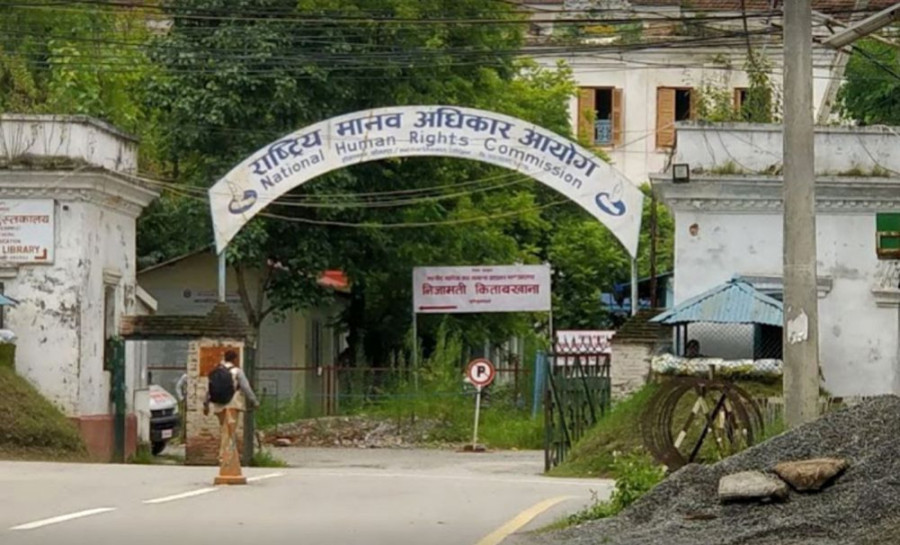
The executive’s attitude towards the National Human Rights Commission has not changed, even under a civilian government led by the people with a long history of rights advocacy.
Following in its predecessors' footsteps, the Sushila Karki government also has also failed to implement any recommendations from the constitutional human rights watchdog, except for some departmental actions against perpetrators. After the Karki government took office, the commission followed up on the implementation of its recommendations.
The Office of the Prime Minister and Council of Ministers said all recommendations of the commission were destroyed in a fire on the second day of the Gen Z protest on September 9, and asked the commission to resend them. Even as the commission resent several of those recommendations, there has been no progress towards implementation. “The implementation of the commission’s recommendations remains dismal. It is disappointing to see even the present government has the same attitude as its predecessors,” said Yagya Adhikari, joint-secretary at the commission.
Since its establishment in 2000, the commission has recommended action on 1,618 complaints as of the first half of the current fiscal year. The commission’s report shows only 13.29 percent of them were fully implemented. While 34.12 percent of them have been partially implemented, 52.6 percent remain completely unaddressed. “Over the last four years, the government hasn’t implemented any of the recommendations fully,” commission officials said.
After probing the complaints, several of which were related to Maoist insurgency-era human rights violations, the commission made around 610 recommendations to the government for interim relief, compensation, departmental actions against perpetrators, and criminal prosecutions since the current team of office bearers took office. Led by chief commissioner Top Bahadur Magar, the five-member team joined the commission in February 2021.
While successive governments never had a positive attitude towards the commission, the situation has worsened over the years, according to officials. All three major parties—the Nepali Congress, the CPN-UML and the CPN (Maoist Centre)—led the federal government until September. Former chief justice Karki has been leading the government since September 12, while prominent ministries directly responsible for implementing the recommendations are led by those who made their names in rights advocacy. Om Prakash Aryal, a prominent human rights lawyer, leads the home ministry while former justice Anil Kumar Sinha is the law minister.
Even though the National Human Rights Commission Act makes it mandatory for agencies concerned to implement its recommendations, compliance remains weak. Section 5 of the Act clearly states that the agency or official must take necessary action accordingly. The law also empowers the commission to make public the names of officials, individuals, or agencies that fail to implement its recommendations. Yet, successive governments have continued to ignore the commission’s recommendations.
The commission makes recommendations to the government to take action, provide compensation, and introduce policy reforms to address violations of fundamental rights and cases of torture. The recommendations cover abuses related to civil and political rights, including illegal arrest and detention, poor prison conditions, problems in the administration of justice, and election-related violations.
They also include economic, social, and cultural rights such as access to education, healthcare, food, housing, labour, and social security. The cases of enforced disappearance, violence against women and children, child marriage, trafficking, and the rights of migrant workers abroad are other areas of recommendations.
The government officials accept that implementation of the commission's recommendation is not satisfactory. “Several factors led to poor implementation,” said Ramji Danai, joint secretary at the Prime Minister’s Office. “The issue was raised during the Universal Periodic Review in Geneva last week where we expressed our commitment to implementation.” He said a taskforce has been formed to facilitate the implementation process.
In addition to the non-implementation of its recommendations, its performance has further been affected by inadequate resources, the lack of a dedicated office building, delays in addressing conflict-era cases and the executive’s traditional mindset towards human rights, the officials at the commission say.
Binod Ghimire covers parliamentary affairs and human rights for The Kathmandu Post. Since joining the Post in 2010, he has reported primarily on social issues, focusing on education and transitional justice.




 23.98°C Kathmandu