Snowfall disrupts mountain districts of Karnali and Sudurpaschim, brings relief to drought-hit farmers
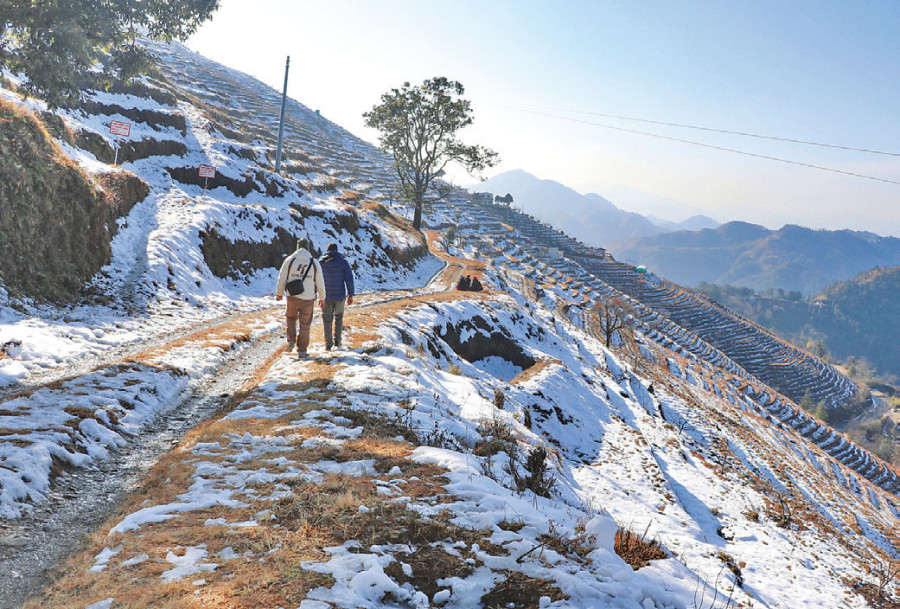
Transport services are suspended on nearly a dozen road sections. Thick snow has largely confined local people indoors. People walk across a road at Dasharath Chand-1 in Baitadi on Saturday. Photo: courtesy of Nari Badu
Snowfall across the high altitude districts of Karnali and Sudurpaschim provinces has disrupted daily life, grounding flights and blocking roads, while bringing much-awaited relief to farmers hit by a prolonged drought.
The snowfall, which began late Friday night and continued on Saturday, affected all high mountain districts of Karnali. According to the Civil Aviation Office, all flights from Surkhet and Nepalgunj to mountain airports were cancelled on Saturday. Nearly one foot of snow accumulated at Simikot Airport in Humla, forcing a complete halt to air services.
Road connectivity has also been severely affected. Transport services were suspended on nearly a dozen road sections, including the Mid-Hill Highway, the Gamgadhi-Nagma road in Mugu and the Simikot-Hilsa road in Humla. Thick snow has made movement difficult, leaving local people largely confined indoors.
Madan Rokaya of Simkot, the district headquarters of Humla, said continuous snowfall had blocked all foot trails connecting Namkha Rural Municipality to the district headquarters. “Around three feet of snow had accumulated at Nara and Nyalu highlands, both located at elevations close to 5,000 metres. And snowfall is continuing until Saturday evening,” said Madan.
Despite the hardship, residents across the mountain districts are welcoming the snow as a sign of “subikal”, which literally means a good agricultural year. Farmers had grown increasingly anxious as months of drought threatened winter crops. The snowfall and rain have brought much-needed moisture.
Bir Bahadur Rokaya of Murma village in Mugu said crops that were drying up due to drought had received relief. “In the mountains, a year without snow brings famine, while snowfall promises good harvest,” he said. “Though late, this snow has come in time to help crops, apples and other fruits.” He, however, said that grazing livestock and collecting firewood as well as grass had become difficult.
Rara, the country's biggest lake and one of Karnali’s major tourist destinations, has been blanketed in white. Ranger Dharmajit Saud of Rara National Park said up to two feet of snow had fallen around the lake, bending trees under its weight.
Chandra Nepali of Rawalbada in Soru Rural Municipality-4 said the snowfall would benefit both early crops, such as wheat and barley, and later crops, including millet, foxtail millet and other crops.
“When snowfall is good, water sources and streams recharge. In such years, the region never faces food shortages. The dependence on rice supplied by the Food Management and Trading Company may end this year,” said Nepali.
According to Sunil Limbu, spokesperson at the Ministry of Land Management, Agriculture and Cooperatives in Karnali, farmers in mountain districts have begun piling snow around apple trees to retain moisture. “The more snow, the better the apple yield. Farmers are free from irrigation worries and pest and disease incidence is also expected to be lower this year,” said Limbu.
Snowfall has also blocked sections of the Mid-Hill Highway, including the Rukum East–Baglung stretch, particularly around the Patihalne area. Heavy snow at Satamod along the Gamgadhi-Nagma road has halted traffic, while large stretches of the Simikot-Hilsa road are buried, said Humla’s Chief District Officer Tek Kumar Regmi. He said flights would resume only after the snow is cleared from the Simkot runway.
In Jumla, snowfall after months has lifted farmers’ spirits. While upper regions had seen light snow in recent years, lower areas mostly received rain. This time, snow has fallen across the district. Vehicular movement along the Karnali Highway and other roads has been disrupted, and flights affected, but farmers say winter crops will benefit.
Gopal Rokaya of Sinja Rural Municipality-2 said residents exhausted by drought and hailstorms were encouraged. “Snow should fall in November or December, but even in late January it helps,” he said. “It has added moisture to newly managed orchards and improved irrigation conditions.”
Agricultural experts say proper fertiliser management now could ensure good harvests. Snowfall has been reported in all 60 wards of Jumla’s eight local units. The District Administration Office has urged residents to exercise caution during heavy snowfall, while experts say the risk of black frost and disease in apples will be minimal.
Similarly, winter rain and snowfall arrived late in Sudurpaschim Province. High altitude places of Bajhang, Bajura, Doti, Dadeldhura, Darchula and Baitadi districts received rain and snow. Electricity supply in Bajhang has been disrupted since Friday afternoon.
Farmers hit by drought over the past four months say the precipitation has brought relief. “Most crops had already dried up. The soil had turned to ash. Snow has added some moisture,” said Deepak Jagri of Durgathali.
Snowfall of up to one foot has been reported in high areas of Surma, Saipal, Talkot, Masta, Chhabispathibhera, Thalara, Kedarsyun, Durgathali and Bithadchir in Bajhang. Bajura’s Gaumul, Budhinanda and Himali rural municipalities also received snow.
Madam Raj Joshi of Badimalika in Bajura, said the rain would help upcoming potato cultivation. Snowfall has also been reported in Baitadi’s Satbaj, Gwalllek, Khodpe and Sigash, and in Khaptad and Gaira of Doti and Hagalte in Dadeldhura.
The cold has intensified, affecting daily wage workers, children and the elderly. Locals traditionally gather around fires, preparing warm dishes of pulses and pumpkin to endure the harsh winter days.
(Krishna Prasad Gautam in Surkhet, DB Budha in Jumla, Mahesh KC in Rukum West, Basant Pratap Singh in Bajhang, Ramchandra Neupane in Dolpa and Mohan Chand in Baitadi contributed reporting.)




 14.83°C Kathmandu