Nepal signs LEAF Coalition deal that could bring up to $55 million in climate finance
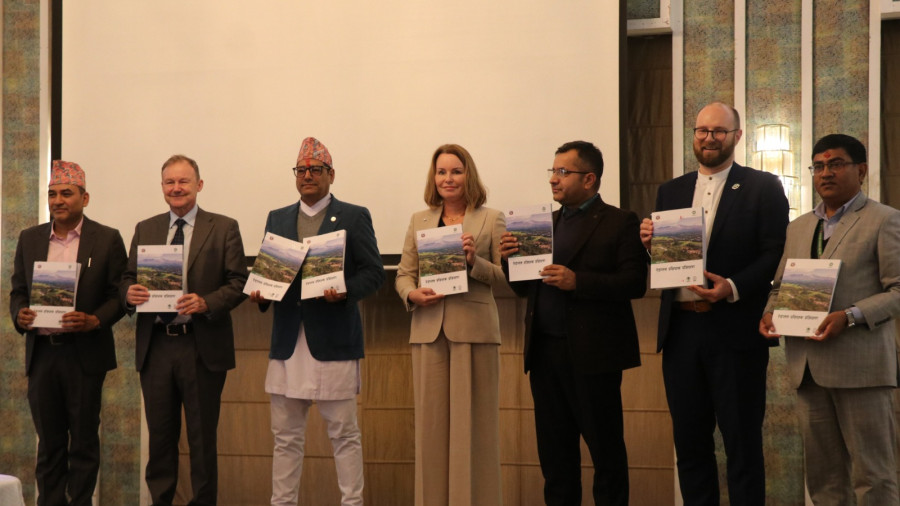
Landmark agreement makes Nepal the first Asian country to access LEAF funding, rewarding decades of community-led forest conservation and emissions reductions. Photo: Courtesy of Norwegian Embassy in Kathmandu
Nepal’s government on Friday signed a landmark agreement to receive up to $55 million in climate finance from the LEAF Coalition, recognising the country’s success in tackling deforestation and expanding forest cover.
With the signing, Nepal becomes the first Asian country to enter into an agreement with LEAF, an innovative global public-private initiative backed by more than 30 major companies and the governments of Norway, the United Kingdom, the United States and the Republic of Korea.
By joining LEAF, Nepal has renewed its longstanding commitment to protecting and restoring forests through its jurisdictional REDD+ (JREDD) programme.
The agreement also makes Nepal the first government to offer correspondingly adjusted carbon credits to private sector buyers through LEAF, enabling their use in compliance schemes such as the Singapore Carbon Tax and the Carbon Offsetting and Reduction Scheme for International Aviation (CORSIA).
Under the deal, up to 25 percent of credits made available to the private sector will carry corresponding adjustments.
Once heavily grazed by livestock and overexploited for firewood, Nepal’s forests have benefited in recent decades from partnerships between provincial Division Forest Offices and community groups, which implement management plans to ensure the sustainable extraction of forest resources.
As a result, Nepal’s forest cover has risen to more than 46 percent of the country’s total land area. The government aims to increase this further through community-based forest management, supported by strong policy, legal and institutional frameworks.
Building on this progress, Nepal plans to make millions of tonnes of high-integrity emissions reductions and removals credits available to LEAF buyers for the period from 2022 to 2026. The agreement was signed with Emergent, the coordinator of the LEAF Coalition.
The governments of the United Kingdom and Norway will provide a purchase guarantee for an initial volume of one million emissions reductions and removals credits.
Additional credits will be offered to corporate buyers through an extended purchase window, with final volumes dependent on the number of credits issued.
According to Emergent, this structure simplifies the agreement process for forest governments while giving private sector buyers greater flexibility on the timing of purchases.
Overall, the deal could deliver up to $55 million in funding for Nepal through the forward purchase of high-integrity forest carbon credits from the government-led programme to reduce emissions from deforestation.
With Nepal’s entry, the total potential value of LEAF agreements with forest governments has reached more than $325 million.
Nepal follows Costa Rica, Ghana, Ecuador and the Brazilian state of Pará in signing such agreements.
Govinda Sharma, secretary at Nepal’s Ministry of Forests and Environment, said becoming the first Asian country to sign a LEAF Coalition deal demonstrated the progress Nepal has made in restoring and expanding its forests.
“We have worked for many years to reach this point, bringing stakeholders together to develop community-based forest management programmes that draw on the traditional and customary knowledge of our people,” he said.
Sharma added that Nepal has sought to build an inclusive national REDD+ programme that shares benefits with those involved in fighting forest loss.
“Finance from the LEAF Coalition brings the prospect of rewarding stakeholders, including Indigenous Peoples and forest communities, for their efforts,” he said.
Eron Bloomgarden, chief executive officer of Emergent, said the organisation was pleased to partner closely with Nepal to help unlock finance from the country’s forest protection efforts.
“We hope to continue this working relationship in the long term,” he said, adding that the agreement showed how healthy forests, managed in partnership with indigenous peoples and local communities, could provide a valuable and sustainable source of income.
With Nepal on board, LEAF buyers can now choose high-quality forest carbon credits from five countries across three continents, with further options expected in the future.
Buddha Gharti Bhujel, senior vice president and REDD focal person of the Nepal Federation of Indigenous Nationalities (NEFIN), welcomed the progress made by the government in consultations on benefit-sharing plans.
He said indigenous peoples and local communities, whose traditional knowledge and practices play a vital role in forest protection, were optimistic that proceeds from the LEAF Coalition would be shared fairly.
Thakur Bhandari, president of the Federation of Forest Users’ Groups Nepal (FECOFUN), said community forest user groups were at the forefront of conserving and restoring forests.
“We are working hard, using our knowledge and skills to protect our home,” he said, expressing hope that the LEAF agreement would bring finance to reward these efforts and enable communities to do more in the future.
Rob Fenn, the UK ambassador to Nepal, said the United Kingdom welcomed Nepal’s decision to work with the LEAF Coalition to access climate finance. “This is a major step forward in efforts to combat deforestation and protect vital ecosystems in Nepal and beyond,” he said.
Norway’s ambassador to Nepal, Dagny Mjøs, congratulated the government on what she described as a groundbreaking agreement. She said Nepal had made great strides in tackling deforestation and increasing tree cover, with ambitious plans to go further.
Mario Boccucci, head of the UN-REDD Secretariat, said the agreement marked an important milestone for Nepal and reflected decades of work to protect forests, establish credible monitoring systems and place communities at the centre of forest stewardship.
He said UN-REDD was pleased to have partnered with Nepal over many years and that the progress positioned the country to engage markets that reward integrity, scale and long-term performance.




 14.83°C Kathmandu