



 19.48°C Kathmandu

Thu, Oct 22, 2026
National
Adult inmates to be separated from juvenile homes
Move follows violence in Bhaktapur correction centre that left eight juvenile offenders injured.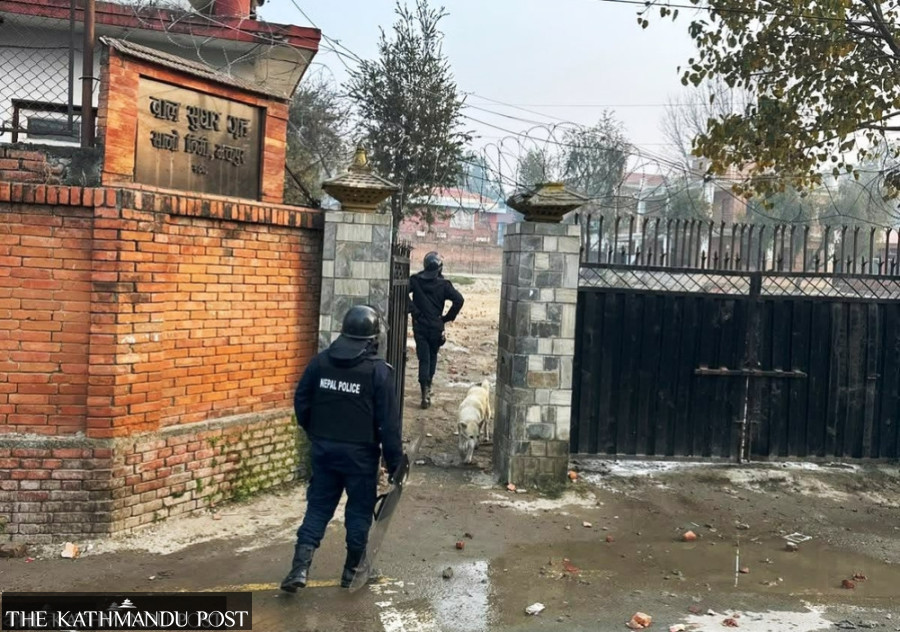
bookmark
Binod Ghimire
Published at : January 24, 2026
Updated at : January 24, 2026 07:23
Kathmandu
The ever-increasing cases of violence in juvenile correction homes have prompted the government to separate minor delinquents from adults and relocate the latter to the Nuwakot-based open prison.
Over the years, infighting in such correction centres has become increasingly frequent, leading to several deaths and injuries. At least six clashes have been reported from the country’s east to the west, the latest being in Bhaktapur.
Eight inmates and one police person were injured after clashes broke out between two groups at the Sanothimi-based correction centre on Thursday night. One of the blocks of the centre was torched by juvenile delinquents. It took hours for the district police to bring the situation under control.
“The inmates have been housed at various police stations as one of the blocks, which accommodated male inmates, was set on fire,” Suresh Acharya, assistant chief district officer in Bhaktapur, told the Post. As many as 169 inmates, including 24 females, were housed in the centre.
This is the second time in a year that clashes have taken place at the Bhaktapur centre.
A juvenile delinquent is a person under the age of 18 who commits an act that would otherwise be charged as a crime if s/he was an adult. Under existing law, minors who commit crimes punishable by law are kept in correction homes instead of being sent to jail after a court verdict.
Those who cross 18 years of age before completing their terms too are kept in correction homes with minors until they serve the given sentence.
Officials say the inmates who are above 18 years of age are often the troublemakers. Unlike other prisons, which fall under the home ministry, the correction centres come under the Ministry of Women, Children and Social Welfare. As a result, police are not allowed in such centres. “Containing clashes is challenging in the absence of police,” said Acharya.
Government bodies and civil society organisations have long recommended separating adults and minors as the only viable solution. In a move towards implementing the recommendation, the Cabinet on December 21 decided to relocate the adult inmates from correction centres to Nuwakot.
“We plan to shift 200 of them from different centres to Nuwakot,” Durga Praasad Chalise, chief of the child protection unit at the Ministry of Women and Children, told the Post. “It will be done after the necessary budget is arranged.”
Home Minister Om Prakash Aryal and Minister for Women, Children and Social Welfare Shradha Shrestha held a meeting following the Bhaktapur incident and decided to relocate the adult delinquents as soon as possible.
The country has eight juvenile correction centres—in Bhaktapur, Morang, Kaski, Makawanpur, Parsa, Rupandehi, Banke and Doti. The centres are tasked with bringing about changes in the attitudes and behaviour of the children who have committed crimes, and these places are required to meet specific standards.
However, various reports suggest that correction centres in the country have failed to serve their purpose.
A 2024 study by the Law, Justice and Human Rights Committee of the House of Representatives found that juvenile correction centres are overcrowded, lack basic amenities, and have safety issues. The report found that they lack adequate facilities for education, healthcare, hygiene, rest, sports and psychological counselling. Many centres are housing inmates more than four times their capacity.
Against a capacity of 50 inmates, the juvenile correction centre in Biratnagar houses 222. Similarly, 117 inmates have been crammed into the Birgunj-based correction centre, which has a capacity of just 17. In Banke, 240 inmates are housed in a centre designed for 190.
Likewise, after monitoring all correction centres last year, the National Human Rights Commission concluded all of them suffer from serious managerial problems.
Binod Ghimire
Binod Ghimire covers parliamentary affairs and human rights for The Kathmandu Post. Since joining the Post in 2010, he has reported primarily on social issues, focusing on education and transitional justice.



Most Read from National

Flood sweeps away houses, bridges in Gorkha

What to know about the US trial over Mamta Kafle’s disappearance

Torrent of black mud and rocks engulfs settlements along Budhigandaki

From blankets to handmade dolls, two foreign women bring comfort to flood survivors

Budhi Gandaki flood washes away three bridges in Gorkha
Editor's Picks




E-PAPER | October 22, 2026

×