62-year-old ‘Tyre Kanchha’ battles to pull bus buried in Trishuli over a year ago
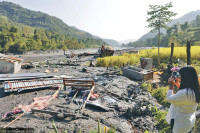
Santa Bahadur Shrestha has spent decades hauling vehicles from cliffs and rivers, but this bus is testing his patience. Santa Bahadur Shrestha works a chain pulley this week to retrieve a bus wreckage buried in the sand of the Trishuli River. Raju Chaudhary/TKP
Tyre Kanchha. One may be amazed upon hearing the unusual name. But once people learn what Santa Bahadur Shrestha, widely known by that nickname, has been doing along the country’s most treacherous highways and rivers for decades, amusement quickly turns into respect.
For the past eight days, the 62-year-old has been camping on the bank of the Trishuli river in Tanahun with a single purpose—retrieving the wreckage of a bus swallowed by the river two and a half years ago. Two vehicles were swept into the Trishuli by a massive landslide at Simaltal along the Narayanghat-Muglin road section in ward 29 of Bharatpur Metropolitan City on July 12, 2024. The remains of one of the vehicles have been detected. And Shrestha is now leading efforts to pull out what is left of the Ganapati Deluxe bus, half-buried in sand and water.
Despite his old age, his energy, according to the people who know him, rivals that of men half his age. Shrestha has pitched two tents on the sandy bank at Dongdrang in ward 5 of Abukhaireni Rural Municipality on the Chitwan-Tanahun border, where he stays with members of his family. He begins work before dawn each day, battling strong currents, shifting sand and freezing water. Only part of the bus is visible, making the task far more dangerous and complex than most recoveries he has handled.
Along the Narayanghat-Muglin section and Prithvi Highway, his name is well known. Whenever a vehicle plunges off the road, calls go out for Shrestha. Over four decades, he has hauled vehicles from cliffs and rivers in Gorkha, Lamjung, Nuwakot, West Nawalparasi and Makawanpur. Four men work with him regularly, with extra hands hired when needed.
Shrestha says this operation has tested him like none before. “The longest I had ever spent on one recovery was eight days. Even excavators submerged in water or vehicles hanging off cliffs usually took five or six days. This one is much harder,” he said. It has already been twelve days since he began working on the bus embedded deep in the Trishuli’s sandy riverbed.
Police personnel first attempted to remove the bus on January 11, using shovels to clear sand, but were forced to abandon the effort. The district administration office in Tanahun then contacted Shrestha, who arrived the next day with chain-pulley equipment. Despite trying multiple techniques day and night, success has remained elusive. “Pulling an excavator from water was easier than this,” he said.
Transporting equipment from the road in Simaltal down to the riverbank has been another challenge. With no access road, everything must be hauled manually, adding to the strain. Still, Shrestha expresses gratitude for the support he has received from the Nepali Army, Armed Police Force and Nepal Police. “Without the police help, I could not have attempted this,” he said.
Shrestha’s life story is as stark as the terrain he works in. Villagers told him his mother died when he was six months old; he never even learned when his father passed away. As a young man, he took a job as a guard at Western Regional Gandaki Hospital in Pokhara. In his spare time, he learned tyre repair and vehicle recovery. After four years, he left the job, opened a small tyre shop in Damauli, the district headquarters of Tanahun, and bought a chain pulley for Rs3,000, venturing into accident recovery.
Sixteen years ago, he bought four ana (127 square metres) of land beside the highway in ward 1 of Byas Municipality in Tanahun. From the same trade, he is now building a concrete house with two shutters. “This profession is my entire property,” he said proudly. “It bought me land, built my house and educated my children.” One daughter now works in Japan, while his son accompanies him on recoveries. Shrestha has registered a company, Milan Chain Pulley, in his son’s name.
In Damauli, Shrestha is a familiar face, respected for his skill and resilience. He says he is training his son to take over one day. “I won’t be here forever. I want my son to carry my name forward,” he said. The affection he receives from the community sustains him. He recalls how elected representatives (mayor, deputy mayor and other municipal officials) visited when his wife Balkumari was critically ill. “I am just a man who pulls vehicles,” he said, “but their presence meant everything to us.”




 15.38°C Kathmandu