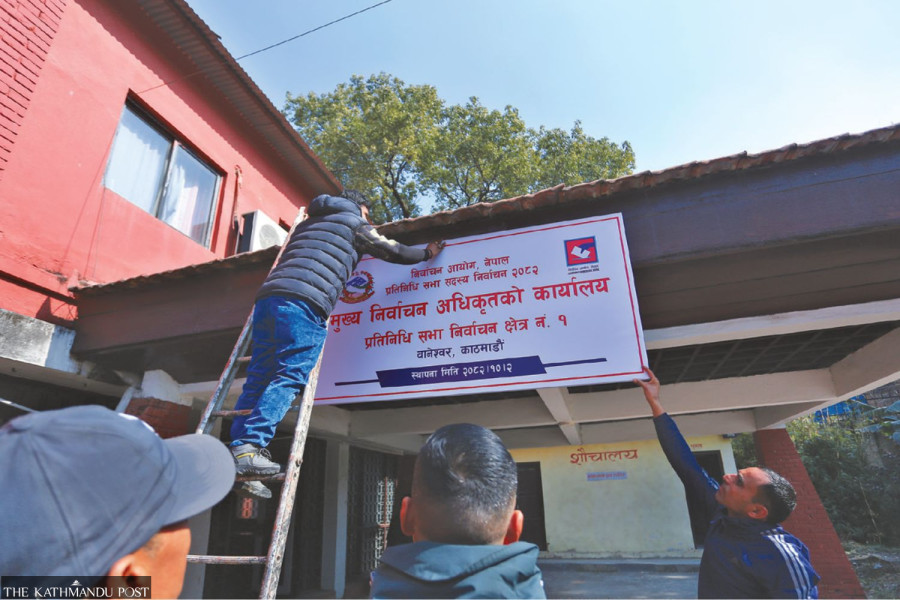
Political parties raise concerns over possible misuse of state power and biased statements of ministers as they call for free and fair elections. The office of the returning officer being set up at New Baneshwar for Kathmandu Constituency-1 on Friday. The Election Commission said it has set up offices in all 165 constituencies. POST PHOTO
Accelerating its election preparations, the Election Commission on Friday set up offices in all 165 constituencies around the country.
The offices were established four days before the nomination date for the first-past-the-post (FPTP) category. The Election Commission has allotted January 20 for filing the nominations for direct elections. Aspirants under the FPTP from the respective electoral constituencies can file their nominations on that day.
The nominations under the proportional representation were completed last week.
“The offices have been set up in all 165 constituencies,” said Kul Bahadur GC, assistant spokesperson at the commission. “Other preparations are also in full swing.” On Friday, the commission also held discussions with representatives of various parties to discuss enforcement of the code of conduct from next week.
During the interaction, parties agreed to abide by the code of conduct but raised concerns about the speeches and actions of government officials.
Participating in the interaction, Nepali Communist Party (NCP) leader Barshaman Pun objected to Prime Minister Sushila Karki’s remarks suggesting that the younger generation (Gen Z) should be made to win the elections. Pun said that such statements by the prime minister and her ministers in public speeches were objectionable.
He also suggested that the commission pay attention to ensuring that state power and resources are not misused during elections. “The Election Commission must pay utmost attention to ensuring that state power and state resources are not misused. We are hearing biased statements from the people in the government,” he said. “The commission needs to build a reliable mechanism to ensure the code of conduct is implemented effectively.”
Similarly, the CPN-UML has said that doubts remain on whether the upcoming elections will be held in a fear-free environment. Putting forward his views, the party’s secretary Rajan Bhattarai asked what kind of preparations the commission was making to ensure that the elections are conducted fairly and without fear. He drew the commission’s attention to the need to make the monitoring system for implementing the election code of conduct more effective.
“What is the Election Commission’s monitoring system for implementing the code of conduct? How prepared is it to control the flow of money and the use of money power, as mentioned earlier?,” he questioned. “Does the commission believe there is an environment for the candidates to confidently go to the people, campaign freely in a fear-free environment, and that elections will be fair without any inducement?”
Responding to the concerns, acting chief election commissioner Ram Prasad Bhandari has said they try their best to ensure the election campaigns are conducted decently. He said candidates will be allowed to promote their own policies, objectives, manifestos and programmes but targeting opponents will not be allowed.
“No one can chant slogans like ‘No, Not Again’ against anyone. Calling someone a bad leader is not allowed,” he said.
He said the commission is ready to take actions if there is information on breach of the code of conduct.
The commission last week endorsed the code of conduct designed to ensure free, impartial, and transparent elections. It bars political parties or candidates from production, use, distribution or display of garments or items (such as jackets, shirts, vests, T-shirts, caps, scarves, masks, badges, or any other kind of clothing) bearing election symbols or stickers, logos, bags, badges, tattoos or similar symbolic materials.
Using the premises of a government, semi-government or public institutions, school or universities for gatherings, campaigns, or publicity purposes has been barred. Likewise, the use of children in election campaigns is prohibited.
Rallies, assemblies, or public meetings that obstruct public transport are not allowed for campaigning purposes. The code prohibits the spread of false, misleading, or divisive information on social media. The use of artificial intelligence (AI) to influence or manipulate the election has also been restricted.
Likewise, creating fake accounts or posting false content on social media that could negatively affect the election is prohibited. It also bars governments (federal, provincial, and local) from holding foundation-laying or inauguration ceremonies during this period.
Except for government employees mobilised on election-related duties, no transfers of staff will be allowed.
Government employees, teachers, and staff of schools and universities are not allowed to participate in election campaigns.
Election campaigning is allowed only from 7:00 am to 7:00 pm and parties or candidates cannot use banners larger than 3 feet by 4 feet in size. One candidate is allowed to use only two vehicles for campaigning.
The commission has proposed allowing parties to publish newspaper advertisements, but only one per day. They can publish campaign materials with a maximum size of four columns by 25 centimetres.
Likewise, on FM radio and television, a party can broadcast its campaign materials only four times within 24 hours. The code also requires at least 24 hours’ advance notice to police of the date, time, route, and venue for organising processions, mass meetings, corner meetings, or gatherings. The local administration and police must be informed.
The code also requires parties to pay election-related expenses through a bank or financial institution. Such payments must be made from the account designated by the party through its authorised office bearer, it says.
Disclosure of the estimated amount of election expenditure is another provision in the code of conduct.
Anyone who violates the code of conduct may face action, including a fine of up to Rs100,000 or cancellation of their candidacy. In addition, such a candidate/candidates could be barred from running for office for up to six years.
“If, during monitoring or implementation of this code of conduct, any person is found to have violated it, the commission shall make public the name of the violator along with details of the violation,” it reads.




 14.82°C Kathmandu