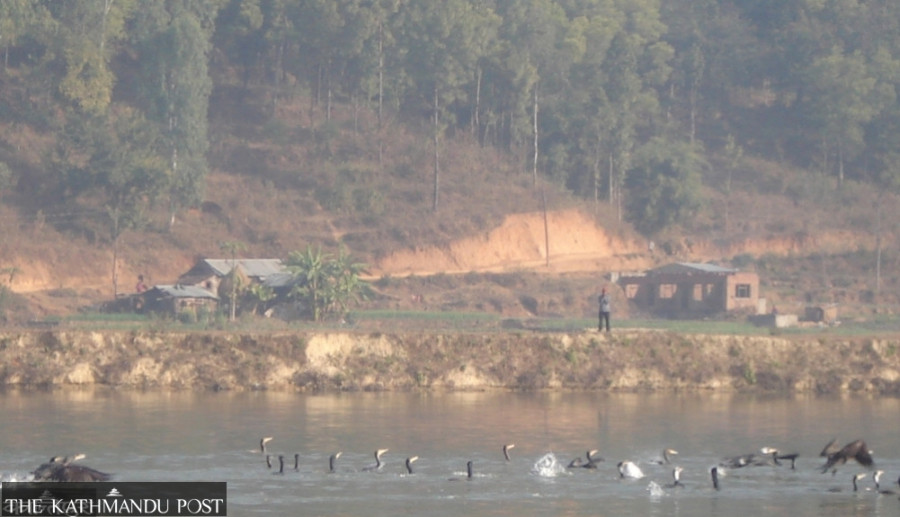
To protect fish in its ponds from migratory water ducks arriving from Siberia in search of warmer weather and food, three watchmen are being deployed daily at the Hetauda-based Natural Water Fisheries Promotion and Conservation Centre.
Located at Piple in ward 5 of Hetauda Sub-Metropolitan City, the centre has assigned three guards from dawn until dusk to chase away water ducks that prey on fish in the ponds. Armed with slingshots, the watchmen work continuously to prevent the birds from entering the ponds.
The guards also fire loud noise-making guns—usually used to scare monkeys—to drive away the ducks quite often. According to the centre, large flocks of water ducks begin arriving from outside areas as winter sets in, causing significant damage to fish stock.
“Since the onset of winter, flocks of water ducks have been coming and eating fish from the ponds, so we have deployed three watchmen daily,” said Saroj Kumar Yadav, chief of the promotion and conservation centre. “Despite deploying guards, water ducks alone cause losses of more than 2,000 kg of fish every year.”
The ducks have been arriving since the third week of November. To protect fish, particularly fingerlings, the centre has also installed nylon nets over several ponds so that ducks cannot enter. The measure has been taken specifically during winter, when migratory ducks from Siberia cause major damage by feeding on fish reared at the centre.
Despite efforts such as beating drums, shouting, or using slingshots, dozens of ducks often dive into the ponds at once to hunt fish. In addition to these measures, the centre has even invited hunters to kill ducks near the fish ponds as a control measure.
In the past, the centre used to provide up to two kilograms of fish as an incentive for killing a duck. However, as even skilled slingshot users and air-gun shooters failed to control the ducks effectively, the Hetauda Fish Development Centre has been installing nets over ponds for the past two years.
Not all ponds are covered with nets. Fish in ponds without nets continue to be eaten by the ducks.
At present, more than 200 ducks have made the trees around the fish ponds their habitat.
Spread over 47 hectares of land, the centre has a total of 53 fish ponds of varying sizes. Located about four kilometres from Hetauda market, the centre focuses primarily on producing and selling fish fingerlings rather than table fish.
Fingerlings produced in cold water are considered healthier and stronger. As a result, fingerlings produced at the centre are purchased not only by fish farmers from the Tarai region but also by farmers from Bihar, India.
Last year, the centre produced and sold fish fingerlings worth Rs44 million. Of this, fingerlings worth Rs 2 million were purchased by fish farmers from Bihar.




 14.81°C Kathmandu