As Chitwan’s wetlands shrink, migratory birds are vanishing
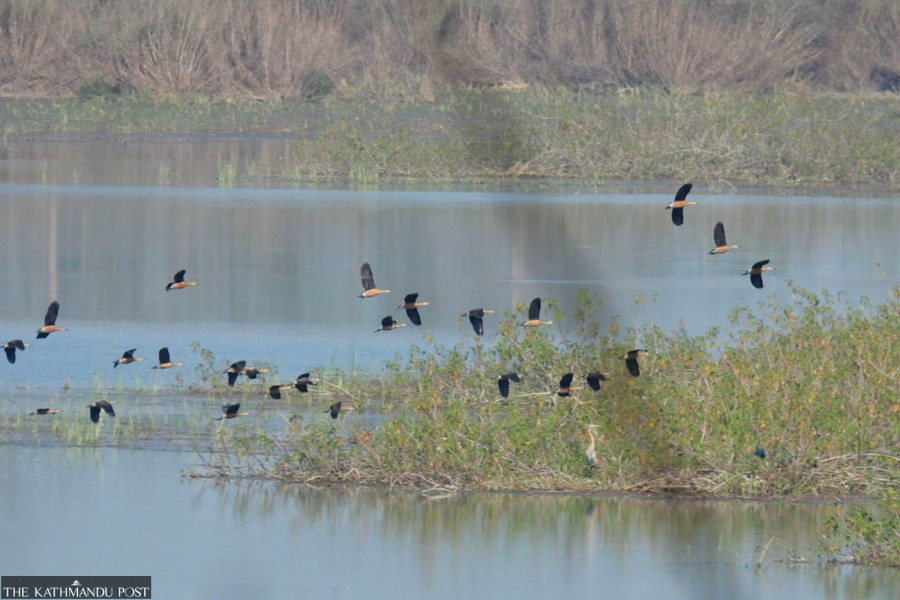
Migratory birds prefer fresh, flowing water and therefore avoid stagnant lakes, experts say. Water birds pictured in Temple Ghol of Chitwan National Park. Post Photo: RameshKumar Poudel
The grandeur of Debital, the largest lake inside Chitwan National Park, and the fame of Nandabhauju Lake are inseparable from any discussion of the country’s first protected area. Nandabhauju is often cited in birding quizzes, a symbol of wetlands that once teemed with life. Each winter, aquatic birds crossing the Himalayas traditionally cluster along the Narayani, Rapti and Riu rivers flowing through the park. But how many of those birds still survive in the lakes inside the protected area itself?
That question drove a 13-member bird-counting team led by conservationist and nature guide Manesh Limbu into the park’s western section on Thursday morning. Limbu, also chair of the Meghauli Ghatgai Nature Guide Association, said the survey aimed to document migratory water birds that historically relied on the park’s lakes and wetlands.
The team crossed the Rapti river from Meghauli and paused at a bifurcate channel opposite Barahi Jungle Lodge. Common shelducks and other wildlife were visible there, offering an early sign that flowing water still sustains life. Hopes dimmed soon after at Nandabhauju Lake. Only a lone oriental magpie-robin, a migrant from the mountain, was recorded. “There was hardly any water,” Limbu said. “The lake bed was dry, with only damp soil in places and a little sludge in one corner. Leaves covered most of it.”
From there, the group turned east to Budhi Rapti Ghol, once a summer refuge where rhinos were regularly seen wallowing. This winter, only a crocodile and a single little cormorant were spotted. Despite water being present, water-dependent birds were scarce, underlining a wider decline.
Heading west after crossing the Riu stream, the team reached Munda Lake. Water was present, but birds were few. A lone oriental darter perched on a dead branch, spreading its wings to dry, while an Asian openbill searched for food in water. “This lake too is slowly filling with sand from the river,” said Limbu, visibly concerned, echoing warnings about sedimentation in Chitwan’s wetlands.
At Singe Ghol, the mood lifted. Though water levels were low, both the diversity and number of birds were higher than elsewhere. A crested serpent-eagle perched on a split, dried tree trunk. “It feeds on snakes,” Limbu explained. “In winter most snakes hibernate, but water snakes, king cobras and pythons bask in the sun. The eagle waits for them here.” A grey-headed fish eagle circled overhead, while both resident and migratory species were recorded.
The team then moved directly west to Temple Ghol near Amaltari, south of Danda Bazaar in Nawalparasi East. Beyond the Narayani lie the ruins of the now-closed Temple Tiger hotel, beside which the ghol was formed by a bifurcated river channel. Here, the scene contrasted sharply with earlier stops. Flocks of water birds fed actively: herons and openbills waiting for prey, and migratory birds flew back and forth. After recording all sightings, the team turned east again towards Debital, a vast lake in the park’s Chure region.
On the way, the enumerators saw a king cobra basking at the base of a red silk-cotton (Bombax ceiba) tree, known as simal in Nepali, and a herd of gaur, raising spirits briefly. At Debital, optimism faded. Invasive weeds and reeds had almost swallowed the lake. There was no visible movement of birds or animals. Tall reeds choked the eastern side, dense scrub covered the west, and only a small patch of water shimmered in the southern corner. “The lake survives on that tiny pool,” Limbu said. “To see one of the park’s largest wetlands at the edge of collapse is deeply worrying.”
Only three birds—a crested serpent eagle, a oriental darter and a red-wattled lapwing—were recorded at Debital. Limbu said Temple Ghol was in the best condition, followed by Singe Ghol, noting that 32 Indian spot-billed ducks were counted at Temple Ghol alone.
Conservationists are worried about the shrinking wetlands that apparently do not offer a conducive environment for migratory water birds to thrive.
Hathan Chaudhary, president of Bird Conservation Nepal, said migratory birds prefer fresh, flowing water and therefore avoid stagnant lakes. “If birds cannot swim and forage properly, they will not stay,” he said, adding that siltation and invasive vegetation are driving birds away. Some outlet for water is essential, he stressed. Chaudhary also recalled that after Bisahajari lake in Barandabhar forest was cleaned, birds paradoxically stopped coming, highlighting the complexity of wetland management.
Ganesh Panta, chief at Chitwan National Park, said invasive plants, debris from the Chure hills and sand carried by rivers are increasingly choking key wetlands. He estimated that only about 10 percent of Debital remains viable. “Restoring Debital alone would cost at least Rs4-5 million, but we do not have the budget,” said Pant, adding that coordination with other agencies is being explored.
A nationwide water bird census is underway in lakes, rivers and wetland areas across the country. The count aims to assess the mid-winter status of the aquatic birds increasingly threatened by habitat loss and climate change. The annual count, conducted every January, helps track population trends, distribution and emerging risks to water birds while engaging local communities in conservation.
This year’s census runs from January 3 to January 18. It is coordinated by Wetlands International in collaboration with Bird Conservation Nepal, with support from the Department of National Parks and Wildlife Conservation. More than 400 ornithologists, nature guides, wildlife photographers and trained volunteers are participating nationwide.




 25.92°C Kathmandu
1.jpg)