Fires lit to speed up grass growth destroy forests and livestock in Kalikot every year
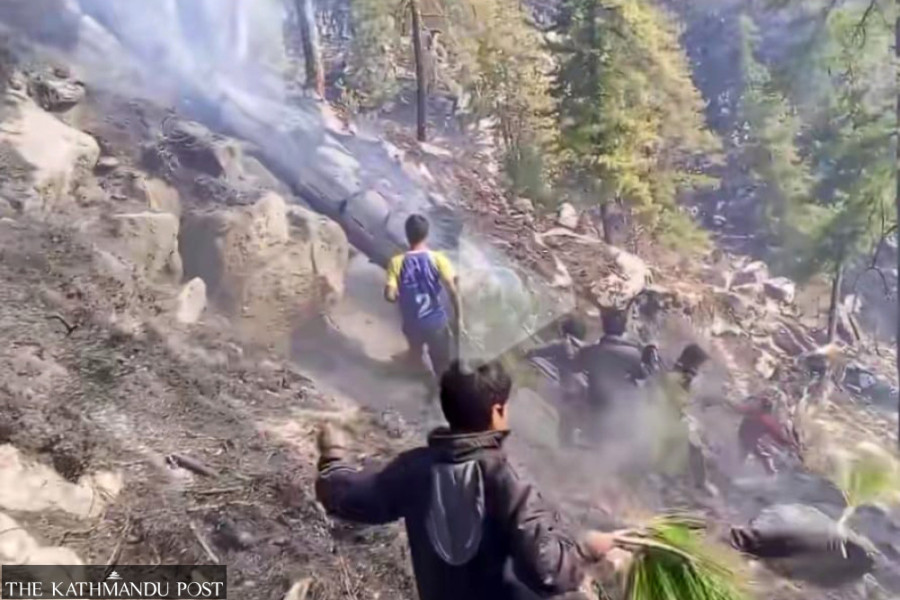
In the past three years, forest fires in the district have killed seven people and injured nine. Fifteen fire incidents have already been recorded since September. Locals using leafy branches to fight a fire in the Mahabaipatal Community Forest at Rachuli in ward 4 of Tilagupha Municipality in Kalikot on December 28. Tularam Pandey/TKP
A forest fire broke out on November 27 in Saldanda Community Forest of ward 4 of Khandachakra Municipality in Kalikot. The wildfire that started at around 5 am was brought under control only by 2 pm due to strenuous effort by the locals. The blaze—deliberately set with the hope that it would help grass sprout quickly for cattle, buffaloes, sheep and goats—destroyed around 5,000 saplings planted as part of community-led afforestation efforts.
“The dry ridge above Saldanda was finally turning green. The fire wiped out everything,” said Prabhananda Acharya, the ward 4 chair. He said the steep terrain made it extremely difficult to contain the flames, underscoring how vulnerable Kalikot’s forests are. “We had to struggle for about 10 hours to take the fire under control,” said Acharya.
The Saldanda incident is just a case in point. Within the past two weeks, fires were reported in several forests in the district—in Ambika Community Forest in ward 1 of Sanni Tribeni Rural Municipality on December 27, and in Mahabaipatal Community Forest in ward 4 of Tilagupha Municipality, on December 28. Similar incidents have occurred across community forests in Khandachakra, Shubha Kalika, Naraharinath, Tilagupha and Palata local units across the district.
Deputy Superintendent of Police Him Bahadur Khatri, chief of the District Police Office, said all these fires were set by the locals. “There is a strange custom of setting forests on fire in the hope that grass will grow faster,” he said. “There is very little awareness in communities about the damage such fires cause to forests, vegetation and wildlife.” He informed that another fire is still burning in the Rachuli area of Tilagupha on Wednesday as well.
The consequences have often been tragic. On March 15 last year, a fire erupted in Nabadurga Community Forest in Dadhagaun in ward 5 of Khandachakra. Fifty-year-old Nandaram Chaulagain, who had gone to graze his goats, and his 12-year-old daughter Hemanti, who followed later to deliver food to her father, were caught in the blaze. Both suffered severe burns and succumbed to injuries during treatment in Surkhet. Of Chaulagain’s 51 goats, 45 died and six were injured.
Police suspected the fire was caused when someone threw a matchstick while smoking, although a person charged in the case was later acquitted by the court.
Police say deliberate forest fires are common in Kalikot, a remote hill district of Karnali province. Police Inspector Bir Bahadur Sunar said many people intentionally burn steep slopes to encourage quick grass growth. “This is an unforgivable crime. People do not realise that a fire set on a slope can easily spiral out of control,” he said.
Two years ago, a blaze in Salghari Community Forest in ward 8 of Naraharinath, on the Kalikot-Achham border, killed Adan Singh Bista of Lalu and Jaipal Kami of ward 2 of Khandachakra while they were sawing timber. Both were critically burned while fleeing the fire and died on the way to Jumla for treatment.
As per the data available at the District Police Office in Kalikot, forest fires over the past three years killed seven people and injured nine others in the district. Since September this year, 15 fire incidents have been recorded. Police data also show that 59 livestock died in forest fires during this period. Locals admit that many of these fires were lit with the expectation of quicker grass regeneration.
Civil society leaders argue that weak law enforcement has allowed the practice to continue. “Setting fire to forests is not treated as a crime here. Such cases are often settled informally within villages,” said Sadananda Timilsena, a civil society leader from ward 5 of Khandachakra.
Authorities concerned say they are trying to change this mindset. DSP Khatri said police units across the district have conducted 56 awareness campaigns through 19 police posts under community-police partnerships over the past one year. “We have instructed all units to respond immediately to fire incidents and to intensify awareness campaigns,” he said.
The Division Forest Office also claims that it has been working at its best to minimise the incident of forest fires. Dharma Raj Upadhyaya, chief of the office, said community forest user group leaders and members have been contacted by phone and urged to remain vigilant. “There is a tendency of burning forest as a normal act,” he said, adding that people also set fires to protect crops from wild animals such as wild boar, porcupines and monkeys.
Under community forest laws and operational plans, penalties range from warnings and fines to removal from user groups. “If user groups fail to act, action can be taken under the Forest Act,” warned Upadhyaya.
Section 49 of the Forest Act 2019 states up to three years imprisonment, a fine of Rs60,000, or both, for those found guilty of setting forest fires. However, the Division Forest Office in Kalikot has yet to file a single case under the act.
Wildfires are common during the dry season in Nepal, peaking between April and May. They spread across hundreds of forests throughout the country, including in community-protected areas. However, not all of them make it to government records.




 25.92°C Kathmandu