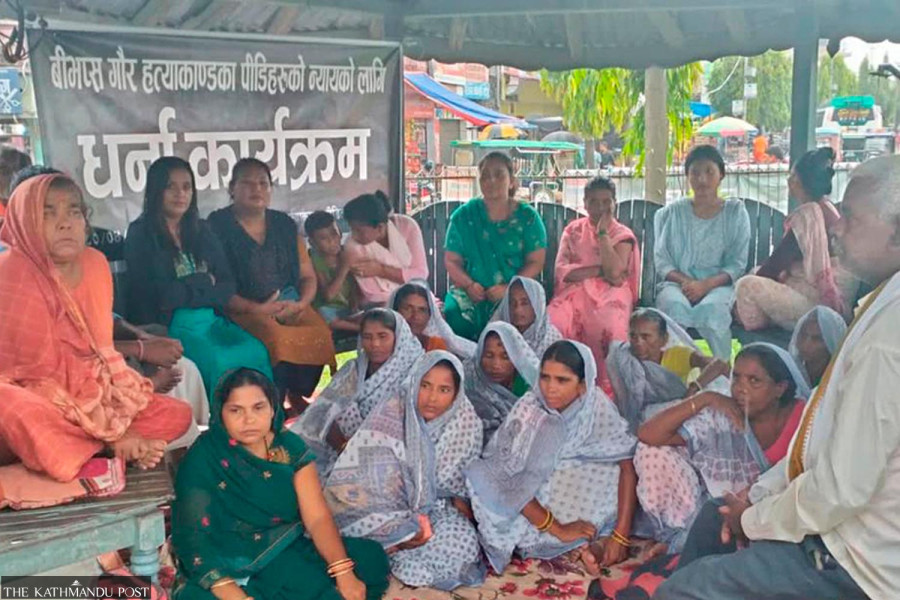
Last month, Supreme Court issued the full text of its 2023 verdict in a case filed by victims and relatives of the massacre and directed police to start investigation. Kin of Gaur massacre at a sit-in demanding justice for their loved ones, in this undated photo. Post file photo
Possibly for the first time in nearly two decades, a glimmer of hope is visible on the face of Tribhuvan Sah, aged 50, of ward 8 of Baudhimai Municipality in Rautahat district. Sah was among those seriously injured in the violent clash that shook Gaur on March 21, 2007—one of the deadliest political confrontations in the post-insurgency era in the Tarai. For 19 long years, he has knocked on the doors of the district administration, police headquarters and Kathmandu’s power corridors, demanding justice for the victims.
Now, following a landmark order from the Supreme Court directing police to investigate the case, Sah believes justice may finally be within reach. “I watched my friends collapse right in front of my eyes that afternoon. I thought I would not survive either. I don’t want to remember that horrific day. But after 19 years, the Supreme Court’s order has revived my faith that justice is not dead,” said Sah.
The Gaur incident, which occurred during a period of intense political polarisation in Madhesh, left at least 27 people dead and dozens injured after clashes erupted between cadres of the then Madhesi Janadhikar Forum (now Janata Samajbadi Party-Nepal) and the then CPN (Maoist), the party that led the decade-long (1996-2006) insurgency. The violence erupted during rival mass meetings in Gaur, the district headquarters of Rautahat.
Despite the scale of the bloodshed, investigations into the killings were stalled for years amid political pressure, administrative inertia and fear within the police force. Families of the dead and injured repeatedly alleged that the case was buried to protect influential political figures.
Sah himself was attacked with bamboo sticks during the clash and sustained serious injuries to his back and legs. “They rained blows on me. I ran for my life and somehow reached the Gaur Hospital,” he said.
Disillusioned by what he describes as a “mockery of investigation” after the incident, he began a relentless campaign for justice in 2008.
Along with other victims, Sah filed a complaint naming 130 individuals on charges of murder. Although the complaint was formally registered 51 days after the incident, it was never acted upon. Based on the complaints, seven separate files were shelved, never to be reopened.
For years, Sah travelled between Rautahat and Kathmandu, submitting memorandums, staging sit-ins, meeting prime ministers and home ministers, and organising demonstrations. “We protested, fasted and pleaded. Still, nothing moved,” he said.
Among those marching alongside Sah was Rupsagar Upadhyaya, whose husband Naradheshwar Upadhyaya, the aged 40, of Saramujhawa in ward 8 of Baudhimai Municipality, was killed in the violence. Now the coordinator of the Gaur Incident Struggle Committee, she says the Supreme Court’s directive has finally opened a door long kept shut. “My husband was killed in front of others, yet we waited 19 years for the state to even begin an investigation. It is late, but at least the process has started,” she said.
The breakthrough came after victims and relatives approached the Supreme Court in May 2023, arguing that police had failed in their legal duty to investigate despite the registration of complaints. In September 2023, a joint bench of Justices Til Prasad Shrestha and Nityananda Pandey issued a writ of mandamus ordering police to immediately proceed with the investigation.
In its full verdict, the court stated that once a complaint is registered, the police are legally bound to investigate. Refusing to register a complaint or failing to act after registration, the court said, is not permitted under the law.
The ruling has highlighted how politically sensitive cases such as the Gaur killings and the Rajpur bomb blast (in which victims were thrown alive into a brick kiln in Rajpur, Rautahat, to destroy evidence of bombmaking ahead of 2008 Constituent Assembly elections) were systematically suppressed despite serious allegations and findings by national bodies.
The District Police Office in Rautahat initiated investigation into the case after it received the Supreme Court’s full text on December 22, 2025. Rautahat police say they have received the full text of the verdict and begun internal preparations. Superintendent of Police Rabin Karki said that given the age and sensitivity of the case, assistance from the Central Investigation Bureau (CIB) would be sought.
“We have already started the investigation process at our level. Earlier, there was sluggishness. Now statements are being recorded and questioning has begun,” said Karki.
Police have already taken statements from victims’ families. According to investigation officers, they plan to contact other victims and witnesses as soon as possible.
The Supreme Court order clears the way for investigation into allegations against 130 individuals, including senior political figures. Those named include Upendra Yadav, then chairman of the Madhesi Janadhikar Forum and now chair of Janata Samajbadi Party-Nepal; former Constituent Assembly members; former mayors; and local leaders from multiple parties.
Some of the accused named in the complaint and in reports by the National Human Rights Commission (NHRC) have since died. According to leaders of the Loktantrik Samajbadi Party, among the deceased are former judge Baliram Singh Kunwar, former Gaur mayor Gauri Shankar Yadav, and former district development committee chair Chandrika Singh.
The NHRC had earlier concluded that the conduct of Madhesi Janadhikari Forum cadres contributed significantly to the scale of casualties. A separate probe committee formed after the incident also pointed to failures by political leadership in preventing escalation.
The revival of the case has reignited political tensions in Rautahat. Two months ago, supporters of some of those named staged daily torch rallies in Gaur, arguing that innocent people were being targeted out of political vendetta.
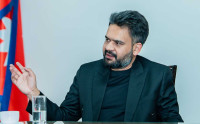
Upendra Yadav has questioned the rationale of reopening investigations nearly two decades after multiple inquiries, including those involving international human rights organisations.
“What does it mean to investigate again after 19 years? Even so, I will cooperate with the investigation,” he said in an interview with Kantipur, The Kathmandu Post’s sister publication. Yadav insists he was in Kathmandu on the day of the incident and denies any involvement. He claims the violence erupted after Maoist cadres attacked a Forum meeting.
“This was unfortunate, but I had no role in it,” he said.
Victims like Sah and Upadhyaya are hopeful to get justice albeit very late. “If the intention is clean, justice will surely follow. Let us see what happens now,” said Sah.




 17.6°C Kathmandu