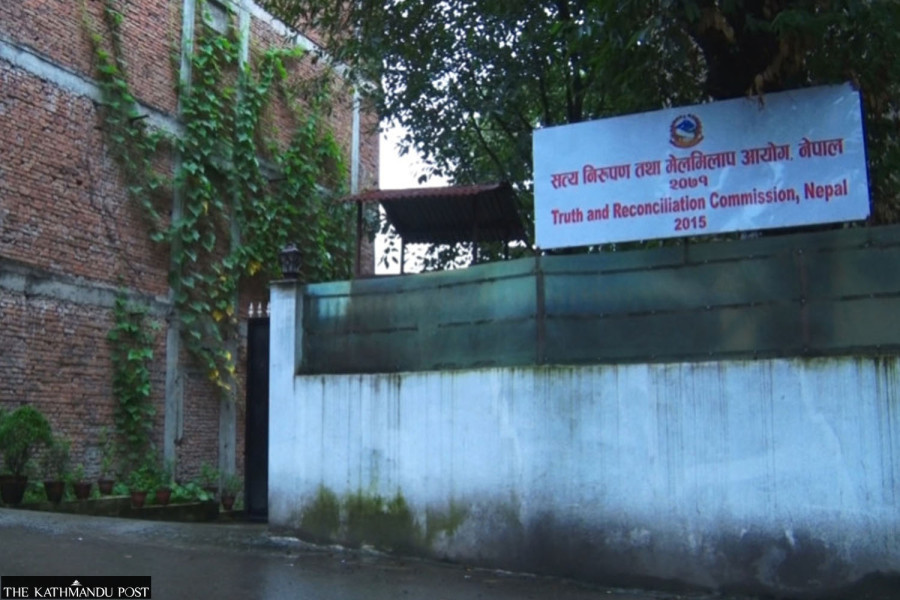
Despite strong reservations from a section of conflict victims, the government is moving ahead with endorsing the regulation to the Enforced Disappearances Enquiry, Truth and Reconciliation Commission Act.
The Truth and Reconciliation Commission and the Commission of Investigation on Enforced Disappeared Persons have been struggling to commence investigation into the thousands of complaints in the lack of regulations.
Nearly one-and-a-half years after the Act was promulgated, the Ministry of Law, Justice and Parliamentary Affairs on Sunday held consultations with the representatives of victims from the decade-long Maoist insurgency.
A group of victims’ representatives registered strong reservations during the consultation, which was attended by Law Minister Anil Kumar Sinha. Some of them even resorted to sloganeering saying that the government formed after the Gen Z movement was treading an autocratic path.
A group of victims has been submitting memoranda to the government, drawing attention to their demands and seeking an environment for dialogue to conclude the transitional justice process.
“We believed that the interim civil government, formed on the foundation of an unprecedented movement, would listen to our legitimate concerns and make concrete efforts to resolve them. However, this government is acting as if no problem exists,” said Gopal Shah, chairperson of the Conflict Victims Common Platform. “The prime minister and her ministers have been ignoring us, even refusing to meet.”
The disgruntled victims say the government, instead of trying to win the trust of the conflict-affected people’s community, was bulldozing the process.
Stating that they have no trust in the present commissions, they have been demanding termination of the chairpersons and members of both the commissions. The erstwhile KP Sharma Oli government, amid reservations of the victims’ group, in May 2025 appointed five-member teams in both the commissions.
Ignoring their reservations, the incumbent government is preparing to endorse the regulation next week. “Not everyone is against the regulation. We received constructive feedback from a number of victims while a few resorted to protests and sloganeering," said Man Bahadur Aryal, joint secretary at the ministry. The ministry is preparing to forward the regulation to the Cabinet next week and will, most probably, get it endorsed within a few days.
“The government will make an effort to accommodate most concerns of the stakeholders but the process will not be stalled as demanded by some,” he said.
The preparation for the regulations has been ongoing for months. According to the commissions, they forwarded draft regulations to the ministry in August, before the Gen Z protest, with their feedback. Both commissions need separate regulations to start detailed investigations.
Both commissions are citing the lack of regulations to be one of the major reasons for the delay in launching an investigation into the complaints they have received.
The victims, across the nation, lodged 15,191 new complaints at the TRC after it was reconstituted in May, taking the total to 78,909. It already had 63,718 cases pending. Likewise, the disappearance commission has received 68 new cases. It has around 2,500 cases pending.
After finalising the regulations, the law ministry is also working to give a final shape to the organisation and management (O&M) surveys that estimate the number of staff required in both commissions are being presented to the finance ministry, said Aryal.
The TRC’s survey, finalised by the Nepal Administrative Staff College, envisages increasing its staff at the central office from the existing 89 to 124, and adding 240 positions in districts for the investigations.
The commission plans to mobilise 60 teams, each comprising four experienced investigators, to various districts for detailed investigations. Each group will have an under secretary, two section officers, and a non-gazetted first-class staffer. The disappearance commission also plans to add around two dozen staff to its already approved workforce.
The office bearers at the commissions say they are not in a position to further delay the investigation. The revised Act has given four years to both the commissions to complete their work. As around eight months have passed just in receiving new complaints, they effectively have less than three-and-a-half years to accomplish their job.
Officials at the commissions say they have completed most internal preparations to start detailed investigations. They have already developed standard operating procedures for truth-seeking and hearings, to keep complaints on hold, and to carry out memorialisation work in the name of victims.
Binod Ghimire covers parliamentary affairs and human rights for The Kathmandu Post. Since joining the Post in 2010, he has reported primarily on social issues, focusing on education and transitional justice.




 17.6°C Kathmandu