Engineering students are designing a settlement to suit Chepang way of life
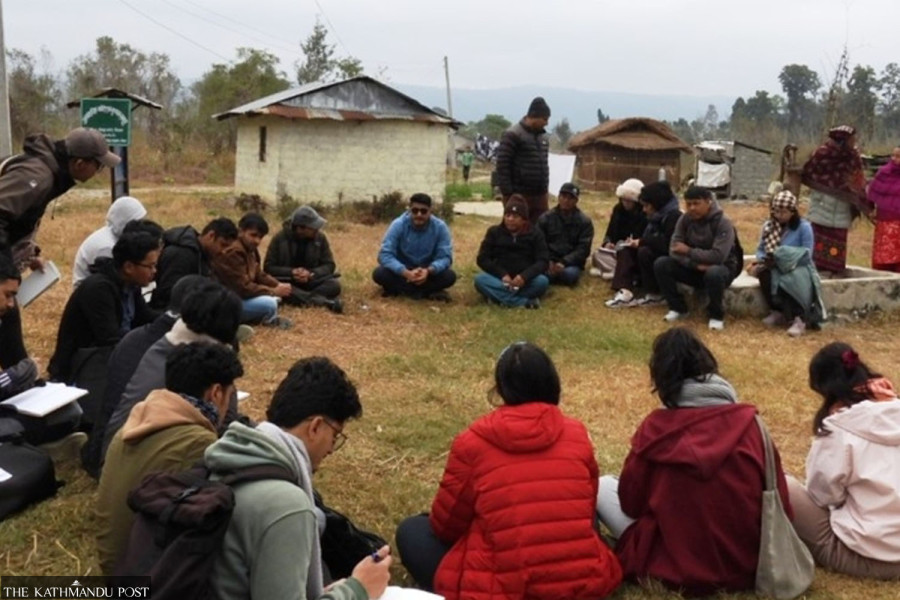
A team from the Tribhuvan University’s Pulchowk campus is in Chitwan to build homes for a 57-household settlement. Bagmati provincial government is funding the project.Students of TU’s Pulchowk Campus during a discussion with the local Chepang representatives and officials of the Urban Developmentand Building Office in the Chepang settlement in Parui in Madi Municipality in this recent photo. Ramesh Kumar Paudel/TKP
As the Bagmati provincial government moves to develop an integrated model settlement for the Chepang community, a group of engineering students from Tribhuvan University’s Pulchowk Campus has taken up the task. They have been working to design the settlement ensuring that the houses are not just shelters but spaces where people can live with dignity, maintain their culture, and sustain their livelihoods.
The initiative focuses on a settlement near the Parui stream in ward 8 of Madi Municipality. There are 57 households and 50 of them from the Chepang community. Surrounded by flood-prone terrain and wildlife threats (the area abuts the Chitwan National Park), the families have long struggled with insecurity, poverty and the absence of basic services. Now, the engineering students are working directly with residents to understand what kind of settlement would genuinely suit their lives.
“Home is not just a structure that protects from sun and rain,” said Arjun Timsina, an eighth-semester architecture student involved in the fieldwork. “It must reflect culture, emotion and daily livelihood. If people do not emotionally connect with a house, they will never truly live in it.”
Timsina and 23 other students, including ten women, have been visiting each household, documenting living conditions and listening to residents’ experiences. Their goal, according to him, is to design houses that support both cultural identity and economic survival.
Before relocating to the Paruikhola area, the families lived in the Kusumkhola area, inside Chitwan National Park. “Every year the park authorities sent us notices saying we were living illegally. Floods destroyed our fields again and again. Finally, we had no option but to leave,” recalled Kamal Chepang, one of the settlers.
About 160 households once lived in the Kusumkhola area. Some moved to Pyauli, others to Shivadwar and Raidanda, while 57 families settled along the Parui stream bank. Initially, their homes were built right beside the stream. After repeated flooding, an embankment was constructed and the settlement was shifted slightly inward. “Even now, the fear of floods remains,” said Kamal.
Electricity reached the settlement only two years ago. The settlers used to drink water from the stream. Drinking water is now available through 12 public taps and two tube wells, but sanitation remains inadequate. There are still no proper toilets.
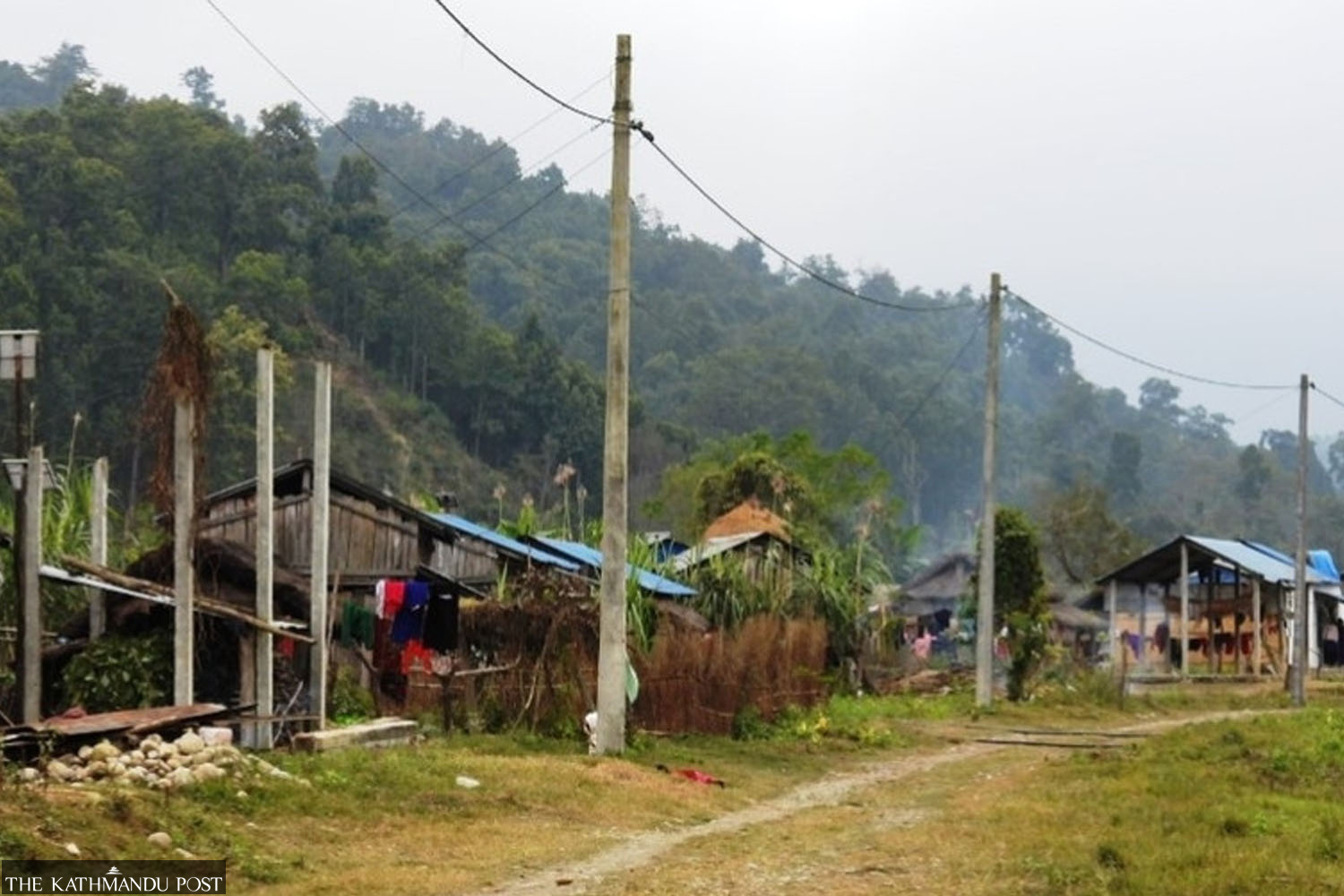
“Most houses are made of wood. During winter, cold winds pass straight through, and it becomes very hard to sleep,” said Anjali Chepang, another resident. Only five houses are built with bricks or concrete; the rest are temporary wooden structures. Livelihood opportunities remain limited. Most families rely on daily wage labour or small plots of marginal land. “Without a steady income, how can we build strong houses?” Kamal asked.
According to the people’s representatives, the local government has gradually improved infrastructures in the settlement. “Electricity and water have reached the settlement, and other works are ongoing,” said Chandra Kumari Baniya, chief of ward 8 of the municipality. She, however, acknowledged that economic insecurity remains a major challenge.
Chepang homes in Parui. Ramesh Kumar Paudel/TKP
The lack of land ownership continues to be a critical concern. According to Nepal Chepang Association chair Govinda Ram Chepang, earlier efforts to develop the area stalled because residents did not have land ownership certificates. “This time, the settlement plan is specifically for Parui,” he said, stating that the sudden dissolution of the Land-related Problem Resolution Commission in September created uncertainty. The commission was later reinstated by the court.
Abhishek Budhathoki, an engineer from the Bagmati Province Urban Development and Building Office, said each house under the model settlement would receive up to Rs400,000 in support. “Students are studying how people live here so that the houses match their lifestyle,” he added.
Drawing on lessons from earlier state-led housing projects that failed, the students are taking a participatory approach. “Past projects built houses without understanding how Chepang families live. This time, we are studying their daily routines—where they cook, how they store firewood, where livestock are kept, and how elders and children use space,” said Timsina.
According to Timsina, culturally significant elements such as chiuri trees (butter trees), which hold economic and symbolic value for the Chepang, could be incorporated into settlement planning. They are suggested to plant chiuri trees on the stream banks if they suit the climate and geography.
“The settlement would be planned to suit the daily routines of its residents, as some people go to work in the morning while others work during the day. Spaces would also be created where elderly people and children could spend time comfortably” said Timsina. “If someone plans to raise buffaloes, the house must be designed accordingly. We need to think about where the cattle will be kept, how manure will be managed, and whether there is any possibility of selling milk. We will design the houses and the settlement by carefully considering all these factors.”




 13.87°C Kathmandu
1.jpg)