Ex-home minister Lekhak denies ordering Sept 8 killings
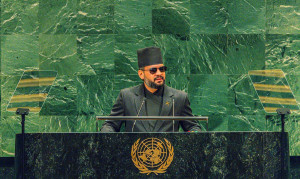
Security agencies, not ministers, decide use of force during protests, former home minister tells inquiry. Ramesh Lekhak speaks to media after testifying to the Karki-led commission on Monday. Deepak KC/TKP
Former Home Minister Ramesh Lekhak has denied any role in the September 8 killings and stated that the unprecedented nationwide arson and vandalism on September 9 was a premeditated conspiracy that needs a thorough investigation.
On Monday, appearing before the Gauri Bahadur Karki-led inquiry commission that is investigating the brutal crackdown of the September 8-9 Gen Z protests, Congress leader Lekhak said the violent acts of September 9 were planned and deliberate.
On September 8, the first day of the Gen Z movement, over a dozen unarmed youths were killed by police outside the federal parliament. The following day, the country saw widespread destruction. Vital infrastructures were set on fire including Singhadurbar, Supreme Court, parliament building, and numerous private and public properties.
Following the death of 19 protesters on September 8, Lekhak resigned from his post. Submitting a six-page statement to the commission, Lekhak said that the September 9 incidents were beyond what any Nepali could imagine.
“After my resignation, the violent incidents on September 9 happened that were directed against national existence, self-respect, and democracy, which a patriotic Nepali could hardly imagine,” said Lekhak, “I cannot imagine that any Nepali mind could dare to burn to ashes the state’s major institutions—Singha Durbar, the Supreme Court, the parliament building, and the President’s residence.”
Lekhak stated that the attacks on representative institutions embodying the principle of balance and separation of powers in a democracy were completely beyond the thinking and planning capacity of the Gen Z generation.
“This was indeed a planned conspiracy. My assessment is that this was a premeditated attack on the nation and democracy.”
The former home minister added that the September 8-9 incidents were not merely the result of momentary anger or impulse. “I don’t see any basis to say that the destruction that occurred simultaneously across the country was merely the product of anger and impulse arising from the immediate incidents,” he said.
While stating that the demands raised by the Gen Z generation were legitimate, Lekhak in his written statement emphasised that the incidents carried out in the name of the Gen Z movement should be thoroughly investigated, and that anyone involved must be held accountable.
After appearing before the inquiry commission, Lekhak organised a press conference and reiterated the same position.
A member of the inquiry said that Lekhak will be summoned again.
Lekhak said that the September 9 destruction must be viewed separately from the youths’ demands, and that whoever is involved in criminal acts must be punished.
During the press conference and in his statement, Lekhak said that he too suffered significant losses due to the Gen Z movement, including the loss of his mother.
His two houses—one in Mahendranagar and one in Kathmandu—were set on fire and destroyed on September 9. “The houses at both places were built not by me personally, but by my father and from ancestral property,” said Lekhak, adding that the pain of seeing his ancestral property reduced to ashes was immense.
“On September 9, in order to protect her from attacks by demonstrators, my elderly mother—who was critically ill and dependent on oxygen—had to be taken to the hospital. She was left without oxygen for a long time, and she passed away a few days later,” he said at the press conference.
He also stated that nearly 5,000 books and important historical documents at his Kathmandu home were burned and destroyed, including reports and collections.
The then home minister who directly oversaw the overall security situation of the country also claimed that he did not give any order to use force during the Gen Z protests.
During the press conference, he gave a detailed account of the series of security related meetings at different levels. “No law grants the home minister the authority to issue directives regarding the use of force. I did not give any such order. The home minister does not have the authority to issue either written or verbal orders for the use of force, and in practical terms, such orders are not given.”
He explained that a person providing political leadership to the government has neither the legal responsibility nor the technical knowledge to decide whether force should be used, how much, or under what circumstances.
Decisions regarding the use of force are analysed by the security agencies deployed on the ground, and neither the home minister nor the prime minister issues such orders, he told the media.
“The prime minister or a minister does not tell anyone to use force to this extent or in this manner,” Lekhak said. “During protests, while maintaining law and order, decisions about where force is required, what the situation demands, how to control the protest, how much force to use, how to use it, and under what circumstances force should be applied are determined by the security agencies deployed at the time, based on the prevailing situation and objective conditions.”
He also maintained that the law grants decision-making authority in such matters to the security agencies and designated officials at the local level.
A government panel assessed the damage caused during the Gen Z movement and submitted a report on December 11. It put the total death toll at 77. It said a total of 2,429 people were injured, of whom 17 were under 13 years of age, while 1,433 were between 13 and 28.
The report estimated total physical damage at Rs84.45 billion. A total of 2,168 government and public bodies were affected, with 2,671 buildings damaged, resulting in losses of around Rs39.31 billion.
According to the report, 12,659 vehicles were damaged, causing losses worth Rs12.93 billion. Overall, losses in the government and public sector amounted to Rs44.93 billion, the private sector Rs33.54 billion, and community and other sectors Rs5.97 billion.




 27.61°C Kathmandu