Local youths take the lead to protect vanishing wetlands and birds
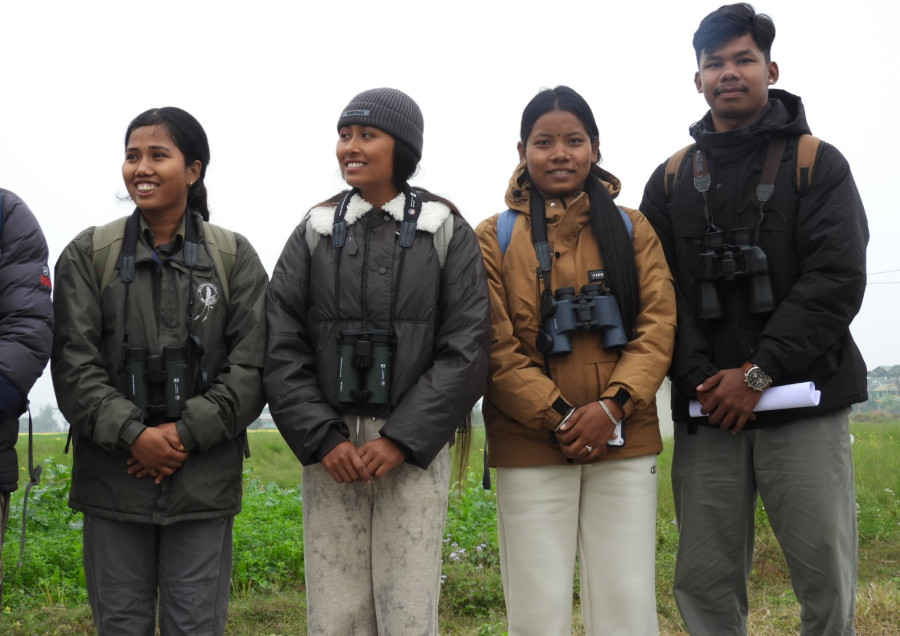
Twenty youth ‘champions’ are monitoring migratory birds and their habitats across Chitwan and Nawalparasi East, and engaging communities in conservation. Youths with binoculars involved in monitoring migratory birds. Ramesh Kumar Paudel/TKP
As winter tightens its grip on the plains of Chitwan, flocks of migratory aquatic birds from the northern hemisphere once again arrive along the Narayani and Rapti rivers, seeking refuge in wetlands that have sustained life for generations.
Every year, the number and variety of these birds fluctuate, raising growing concern among conservationists. This winter, a group of trained local youths—known as “champions”— are working to understand why these changes are happening and what can be done to protect the fragile ecosystems on which the birds depend.
Among them is Lal Bahadur Bote, a nature guide from ward 15 of Kawasoti Municipality in Nawalparasi East. For years, he has guided tourists through Chitwan National Park and its buffer zones. Now, he is also part of a 20-member team of youth from Nawalparasi East and Chitwan tasked with monitoring migratory birds and their habitats.
Bote was recently seen at Budhaulikuna Ghol (wetland) near Kawasoti, carefully recording bird sightings, vegetation patterns and changes in land use with his senior conservationists and fellow friends. The team has documented 32 species of local and migratory birds in the area by Sunday. The wetland is not only a crucial habitat for birds but also a lifeline for nearby communities.
Even in mid-winter, water from the ghol irrigates surrounding farmland, where farmers are already preparing fields for the next paddy season.
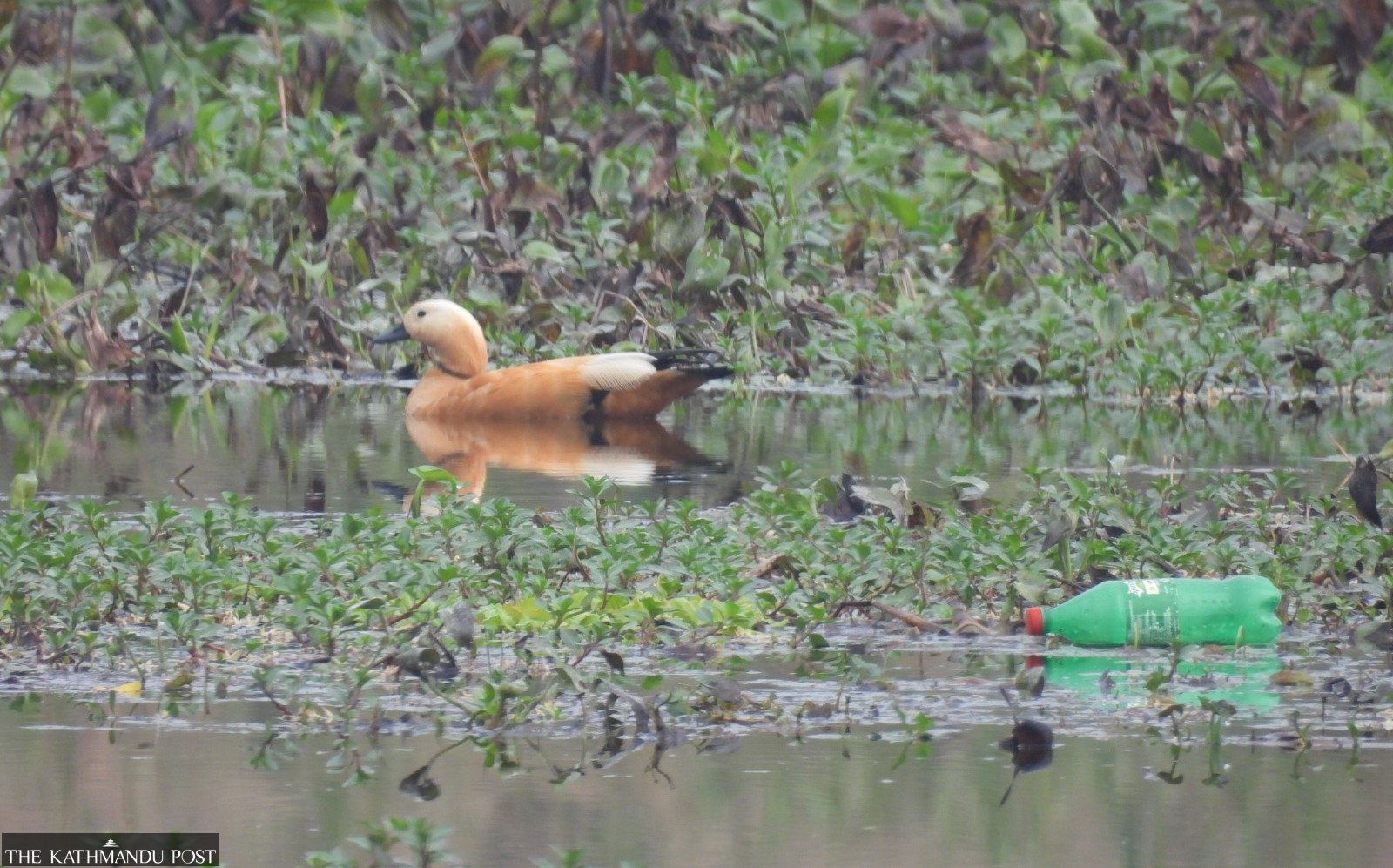
Scarecrows made from plastic sheets and sacks do little to stop the birds from foraging on newly sown fields. Around the wetland, large birds such as Asian openbill stork (locally called Ghungiphor garud) and lesser adjutant (Bhundiphor garud) can be seen, while flocks of migratory ruddy shelducks glide across the water. Plastic waste floating near the birds and locals cutting grass nearby paint a stark picture of the fragile balance between livelihoods and conservation.
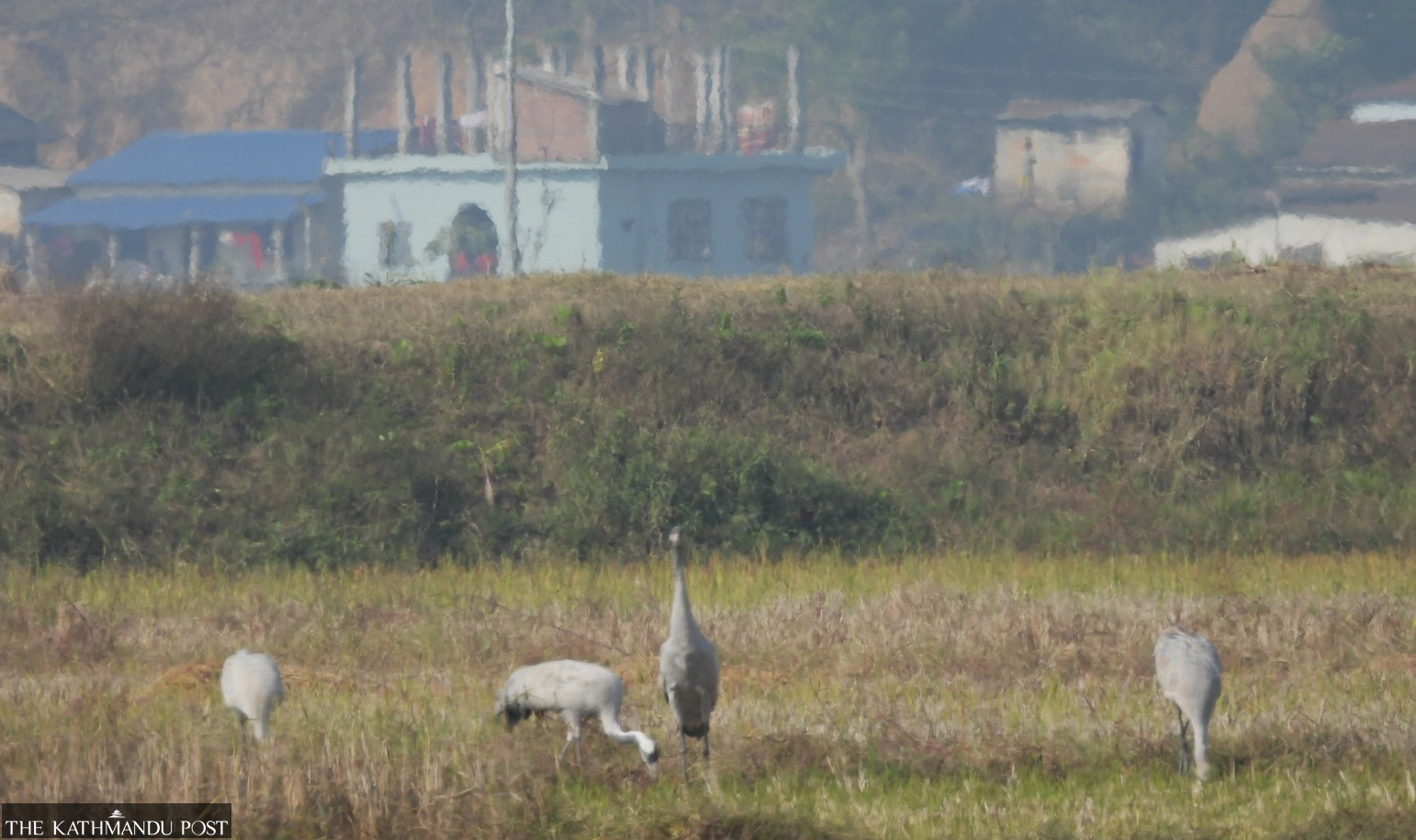
Common cranes foraging on a freshly-harvested ricefield to the south of Budhaulikuna ghol near Kawasoti in East Nawalparasi last week. Ramesh Kumar Paudel/TKP
Located barely two kilometres from the East-West Highway, Budhaulikuna Ghol lies between forest patches and expanding settlements. Residents from nearby villages such as Laukhani and Kawasoti visit daily for fodder, grazing and water. “We have all seen the birds decreasing over the years,” said Chhabilal Gurau, a local resident. “The wetland itself is shrinking.”
Gurau and Anita Pariyar from the settlement on the edge of the forest had also come there to cut grass for their cattle. They said they had all witnessed the arrival of birds over the years, but also felt that the wetland has been gradually shrinking.
Many locals believe that protecting the wetland ensures better irrigation and farming outcomes, yet few fully understand how human activity affects migratory birds. This knowledge gap is what the “champions” initiative aims to address.
The programme is part of the Tarai Arc Landscape (TAL) initiative implemented by the World Wildlife Fund for Nature-Nepal (WWF-Nepal) in partnership with the government. According to Prem Paudel, the eastern cluster in-charge of TAL, the youth were trained to monitor birds, wetlands and surrounding human activities.
“They are called champions because they have deeper knowledge about bird behaviour, habitats and conservation methods, and they share that knowledge with their communities,” said Paudel.
A ruddy shelducks, orange-brown waterfowl known as chakhewa in Nepali, gliding on the Narayani River. Ruddy shelducks are migratory birds that visit Nepal during winter. Ramesh Kumar Paudel/TKP
Nepal lies along a major migratory flyway, and rivers flowing through Chitwan National Park serve as crucial wintering grounds for many species. WWF-Nepal conservation officer Rajendra Suwal said that beyond counting birds, understanding habitat conditions is now essential. “We are documenting water availability, vegetation cover, grazing pressure and extraction of sand and gravel,” he explained. “Only long-term monitoring can guide effective conservation planning.”
Among the champions is Chandra Mahato, a nature guide from ward 10 of Kawasoti who has been spreading awareness among the local communities and schools for the past one year. She says she is trying her best to make people aware about the importance of wetlands conservation.
“Birds may survive without humans, but humans cannot survive without birds,” said Bote, echoing a sentiment shared by many conservationists.
Senior conservationist DB Chaudhary added that birds are not only ecological indicators but also a foundation for nature-based tourism. “Protecting birds strengthens both the environment and the local economy,” he said.
According to Paudel, 20 youths—including nine women—are currently active across Chitwan and Nawalparasi East. In areas such as Kalabanjar, Pithauli, Lamichaur and Gundrahi-Dhakah, they regularly record sightings and engage communities.
In Dibyanagar of the Kalabanjar area, for instance, common cranes are seen in paddy fields, though numbers have dropped sharply. “Five or six years ago, we recorded over 200 common cranes here. This year, we saw only 26,” said Manesh Limbu, a Meghauli-based nature guide in Chitwan.
Inside Chitwan National Park, wetlands that once supported large bird populations are increasingly choked by invasive plants and sedimentation, according to park information officer Abinash Thapa Magar. Outside the park, the rising use of pesticides, fertilisers and plastic waste is worsening the situation.
“The arrival of migratory birds is a sign of a healthy environment. If their numbers increase, it means our ecosystems are recovering. If they decline, it is a warning we cannot ignore," said Thapa Magar.




 14.81°C Kathmandu
1.jpg)