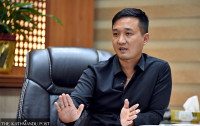
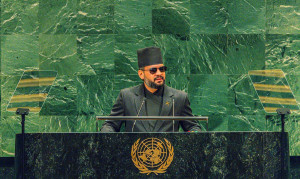
Former home minister Ramesh Lekhak has said that he accepted full moral responsibility for the deaths and other losses of September 8 and therefore resigned accordingly. He, however, claimed that the incidents of September 9 were not a spontaneous escalation but a planned conspiracy against the nation and democracy.
Testifying before the commission investigating the incidents of September 8-9 Gen Z protests, Lekhak said he had stepped down immediately after the September 8 tragedy because, as the political head of the home ministry, he felt a deep personal and institutional responsibility.
However, Lekhak drew a sharp distinction between the peaceful Gen Z protest of September 8—which, according to him, was later infiltrated and hijacked—and the extensive arson and attacks that took place the next day.
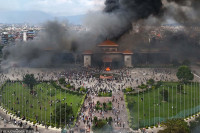
“The violent incidents of September 9 were against national integrity, dignity and democracy. No patriotic Nepali could even imagine torching Singha Durbar, the Supreme Court, Parliament, and the President’s Office,” he said, calling the events “a planned conspiracy” and “a deliberate attack on the nation and democracy”.
The inquiry commission, led by former judge Gauri Bahadur Karki, on Tuesday summoned Lekhak, who was home minister during the anti-corruption protests that left 77 people dead and scores injured.
Lekhak recalled that the Gen Z protesters’ demands—anti-corruption, good governance and freedom of social media—were legitimate and widely accepted. He said he had convened a meeting of the Central Security Committee on the evening of September 7, where all security agencies agreed to maintain law and order and avoid casualties.
“I clearly instructed for no casualties, maximum caution, and coordinated security,” he said, adding that there was no decision or plan to use excessive force.
Then home minister Lekhak said that the September 8 protest turned violent after “extensive infiltration” by anti-democratic elements. Once violence erupted near New Baneshwar, Gen Z leaders themselves urged protesters to return home, saying their peaceful movement had been hijacked.
He said the September 9 destruction—including the burning of key state offices, private property, party buildings, police units and business establishments across the country—could not have resulted from “momentary anger.” Such synchronised attacks, he said, suggested preparation, planning and intent. “These were not spontaneous acts. These were organised assaults on the nation’s institutions,” he said.
Lekhak stressed that the commission must closely investigate who infiltrated the protest, who planned the September 9 attacks, and who executed them. He added that while youth demands must be acknowledged, criminal acts must be treated separately and prosecuted.
He also outlined the policy and legal reforms he had initiated during his tenure—new laws for Nepal Police and Armed Police Force, regulation of foreign-funded NGOs and INGOs, and improvements in citizenship, prison management and administrative services—saying the ministry had achieved top performance ratings during that period.
The former minister also questioned the legal and moral rationale behind limiting his movement. The then prime minister KP Sharma Oli and Lekhak have been barred from leaving the Kathmandu Valley, citing their need for inquiry by the commission.
Lekhak said he appeared before the commission because it was his legal and moral duty. “I offer heartfelt condolences to those who lost their lives and sympathies to their families. The truth must come out—for the country and for democracy,” he concluded.
The Karki commission, which was formed in the third week of September, was given three months to study and submit the report. The government extended the deadline by one more month earlier this month.




 23.25°C Kathmandu