Former Home Minister Ramesh Lekhak has said that he will appear before the inquiry commission that is investigating the deadly crackdown of the Gen Z protests of September 8 and 9 to record his statement.
“I am going to appear before the commission to record my statement on Monday,” he told reporters at the Nepali Congress party headquarters on Thursday.
On Wednesday, several Nepali Congress leaders during the party’s meeting had advised Lekhak to appear before the inquiry commission to record his statement. The commission, led by former judge Gauri Bahadur Karki, on Tuesday sent a summons to Lekhak, who was home minister during the anti-corruption movement that left 77 people dead and scores injured. He resigned on September 8 after 17 unarmed youths were shot dead by police outside the federal parliament.
Lekhak’s decision comes a day after a Nepali Congress leader told the Post that party chief Sher Bahadur Deuba had been pressuring him not to testify.
“The commission formed to investigate the incidents of September 8 and 9 has called me to gather information about the events. I have decided to go to the commission,” said Lekhak. He said that the commission had called him for Friday, but that he would go only on Monday.
The commission has begun summoning political leaders after completing the interrogation of officials who held administrative and security responsibilities during the crackdown. It has so far interrogated over 150 officials.
The commission said it is also set to send a summons to UML chair and then prime minister, KP Sharma Oli.
The government had formed a three-member inquiry commission under retired judge Karki to investigate the excessive use of force and other violent incidents during the Gen Z movement.
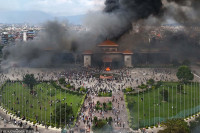
The youth-led uprising, organised against corruption, bad governance and nepotism, toppled the KP Sharma Oli-led government. Oli was ousted on the second day of the movement, on September 9, and an interim government led by former chief justice Sushila Karki was formed on September 12.
On Wednesday, the inquiry commission’s spokesperson Bigyan Raj Sharma had told the Post that Lekhak would appear before the commission on Monday. Sharma also told the Post that the commission would also issue a summons to Oli, the UML chief and former prime minister. However Oli has remained reluctant, and on several occasions in the past few weeks, has termed the commission as illegal and unconstitutional.
Oli's refusal to testify with the commission was also discussed at a meeting called by President Ramchandra Paudel on Tuesday with Prime Minister Sushila Karki. President Paudel had called a meeting of the top leaders of the major political parties where Oli, Nepali Congress President Sher Bahadur Deuba and Coordinator of the Nepali Communist Party, Pushpa Kamal Dahal were present. According to a source at the President's Office, a middle course was proposed for Oli if he continues to refuse to appear before the commission. It was discussed that the commission chair and members could visit Oli’s residence in Gundu, Bhaktapur to record his statement if he declines to appear at the commission’s office at Singha Durbar. However, no official decision has been made yet on whether the commission chair and members will visit Oli’s residence.
A government panel assessed the damage caused during the Gen Z movement and submitted a report on December 11. It put the total death toll at 77, including 20 on September 8, 37 on September 9, and another 20 in the days that followed. It said a total of 2,429 people were injured, of whom 17 were under 13 years of age, while 1,433 were between 13 and 28.
The report estimated total physical damage at Rs84.45 billion. A total of 2,168 government and public bodies were affected, with 2,671 buildings damaged, resulting in losses of around Rs39.31 billion.
According to the report, 12,659 vehicles were damaged, causing losses worth Rs12.93 billion. Overall, losses in the government and public sector amounted to Rs44.93 billion, the private sector Rs33.54 billion, and community and other sectors Rs5.97 billion.
Of the government-related losses, 68 percent occurred at the federal level, with provinces accounting for 10 percent and local governments 22 percent.




 23.25°C Kathmandu