Tarai cold hits the poor the most. No relief in sight
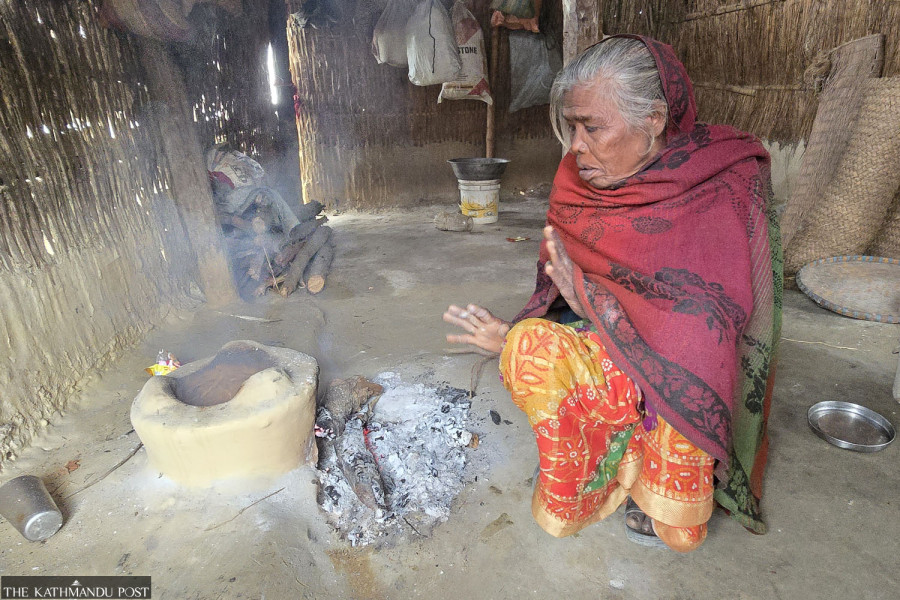
Dalit settlements in Dumariya, Chetanagar, Santapur, Jugauliya, Katahariya, Ishanath, Gaur and Samanpur in Rautahat district badly affected. Devratiya Devi Majhi warms herself by the hearth in her flimsy bamboo hut in Chetanpur, Rautahat on a cold Saturday morning. Shiva Puri/TKP
Approximately six kilometres south-east of the East-West Highway lies Chetanagar village, where a small thatched hut on the edge of the settlement tells a stark story of winter hardship.
Sixty-year-old Devratiya Devi Majhi, a Musahar woman, shivers under a thin straw mat, lying on the bare ground lined with straw and old sacks. “The cold has been unbearable. She has nothing to cover herself with. She spends the night wrapped in a straw mat. It is miserable,” said Bir Bahadur Shrestha, Devratiya’s neighbor.
A resident of ward 9 of Chandrapur Municipality in Rautahat, Devratiya has been unable to get out of bed until late morning as temperatures have plummeted sharply over the past two days. Her husband, Lal Govinda Musahar, died a decade ago, and her three sons now live elsewhere, so she is completely alone.
Her plight reflects the wider suffering in Musahar and other impoverished Dalit settlements across Rautahat and the entire Tarai-Madhesh region, where a cold wave accompanied by dense fog has disrupted daily life. Many families say they do not have quilts or warm clothing for the night, leaving the elderly and children most vulnerable.
“Most of us in the settlement sit around open fires all day to keep warm. We have reached a point where the cold could take lives, but we have not received any help from the local authorities,” complained Sukhliya Majhi Musahar of Dumariya.
According to locals, the impoverished Dalit settlements in Dumariya, Chetanagar, Santapur, Jugauliya, Katahariya, Ishanath, Gaur and Samanpur in Rautahat district have been badly affected due to the biting cold. Pregnant women, new mothers, elderly, daily wage earners and even livestock are suffering the most, with people in the settlement cover the animals with sacks to protect them from the cold.
Doctors warn that the cold wave poses serious health risks. “Patients with asthma and respiratory problems suffer the most in this weather,” said Subash Chaudhary, a doctor at Chandrapur Hospital. “Cold exposure can quickly worsen their condition,” he said, advising patients to keep themselves warm.
Dense fog has also reduced visibility on highways, cutting traffic movement. Rajendra Thapa Magar, an inspector at the District Traffic Police Office in Chandranigahapur, said security personnel have been deployed on roads to warn drivers. “Vehicles are barely visible in the fog. We are urging drivers to slow down and have placed warning boards at several points,” he said.
Marginalised communities remain exposed as relief has yet to arrive. Despite annual warnings, emergency support often arrives late or not at all. With the cold wave continuing for a third day on Sunday, vulnerable communities fear that without immediate intervention, the winter will claim an even heavier toll.




 25.92°C Kathmandu