Squatters rally in Chitwan for papers to call the land theirs
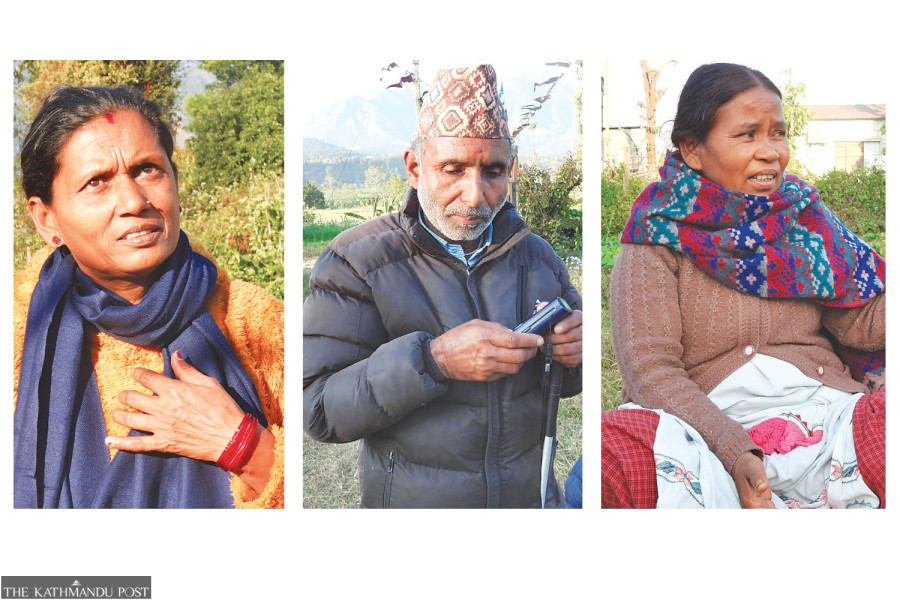
At a three-day meeting this week, families living on public land demanded recognition of their claims and protection from eviction. Squatters Maya Devi Thakuri, Yam Prasad Jaisi, and Neplu Majhi recount their hardship due to lack of ownership documents for the land they have been living on for years, earlier this week. POST PHOTOS: RAMESH KUMAR PAUDEL
For Maya Devi Thakuri, a bitter irony is impossible to miss. She has lived decades on a tiny plot in Bhagyodayatol (which means a place where one’s fortune blossoms) in ward 6 of Gaidakot Municipality in Nawalparasi East. But she has never received the ownership certificate for the seven ana (222.57 sq metres) land that would make it truly hers.
“In 2010, the land ownership document was prepared in my husband’s name. We were told the chairperson of the landless commission would sign it and stamp it. We thought our struggle was finally over,” recalled Maya. “Then we were told a case was filed somewhere. Since then, nothing has happened.”
Originally from Sarlahi, Maya married Shankar Bahadur Thakuri of Dhading. With no land in their home districts, the couple drifted until they settled on thestate-owned land along the Narayani riverbank in Gaidakot. Their makeshift hut eventually became home to three daughters and a son.
With no employment prospects in Nepal, their son left for the Middle East. Their daughters are married, while Shankar still survives on daily wage labour. “We have lived here for more than 30 years. Where else can we go now?” asked Maya. “We live in constant fear that we will be evicted any day because the land is not in our name.”
Frustrated by years of unfulfilled promises despite the formation of successive “land problem resolution commissions”, Maya has joined protests for the rights of the landless squatters for long. “I am already on the streets. At this age, even death does not scare me anymore,” she said. “If the government cannot give us ownership of the tiny plot we live on, whose government is this?”
Maya is now active with the National Land Rights Forum Nepal, which held its three-day national council meeting in Thimura of Bharatpur starting from Tuesday. The gathering brought together landless families from across the country, people who have spent decades waiting for recognition of the land they occupy.
Ichchharam Pariyar from ward 10 in Mithila Municipality, Dhanusha, described the plight of landless families living along the Ratu river. “Families have lived there since the 1980s. When Devchandra Jha was the district chair of the landless commission, he conducted surveys and promised the land titles within 15 days. Then the government changed in the centre, he was removed, and the process stopped,” he said. About 250 households along the river now face uncertainty over whether they will ever receive ownership certificates.
Nepalu Majhi from Sundar Haraincha Municipality-2, Morang, shared a similar story. “More than 36 families have lived on over a bigha (4.74 hectares) of land in a place called Ailanpur since 1997,” she said. “When we built huts, no one objected. After three years, someone suddenly appeared claiming the land was his—but he could not show any proof.”
Victims of the birta land system, which was abolished in 1959, from Rasuwa and Lalitpur districts also attended the meeting in Bharatpur. Bhawani Prasad Neupane from Rasuwa said families there continue to suffer from land grants (birta) distributed during Nepal’s unification. “Although the birta system was abolished many decades ago, more than a thousand families in Rasuwa are still fighting for land rights,” he said.
According to Neupane, a major movement in 2009 led to partial relief. “When Dambar Shrestha was land reform minister, 167 people in Rasuwa received land ownership certificates for about 1,500 ropani [76.31 hectares]. Many others are still waiting.”
The human cost of eviction threats was highlighted by Yam Prasad Jaisi of ward 8 of Birendranagar Municipality, Surkhet who has lost his eyesight to glaucoma. He has lived since 2003 on vacant land near the local buspark, where 43 households now stand. “The municipality issued eviction notices as early as 2011. The district administration gave another deadline in 2020,” he said. “Then Covid-19 lockdowns began, and the eviction stopped. When will the next notice come?” he lamented.
Jaisi, whose wife is also visually impaired, said personal tragedies go unheard. “I came here after failing to survive elsewhere. One son went to India and has been out of contact for two years. The state does not listen to people’s pain,” he said.
According to Lyam Bahdur Darji, chairman of the National Land Rights Forum, applications have been filed by 88,895 landless Dalits, 168,441 landless squatters and 872,181 unmanaged settlers. “Since 2019, three commissions have been formed to resolve the land-related disputes, but only 8,848 families have received land ownership certificates so far,” he said.
The council demanded a conducive environment for the Land Problem Resolution Commission to work effectively, and called for strong laws to address the problems of mohi (tenants), guthi (trust) and birta. Darji said the forum opposes forced evictions. “We stand for zero displacement. No landless family should be evicted without proper alternatives, even if the land is forest or required for public purposes,” he said.
In September, the interim government led by Sushila Karki had dissolved the Land-Related Problem Resolution Commission constituted by the erstwhile KP Sharma Oli administration claiming the structure of the commission is unnecessarily large and the incumbent government does not have mandate for land distribution. The Supreme Court, however, had revoked the government’s decision to scrap the commission and its subordinate offices in all districts two weeks ago.




 14.81°C Kathmandu
1.jpg)