President issues ordinance to revise proportional representation seat shares
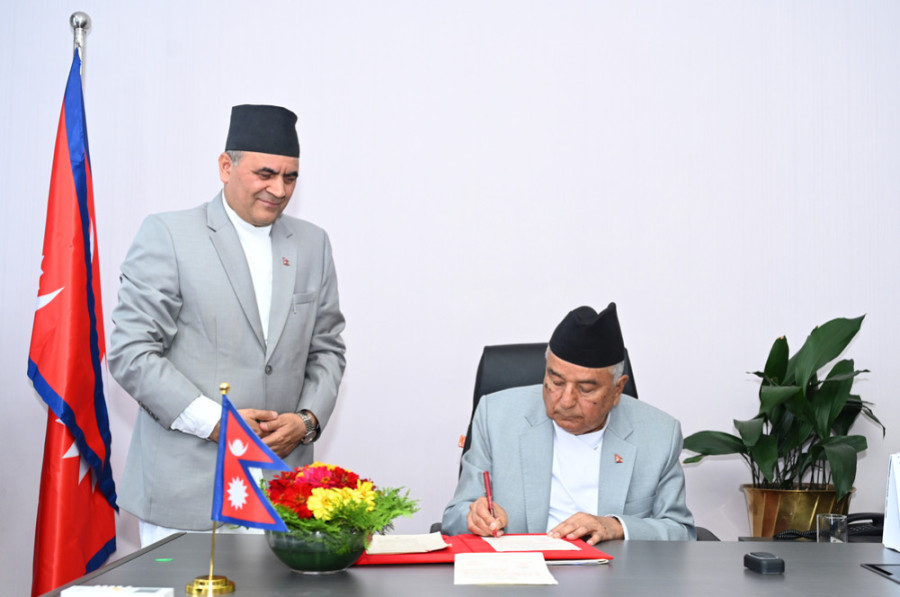
The new amendment reflects population changes based on the 2021 census.President Ramchandra Paudel signs an ordinance on Friday. Photo: Courtesy of the Office of the President
President Ramchandra Paudel on Friday issued an ordinance to amend the Act Relating to the Election of Members of the House of Representatives to revise the share of different castes and communities under the proportional representation system.
The Cabinet on Thursday had recommended the President to revise schedule 1 of the Act to adjust the representation of various caste groups and communities in line with population data from the national census 2021.
“President Ramchandra Paudel has, in accordance with sub-clause (1) of Article 114 of the Constitution of Nepal and on the recommendation of the Government of Nepal, Council of Ministers, has promulgated the the first amendment to the Act,” reads a statement from the President’s Office.
The decision to amend the Act was taken after an agreement between the government and the Election Commission to review community-wise representation based on the population size as per the latest census. A six-member panel was constituted on December 11 for a study.
The panel led by Subash Bhattarai, a joint secretary at the Ministry of Law, Justice and Parliamentary Affairs, has submitted its report to the Ministry of Home Affairs.
The report suggests that there have been slight changes in the composition of various caste groups and communities since the last parliamentary elections. Taking to the Post on Wednesday, Bhattarai had said that his team had recommended adjustments to representation for different categories as per the latest census.
Several newly formed political parties and the ethnic groups had been urging the government to revise the share of clusters represented in the House of Representatives under the proportional representation system.
Election laws require that seats be allocated to different groups in proportion to their population share from the 2021 census.
Schedule 1 of the Act Relating to the Election of Members of the House of Representatives has specified the share of the different groups based on the population data from the 2011 census.
As the detailed census report from 2021 was not ready when the previous elections were held in November 2022, the government had relied on the decade-old census data.
Even before the Bhattarai-led panel was formed, the Central Bureau of Statistics had already forwarded the detailed data on cluster-wise population to the home ministry.
According to the 2021 census, the share of the Khas-Arya cluster had declined from 31.2 percent in 2011 to 30.3 percent. Likewise, there has been a slight decline in the share of indigenous nationalities cluster from 28.7 to 28.2 percent.
Dalit and Tharu clusters have also seen small decreases. The share of Dalits has fallen to 13.4 percent from 13.8 percent, and that of Tharus to 6.5 percent from 6.6 percent.
However, the share of Madheshis has gone up by nearly one percent to 16.2 percent from 15.3 percent. Similarly, Muslim’s share has increased from 4.4 percent to 4.9 percent.
Therefore, the schedule of the Act needs to be amended to adjust the share of representation of the different groups with current population figures.
The Constitution of Nepal and different election laws envision proportional representation. There will be a slight decline in the representation of the Khas-Arya and indigenous/janajati communities if the representation is done based on the latest census.
As per the election schedule, the parties contesting the March 5 polls must submit their closed list on December 29 and 30. The final closed list will be published on January 3.
While 114 parties are contesting under the first-past-the-post category, 100 parties, including those that have applied to contest under the single election symbol, have been registered for the proportional representation system.




 14.82°C Kathmandu