



 26.12°C Kathmandu
Thu, Apr 2, 2026
National
Flush season brings relief to dairies as farmer dues largely cleared
DDC and private processors say payments are largely up to date this winter, though weak demand and high prices continue to weigh on milk consumption.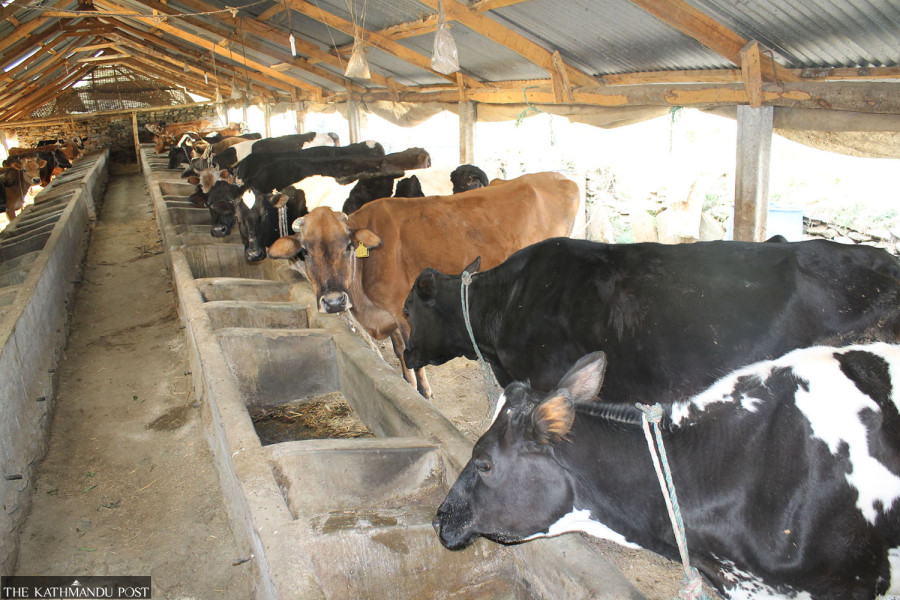
bookmark
Post Report
Published at : December 16, 2025
Updated at : December 17, 2025 16:05
Kathmandu
With the ongoing flush season, when milk production rises, both the state-owned Dairy Development Corporation (DDC) and private dairies appear less stressed this year, as they say they have almost cleared pending dues to farmers.
The corporation said it has cleared almost two thirds of its outstanding dues, while private dairies claim there are now almost no pending payments to farmers.
In the past, dairies typically came under stress during the winter or flush season due to mounting dues following a prolonged recession in the dairy sector.
Nepal has two distinct milk production seasons—flush and lean. The flush season, from August to February, leads to oversupply, while production drops sharply during the lean months. The ratio between lean and flush production is roughly 1:3.
DDC, which had dues amounting to Rs860 million until mid-September, said these have now fallen to around Rs300 million.
“Currently, we are buying more than 100,000 litres of milk daily from farmers. This will increase in the coming months as production rises. But consumption in the market has still not improved,” said DDC General Manager Sanjeev Jha.
Milk and dairy product consumption was strong from mid-November to mid-December due to the wedding season, but with the onset of winter, consumption has started to decline.
“This trend may continue for two to three months, which increases stock due to unsold products and impacts the payment cycle to farmers,” Jha said. “But as we have cleared over two thirds of the outstanding dues, there is less stress now.”
Milk collected during the flush season is converted into butter and powdered milk.
DDC had around 600 tonnes each of butter and skimmed milk powder in stock until August, which has now reduced to 360 tonnes each, according to Jha.
“We paid the farmers by selling stock butter and powdered milk,” he said. “We hope the payment cycle will return to a normal track soon.”
Currently, DDC is paying farmers on a daily basis, amounting to around Rs250 million per month.
Jha said DDC, which had been supplying 1,000 kilograms of raw cheese or whey made from 10,000 litres of milk daily to Himalayan Dog Chew, has halted the supply for the past month due to higher demand for milk in the domestic market.
Whey is the liquid remaining after milk has been curdled and strained, and is used to make chhurpi.
In December last year, DDC inked a deal with Himalayan Dog Chew, owned by the Manaram Group, a key exporter of the hardened cheese, to supply raw cheese.
“We will resume the supply again,” Jha said.
DDC, the state-owned utility, has long struggled to pay dairy farmers on time as demand for milk dropped sharply, which market insiders attribute largely to rising prices.
The consumer price of processed milk, which was Rs76 per litre in January 2022, has climbed to Rs120 per litre after a steep 58 percent rise over three years. The problem of delayed payments began to worsen around August 2023.
In previous flush seasons, farmers’ dues had crossed Rs1 billion.
Market analysts say higher prices, compounded by shrinking household incomes, have resulted in weak demand for raw milk. Demand for other dairy products, including butter, also remains subdued.
Private dairy producers say they are unlikely to face payment problems this flush season given the current trend.
“Milk production has reduced. We hope there will be no delay in payments as a result,” said Prahlad Dahal, president of the Nepal Dairy Association.
“If there is no stock of milk products, then there will be no problem in paying farmers,” he said.
The association said almost all stock was sold during the festive and wedding seasons, helping clear outstanding dues.
A few dairy companies still have some payments pending, but the issue has been resolved as cheques have already been handed over to farmers, Dahal said.
The market receives around 3.1 million litres of milk daily, of which 1.3 million litres is sold by the private sector, 200,000 litres by DDC, and around 1.5 million litres goes to the informal sector.
Private sector dairies currently hold little stock of milk products, according to industry officials.




Most Read from National

14 ministers in Balendra Shah Cabinet finalised

Ex-PM KP Sharma Oli, former home minister Ramesh Lekhak detained over Gen Z protest crackdown

Businessman Deepak Bhatta under money laundering probe, barred from leaving Nepal
Government unveils ambitious 100-point roadmap for effective governance
Karki commission’s recommendations on the Gen Z protests, explained in 10 points
Editor's Picks
Nepal risks losing up to 132,000 jobs, $1 billion after LDC exit

Raped and left to die, teenager’s family wants answers

Bengal tigers move to mid-hills. Sighted in Palpa, Arghakhanchi

Escaping poverty at home, Nepali women fall into the Gulf trap
Once the heartbeat of Nepali democracy, now a ghostly shell
E-PAPER | April 02, 2026

×