With no rains in winter, air quality in the Valley is worsening in the Valley, and reaches very unhealthy levels in the morning. KMC officials test vehicle emission in Kathmandu. Post File Photo
The Kathmandu Metropolitan City said that it is ready to resume emission testing of polluting vehicles, both private and public. The testing was suspended in mid-July.
The prolonged halt of pollution control measures has raised serious concerns, as the dry season has already set in. Kathmandu Valley is witnessing a spike in air pollution in the morning, with the air quality index reaching very unhealthy levels.
Officials said that the city office has hired mechanical engineers to carry out emission testing. Emission testing was suspended at the end of last fiscal year after the previous mechanical engineer’s contract expired, and the office faced a shortage of staff.
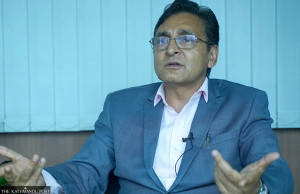
“We have hired a new engineer, and will resume emission testing from next week,” said Jagatman Shrestha, traffic expert adviser at the Kathmandu Metropolitan City office.
Random on-the-spot emission testing of vehicles has for long figured in the metropolis’ roster of plans to tackle growing air pollution in the Kathmandu Valley.
Nepal’s air quality reaches hazardous levels several times a year, and the capital city often becomes the world’s most polluted metropolis. These days, the air quality in the morning reaches a very unhealthy level.
The city office started carrying out emission testing from January in coordination with the traffic police, the federal Department of Environment and the Department of Transport Management.
The test showed that around 80 percent of diesel-fueled vehicles—buses, micro-buses and tata pick-up trucks—on Kathmandu’s roads emit black smoke beyond permissible levels. Likewise, around 30 percent of petrol vehicles—cars and motorcycles—also failed the tests.
“The crackdown on polluting vehicles had shifted vehicle owners’ attitudes towards engine maintenance,” Shrestha said. “After repeated warnings and fines, the percentage of polluting diesel vehicles had lessened to 60 percent and petrol vehicles to 10 percent.”
The metropolis carried out emission testing on over 3,000 vehicles on a random basis.
Although vehicle emission testing is mainly the responsibility of federal agencies, the Constitution also mandates local governments to take measures to reduce pollution.
The metropolis has developed pollution control guidelines as per the KMC Environment and Natural Resources Protection Act-2021.
In the initial stage, the metropolis carried out testing to raise awareness among drivers. It also warned drivers and owners to maintain their vehicle engines to avoid fines and legal action, and had obtained written commitments from vehicles that failed initial tests.
Later, it slapped Rs1,000 fines on drivers of polluting vehicles for ignoring these warnings.
Metropolis officials say more problems have been found in vehicles older than 20 years. The government has announced several times its intention to ban vehicles older than 20 years throughout the country to reduce traffic congestion, air pollution, and road accidents caused by old vehicles. However, the decision has not yet been implemented.
Meanwhile, the Environment Department under the City Office has also prohibited waste burning in its jurisdiction.
Burning of waste out in the open is one of the chief reasons behind the Valley’s deteriorating air quality, environment experts say. Incidents of waste-burning are increasingly being reported in the Valley of late.
A study on waste burning has estimated that municipalities in the Valley burn about 7,400 tonnes of waste per year or 20 tonnes per day—which is three percent of the total waste produced.
The major sources of air pollution in the Valley also include emissions from vehicles, industries, brick kilns, road upgrade drives, and construction sectors. Geographical factors, too, play a role, experts say.




 25.92°C Kathmandu