12 Tharu villages work in tandem to keep 20-km irrigation canal flowing
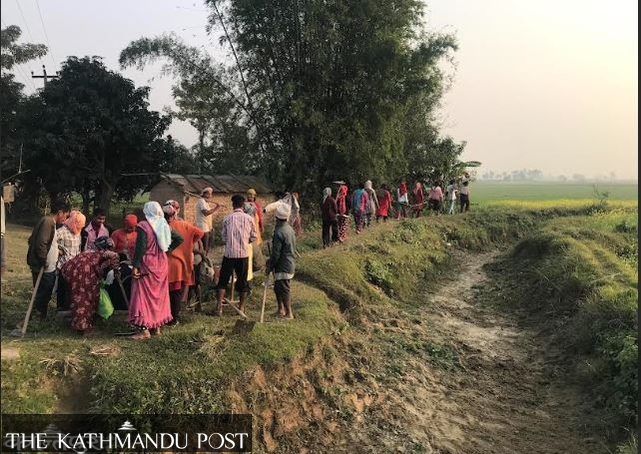
Generations of farmers in Bhajani, Kailali rely on voluntary labour to repair and dredge the canal that sustains their agriculture. Farmers repairing the Gaunaiya canal, recently. Collective labour is key part of Tharu tradition. Post Photo
As the clock edged towards 10am, a member from nearly every household in Bhajani stepped out carrying a hoe. The meeting point had been fixed the previous day. From different directions, men and women walked towards the canal, some with tools balanced on their shoulders, others gripping them tightly in their hands.
Representatives from around 400 households across 12 villages in the Bhajani area gathered to clean Gaunaiya irrigation canal, which has sustained their fields for generations. Residents of Tharu settlements in Bhajani Municipality have long relied on voluntary labour, to keep the canal functional each year, ensuring irrigation without waiting for state support.
The Gaunaiya canal, stretching nearly 20 kilometres, irrigates farmland belonging to around 400 families in wards 1, 2 and 3 of Bhajani. With wheat crops in dire need of water across the Tarai, the annual canal cleaning is timed to ensure uninterrupted flow. “If even one section remains blocked, water does not reach the lower fields,” said Baburam Chaudhary, a local farmer.
Most men from the Tharu settlements are currently working outside the village in search of employment, resulting in a higher participation by women in the canal cleaning. The canal, which has been in use for decades but without concrete structure, is regularly damaged by floods and erosion during the monsoon. To prepare for winter crops, villagers assemble every year to repair breaches and remove silt.
Collective labour is a deeply rooted tradition within the Tharu community. The Gaunaiya canal, which irrigates fields across three wards, draws water from the Kanda river. After a permanent embankment was constructed at the intake point in 1991, villagers no longer needed to carry out annual repairs at the river source. However, the earthen canal running through settlements remains vulnerable.
“Cleaning this long canal is beyond the capacity of one or two families. Every year in the month of November-December, everyone must contribute at least four days of labour to make the canal functional,” said Baburam Chaudhary, another farmer of Bhajani. According to locals, the practice has continued uninterrupted despite changes in population and land use.
Last week, participants gathered near the bridge in Kanda village and cleaned sections of the canal flowing between Kanda, Padariya and Perhanni in ward 3. In ward 1, residents from Danga Bhajani, Gaunaiya, Chakuliya, Thegarpur, Madhuban as well as Srijanabasti and Rajawara in ward 2 joined to clean the canal.
The method of canal cleaning has also been passed down through generations. Participants are divided into small groups of six or seven to make the work manageable. Each group is assigned a four-metre stretch of the canal. Some remove weeds, others clear silted banks, while the rest dredge accumulated soil from the canal bed. “During canal cleaning, the excitement feels like a festival,” said Baburam.
The Kanda Bhajani Water Users Committee coordinates and manages the locals during the canal cleaning. Mobilisation of people at the village level is carried out by Tole (settlement) Development Committees formed voluntarily by the locals. “This is a shared canal of 12 villages in Bhajani. Cleaning it once a year is an inherited tradition. Tole committees keep track of who participates and who does not,” said Benulal Chaudhary, chairman of Kanda Bhajani Water Users Committee.
Work runs from 10am to 4pm each day, with mandatory participation from one member of every household. Attendance is recorded separately in each village every evening before they return home. Saraswati Chaudhary, chair of the Shiva Parbati Tole Development Committee in Rajawara, said households absent without prior notice are fined Rs600 per day. “Office bearers from 17 tole committees across the 12 villages volunteer to mobilise people. Bhalmansas, chieftains of the communities, also assist in coordination,” she said.
Until about three decades ago, hill residents referred to the Bhajani area as ‘Malawar’, reflecting its sparse settlements. In recent decades, migration from the hills has transformed Bhajani, with houses steadily spreading across former farmland.
“We don’t wait for the government. The canal is ours, the fields are ours, and so is our future,” said Hariram Chaudhary, a community leader. He also expressed concern over fertile agricultural land being converted into residential plots.
Villagers take pride in their tradition of maintaining the canal intact through voluntary labour. “This is a living example of community unity. If we had depended on government authorities, the canal would have stopped functioning long ago. We solve our own problems together,” said Bhim Chaudhary of Rajawara. The yearly phenomenon of canal cleaning remains both a necessity and a symbol of collective resilience in Bhajani.




 15.26°C Kathmandu