Farwest’s Tharu youths buck migration trend, earn locally through construction
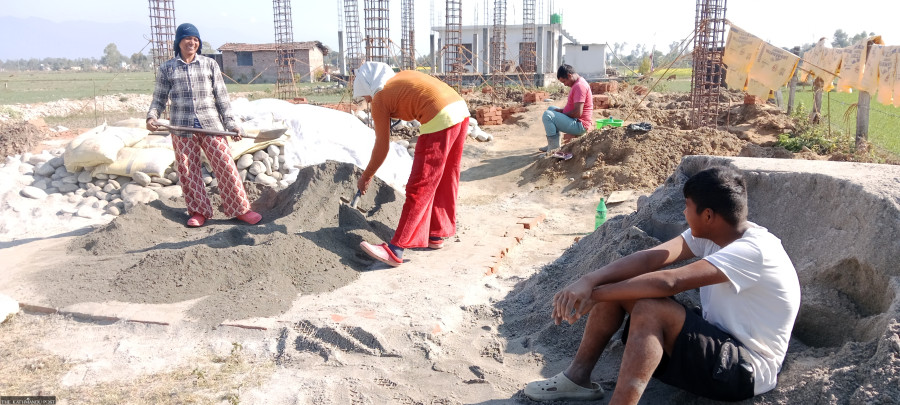
Many have received proper mason training and make a steady income building homes throughout the year. Workers from the Tharu community at a house construction site at Airi in ward 12 of Bhimdutta Municipality in this recent photo. Bhawani Bhatta/TKP
After major festivals end and farming work is completed, most Tharu youths from Kanchanpur traditionally travel to India for work. Many go as far as Uttarakhand and Himachal Pradesh, while some go even further to big cities like Delhi, Mumbai, and Bengaluru. However, some Tharu youths are staying in their villages and earning a decent living throughout the year through construction work.
One of them is Subarna Chaudhary of Hasulia in ward 3 of Kailari Rural Municipality, Kailali. Living with his family in Mahendranagar, the district headquarters of Kanchanpur, for the past two decades, he has made a name for himself in house construction. A trained mason himself, he now takes contracts for large houses and earns well.
Born into a freed Kamaiya (bonded labourer) family, Chaudhary began his working life as a daily-wage labourer. Over time, he learned masonry skills and gradually moved into contracting. These days, he handles construction of three to four houses at a time. “Sometimes I supervise the work myself, and at other times I assign it to my workers. I take contracts from homeowners throughout the year,” he said.
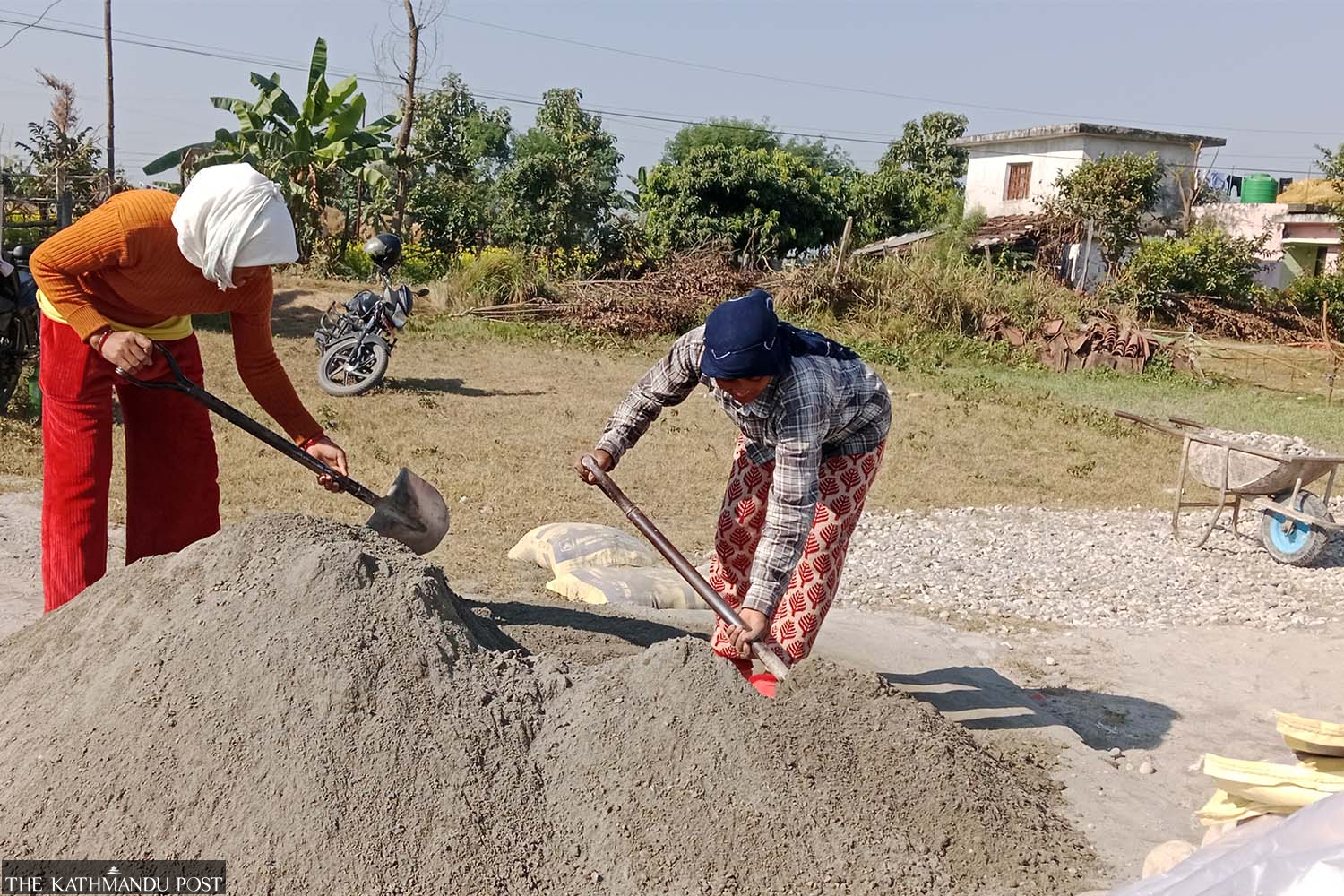
His wife, Ritidevi, also works alongside him as a helper. They are usually seen working together—Subarna as the mason and Ritidevi as the assistant.
In recent years, most of the people involved in construction work in the area belong to the Tharu community. Some Tharu women have also started working as masons. In fact, Tharu workers are now ahead of others in building earthquake-resilient houses. After the abolition of the Kamaiya system in 2000, many young people from the community received mason training, and they are now actively engaged in construction.
“We started this work after receiving proper training,” said Hari Chaudhary, another mason from Hasulia. “Most of the people who trained with us are currently working in construction.” Hari, who is also from a freed Kamaiya family, has been working as a mason for more than a decade. Other workers assisting him also come from the same locality.
The construction workers often rent a room together, cook and eat there, and leave for work after breakfast. They carry their lunch with them and return to the same room in the evening to cook and rest. Sometimes, they even stay at the construction site itself. Not only masons but also labourers are brought along by them, most of whom return to work after finishing agricultural activities in their villages.
Bhawani Bhatta/TKP
Finding workers in towns has become increasingly difficult. It is mainly people from rural areas who are now sustaining the construction sector in urban centres. In the Tharu settlements of Kanchanpur and Kailali districts, most young men and women are engaged in construction work. Skilled workers become masons, while the unskilled work as helpers. Nowadays, a mason earns between Rs1,000 and Rs1,200 per day, while helpers earn Rs600 to Rs700.
“We are all surviving on daily-wage labour. This is how we support our families,” said Raju Chaudhary of Kailari. “Some of us are working here, some there, but all of us are earning through our own hard work.”
For most of the residents of Sudurpashchim—which ranks among Nepal’s poorest and underdeveloped provinces—India’s major cities have long been the primary destination for employment. Many work as security guards, hotel staff, shop assistants, domestic help, or construction labourers. Because such jobs often pay very low, many workers supplement their income by cleaning vehicles in the mornings, they say. The involvement of some Tharu people in construction work gives some hope to retain youths in the home country to sustain their livelihoods.




 12.97°C Kathmandu