The government has failed to finalise its long-promised agreement with Gen Z groups despite Prime Minister Sushila Karki’s explicit directives, adding to the youths’ doubt of the interim government.
Bureaucratic resistance is suspected to have played a role in delaying the agreement between the government and the Gen Z groups, who led nationwide anti-corruption protests in September that toppled the powerful Congress-UML coalition government.
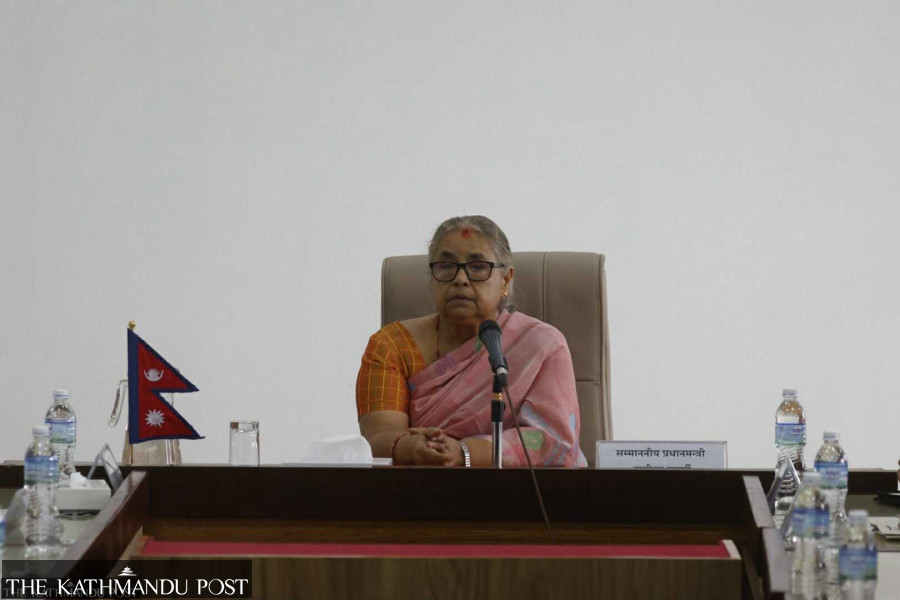
The interim government led by former Chief Justice Karki has been working to create a conducive environment for the March 5 elections and has intensified dialogue with political parties. However, Karki, who became prime minister in the wake of the Gen Z movement and initially enjoyed extensive youth support, is dissatisfied with her own government after it failed to sign an accord that would formally recognise the Gen Z movement.
Although the government had pledged to reach an agreement with Gen Z by this past Sunday and get the agreed points endorsed by Monday’s Cabinet meeting, this did not happen. Despite Prime Minister Karki’s clear directives to the authorities to finalise the agreement by Sunday, the deadline quietly passed.
Instead, Monday’s Cabinet merely announced that September 8 would be observed as Gen Z Day.
Despite the prime minister’s clear instructions, why are the government and Gen Z still unable to reach an agreement?
On Wednesday, some Gen Z representatives including Amit Khanal ‘Urja’, Ojaswi Bhattarai and Samjhana Rai met the prime minister. According to Khanal, the prime minister expressed her willingness to sign the agreement.
“The prime minister is ready to sign an agreement with Gen Z,” Khanal said. “Despite the prime minister’s own directives, the draft of the agreement has not been finalised. This has made us suspect lack of cooperation from within the bureaucracy.
“However, we will wait until the end of this week. If the government continues to delay signing the accord, we should take some action to put pressure on the government.”
Another Gen Z representative, Ashutosh Jha, sounded more optimistic. He believes that the government will draft the agreement. “We feel that the government is buying time to sign the agreement, but the delay is likely due to the drafting process,” Jha told the Post.
“In order to formalise the Gen Z movement there must be a tripartite agreement between the President, government and Gen Z representatives. Hopefully, this will happen soon,” Jha said.
Phanindra Gautam, who retired on Wednesday from the civil service and was law secretary at the Prime Minister’s Office before that, said the government has inducted conflict experts Surya Dhungel and advocate Raju Chapagain to expedite the drafting process.
When some Gen Z representatives accused Gautam of delaying the agreement, he rubbished the claims. He explained that the agreement requires not just political but also legal endorsement, hence the expert involvement and the delay.
Gen Z youths fear that the movement is increasingly being criminalised, which could leave protesting youths vulnerable to legal repercussions. For this reason, Gen Z leaders have been pushing to conclude the agreement as soon as possible.
In an effort to institutionalise the movement, organisations such as the Gen Z Movement Alliance and Gen Z Front initially submitted separate draft proposals to the government.
Later, the government urged them to come together. Following continuous dialogue, the groups reached a common understanding and prepared a unified draft proposal, and then called for its formal endorsement by the government.
According to Gen Z leaders, the prime minister’s instructions have not been implemented as officials on the government side, including former law secretary Gautam, have been reluctant to accept their demands.
As outlined in the draft prepared by Gen Z groups, the process of truth-seeking and reconciliation should follow the principles of transitional justice. The draft also calls for immediate release of those arrested in connection with the Gen Z movement, except for the ones accused of serious crimes.
“Though we have been demanding that the Gen Z movement should be looked at as per the principles of transitional justice, the government is not ready, fearing that top political leaders could also be implicated,” said Khanal, a Gen Z representative.
But, Gautam, the retired law secretary, said that the events of September 8 and 9 cannot be examined through transitional justice principles.
“Incidents like the Gen Z movement have happened before as well, such as during the Madhesh movement, and if we apply transitional justice here, all such movements will also demand the same, which is not feasible,” Gautam argued.
The former secretary also maintained that his statement represented a collective position of the government side and that it would not be right to accuse him of being reluctant to accept Gen Z demands.
The decade-long (1996-2006) Maoist insurgency, seen through the transitional justice principle, is still to be concluded.
A disagreement, however, persists between the Gen Z representatives and the government over whether the killing of 19 unarmed youths in front of the federal parliament in Kathmandu on September 8 should be called a “massacre,” among other terminologies, which both Gen Z representatives and Gautam acknowledge.
There was some disagreement over the term’s use, which Gautam believes can be settled. He expects the government and the two experts it has recently hired to settle the issue soon so that an agreement with Gen Z can be signed.




 26.08°C Kathmandu