Dhangadhi invests Rs15 million to restore ponds to tackle water shortage
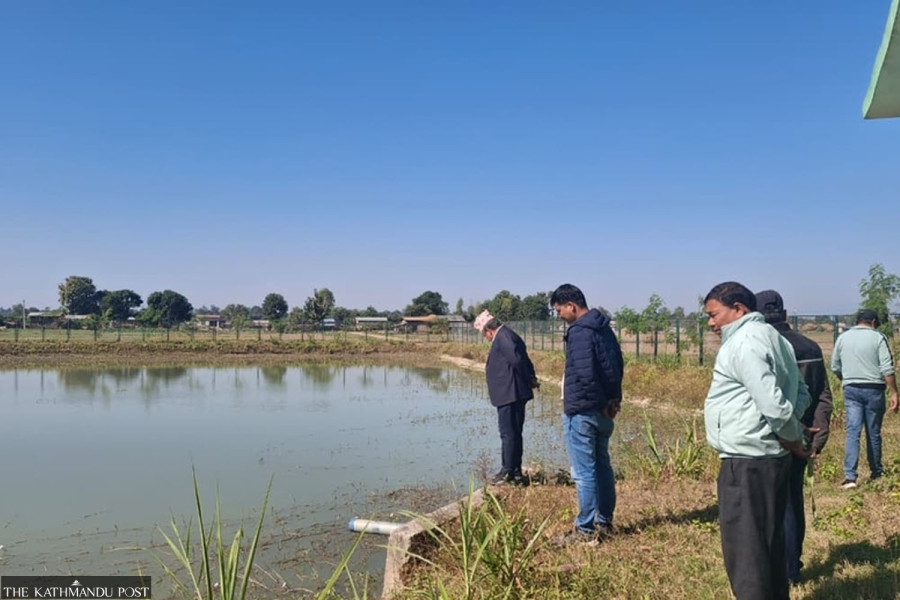
80 ponds identified in the area. Work ongoing to restore them, support fish farming and develop some ponds for tourism. Local officials inspect a pond in Dhangadhi Sub-metropolis in this recent photo. The sub-metropolis has launched a plan to conserve and restore ponds to address growing water shortage. Post Photo
As the level of underground water drops across the Tarai region during summer, Dhangadhi Sub-Metropolitan City in Kailali district has begun building a network of recharge ponds to replenish groundwater. The sub-metropolis has released about Rs15 million so far under its new water management initiative.
Residents in Kailali, a Tarai district in the Sudurpaschim province, have long relied on shallow tube wells (called hand-pumps locally) for domestic water, but many of these dry up between April and June each year. The problem has worsened now, mirroring the drought and groundwater depletion that struck the plains of Madhesh province last monsoon. Experts trace this to over-extraction, depleted recharge zones and shrinking forest cover—especially in the fragile foothills of the Chure hills.
In response, Dhangadhi Sub-Metropolitan City has rolled out a plan to conserve and revive local wetlands, streams and forest catchments—aiming to raise subsurface water and restore ecological balance. As described by divisional engineer Dwijaraj Bhatta, head of the Urban Development and Infrastructure Department of the sub-metropolis, the goal is to use surface water in ‘multi-dimensional ways’—for irrigation, fish farming, livestock rearing, and recharge purposes.
“The ‘one community forest, one pond’ policy of the sub-metropolis envisions ponds inside each of the 65 community forests in the local unit,” said Bhatta. By doing this, the sub-metropolitan city intends not only to conserve forests and recharge underground water but also to create potential tourist destinations and provide wild animals access to water.
Bhatta explained that while the plan covers 65 ponds, the municipality has not allocated a separate budget for construction in community forests—assuming that forest users will fund those themselves. Instead, it has prioritised constructing recharge ponds within the urban sub-metropolis area.
The initiative was started in the fiscal year of 2023-24 with a study involving scholars from the Tribhuvan University. The study identified more than 80 ponds and wetlands within the boundaries of the sub-metropolis. But field visits revealed that many were buried, silted up, or destroyed. The study classified them into government-maintained ponds, community forest ponds, buried ponds, and those beyond repair. The sub-metropolitan city further divided the ponds and wetlands into “urban” and “rural” categories based on their location and preserved them.
Currently, over 50 ponds are formally identified as safe, though eight have been found encroached upon. Around those encroached ponds, residents from economically weaker communities live and some of them asked the sub-metropolis to first manage their settlements before restoring the ponds. The sub-metropolitan city has agreed to this, vowing to reorganise settlements before rehabilitating the water bodies.
Dhangadhi plans to transform urban ponds into economic and tourism hubs, while conserving rural ones to support fish farming for the livelihoods of the local residents. Already, four urban-area ponds have been rebuilt for tourism and some community schools in wards 11, 14 and 15 have maintained ponds—using income from fish farming for school development.
“Once we trained schools to measure pond surface area and calculate optimum fish yields, their revenue rose significantly,” said Bhatta. One pond in ward 14 has been transformed into a neatly managed picnic park, and as local visitors increase, residents are now urging the sub-metropolis to allow boating at the pond.
Of the five recharge ponds currently under construction, the first—in ward at Badhigadaiya is ward 15—is complete. Construction of another, at Behadababa in ward 7, is ongoing, while a third at Raktauna in ward 19, and yet another in ward 15 are under repair. Under this plan, the Rs15 million municipal fund will cover four ponds; the fifth will be built with about Rs400,000 with support from UNDP.
Once completed, according to Bhatta, private companies will be allowed to operate the ponds. They can invest to make the ponds more attractive, and the sub-metropolitan city will get a share of the earnings, he said. The privately managed Taulaha pond in ward 8 is already earning more than Rs100,000 a month and the local unit receives Rs36,000, he said. At the same time, a pond in ward 6 managed by locals has been helping a school through fish farming.
Although urban ponds have revived with minimal disruption, Bhatta admitted that ponds in community forests, which fall under the federal government, pose bureaucratic obstacles, complicating restoration work.
To tackle deeper hydrological issues, the sub-metropolitan city has also launched a broader study—covering the Chure foothills to Dhangadhi—to map streams, wetlands and catchment recharge zones. This study, conducted jointly with Nepal Red Cross Society, will focus on regions including Chure area, Tikapur, Bhajani and Dhangadhi.
“Our ponds are incomplete without Chure. To recharge effectively, we must protect the Chure hills. Only once Chure is conserved will our ponds refill and sustain water supply,” said Bhatta.
In the long run, Dhangadhi Sub-metropolitan City hopes these efforts will not only improve underground water levels and prevent future shortages but also promote environmental conservation, livelihood generation, and increased municipal revenue.




 19.64°C Kathmandu