NEPSE slips as investors rotate into banks and manufacturing
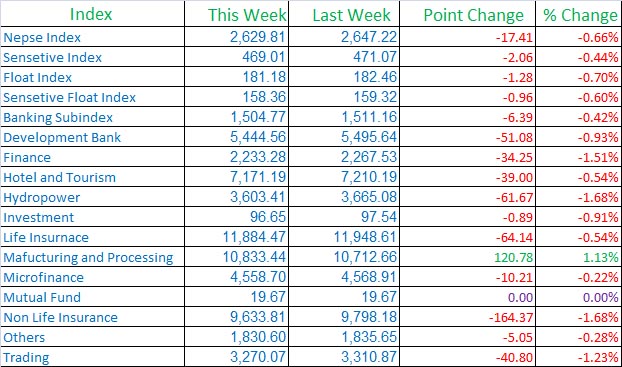
The benchmark index fell 0.66 percent to close at 2,629.81 in a shortened trading week, while average daily turnover edged up to Rs6.12 billion as investors shifted away from hydropower and finance stocks. AI generated
The Nepal Stock Exchange (NEPSE) slipped 17.41 points, or 0.66 percent, last week as investors took a cautious approach during a three-day trading week.
The benchmark index closed at 2,629.81 on Thursday, down from 2,647.22 a week earlier. Market capitalisation fell by about Rs30 billion to Rs4.52 trillion.
The decline in total turnover was largely a function of the shorter trading week. Turnover fell 39.3 percent to Rs18.36 billion from Rs30.26 billion in the previous five-day week. But average daily turnover actually edged up to Rs6.12 billion from Rs6.05 billion.
That suggests market liquidity remained broadly intact despite the shorter trading window.
Trading was also selective. Of the 13 sectoral indices, Manufacturing and Processing was the only sector to gain, rising 1.13 percent. Mutual funds were unchanged, while the other 11 sectors declined.
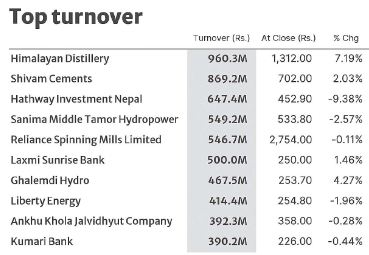
Manufacturing attracted buying interest, with Himalayan Distillery Limited recording Rs960.3 million in turnover and gaining 7.19 percent. Shivam Cements rose 2.03 percent on turnover of Rs869.2 million. Sonapur Minerals and Ghorahi Cement also gained 7.38 percent and 6.64 percent, respectively.
Commercial banks also drew substantial trading activity, although their price gains were more muted. Laxmi Sunrise Bank was the most actively traded stock, with 2.009 million shares changing hands for about Rs500 million. Kumari Bank and Global IME Bank were also among the most traded counters.
The rotation was less favourable to more volatile sectors. Hydropower and non-life insurance each fell 1.68 percent, while finance declined 1.51 percent. Snow Rivers Limited, Mount Everest Power and Yambaling Hydropower were among the biggest losers, falling 6.39 percent, 5.75 percent and 5.50 percent, respectively.
At the individual-stock level, Nepal Lube Oil was the biggest gainer, climbing 14.93 percent to a 52-week high of Rs271.30. Infinity Laghubitta was the biggest loser, dropping 10.80 percent to Rs950. Hathway Investment Nepal also saw heavy trading, with Rs647.4 million worth of shares changing hands as its price fell 9.38 percent to Rs452.90.
Policy changes draw attention
Market participants are watching recent changes in capital-market policy for their potential impact on trading in the coming weeks.
Chartered accountant and market analyst Manish Aryal said the reduction in capital gains tax to 3.75 percent for shares held for more than a year and 5 percent for shorter-term holdings could support activity. He also pointed to the Nepal Rastra Bank’s September 24 circular allowing banks and financial institutions to buy and sell listed shares after holding them for at least 45 days.
The provision is intended to bring more institutional money from banks and financial institutions into the stock market, Aryal said.
At least seven brokerage firms have also begun offering margin lending to clients, potentially providing another source of liquidity.
Aryal said increased participation by banks and financial institutions could favour fundamentally stronger companies, particularly commercial banks, where he sees continued accumulation and relatively firm prices.
Investor and market analyst Subas Chandra Dhungana said the market needs daily turnover of more than Rs8 billion to sustain a stronger upward move. He expects traders and investors to increasingly favour fundamentally sound stocks as the government’s 21-point capital-market reform plan takes effect, with the banking sector particularly well placed to benefit. Banks have already started showing strength, he said.
Many traders also appear to be waiting for the index to retrace and fill the gap created by the sharp opening on September 15, before taking fresh positions.
Technical picture
Technically, the index remains above its 20-day and 50-day exponential moving averages after forming a higher low around the 2,500 level. The MACD has turned positive, while the RSI at 54.68 suggests momentum is neither overbought nor deeply stretched.
Analysts are watching the 2,660–2,680 area as near-term resistance. A sustained move above that range could strengthen the upward momentum, while 2,605 and the moving-average cluster around 2,580 provide nearby support levels.
For now, the market appears to be consolidating around 2,630, with the flow of money suggesting a more selective approach rather than a broad-based buying spree.




 16.72°C Kathmandu