Bhotekoshi floods prompt ADB to cut Nepal’s growth forecast to 4.1 percent
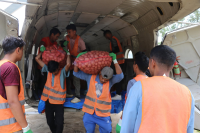
The Asian Development Bank has raised its inflation forecast to 5.3 percent and expects the fiscal deficit to widen as reconstruction spending increases following the devastation. The extreme flood wave of August 26, travelling at roughly 188 kilometres per hour, killed over 1,400, left over 6,000 missing and swept away large swathes of land, homes, schools, roads and other critical infrastructure. Shutterstock
Last month’s Bhotekoshi floods have tempered Nepal’s growth momentum and may push up inflation in the current fiscal year, which ends in mid-July 2027.
The Asian Development Outlook September 2026, released on Wednesday, has trimmed Nepal’s growth forecast by 0.4 percentage point to 4.1 percent for the current fiscal year, largely because of the impact of the August 26 floods. In its July outlook, the Asian Development Bank (ADB) had forecast growth of 4.5 percent.
According to a government assessment, the extreme flood wave, travelling at roughly 188 kilometres per hour, killed over 1,400, left over 6,000 missing and swept away large swathes of land, homes, schools, roads and other critical infrastructure.
Based on preliminary information, the flood wave travelled approximately 20 km from its source area on the upper slopes of Mt Langtang Lirung to the Rasuwagadhi border in about seven to eight minutes.
The assessment, released by the Water and Energy Commission Secretariat under the Centre of Hydrology and Water Resources Research, described the Bhotekoshi-Trishuli flood as a highly unusual and rapid-onset hydrological event.
Its preliminary findings indicate that the disaster was not a conventional rainfall-induced flood but a sudden flood wave generated by an upstream outburst following the failure of an ice-avalanche/landslide dam.
The Asian Development Bank (ADB) said Nepal’s growth is expected to moderate in 2026-27 from its July projection due to economic disruptions caused by the floods.
Damage to transport infrastructure, hydropower facilities and other productive assets, together with disruptions to trade, tourism, agriculture and local economic activity, is expected to weigh on industrial and services growth in the first quarter, the ADB report says.
“The tragic loss of life is the most devastating consequence of the floods, but the disaster will also have severe and far-reaching impacts on livelihoods, critical infrastructure, and Nepal’s wider economy,” said ADB Country Director for Nepal Arnaud Cauchois.
“Damage to transport infrastructure, hydropower facilities, and other productive assets has disrupted trade, tourism, agriculture, and local economic activity. Reconstruction and rehabilitation will support recovery by restoring critical infrastructure and boosting demand, but increased post-disaster spending may also put additional pressure on public finances.”
Reconstruction and rehabilitation spending, including on hydropower expansion, will partly offset these impacts by supporting demand and restoring critical infrastructure, although post-disaster spending may place additional pressure on public finances, according to the report. The government’s preliminary estimates show Nepal will need Rs723.31 billion to rebuild infrastructure damaged by the floods.
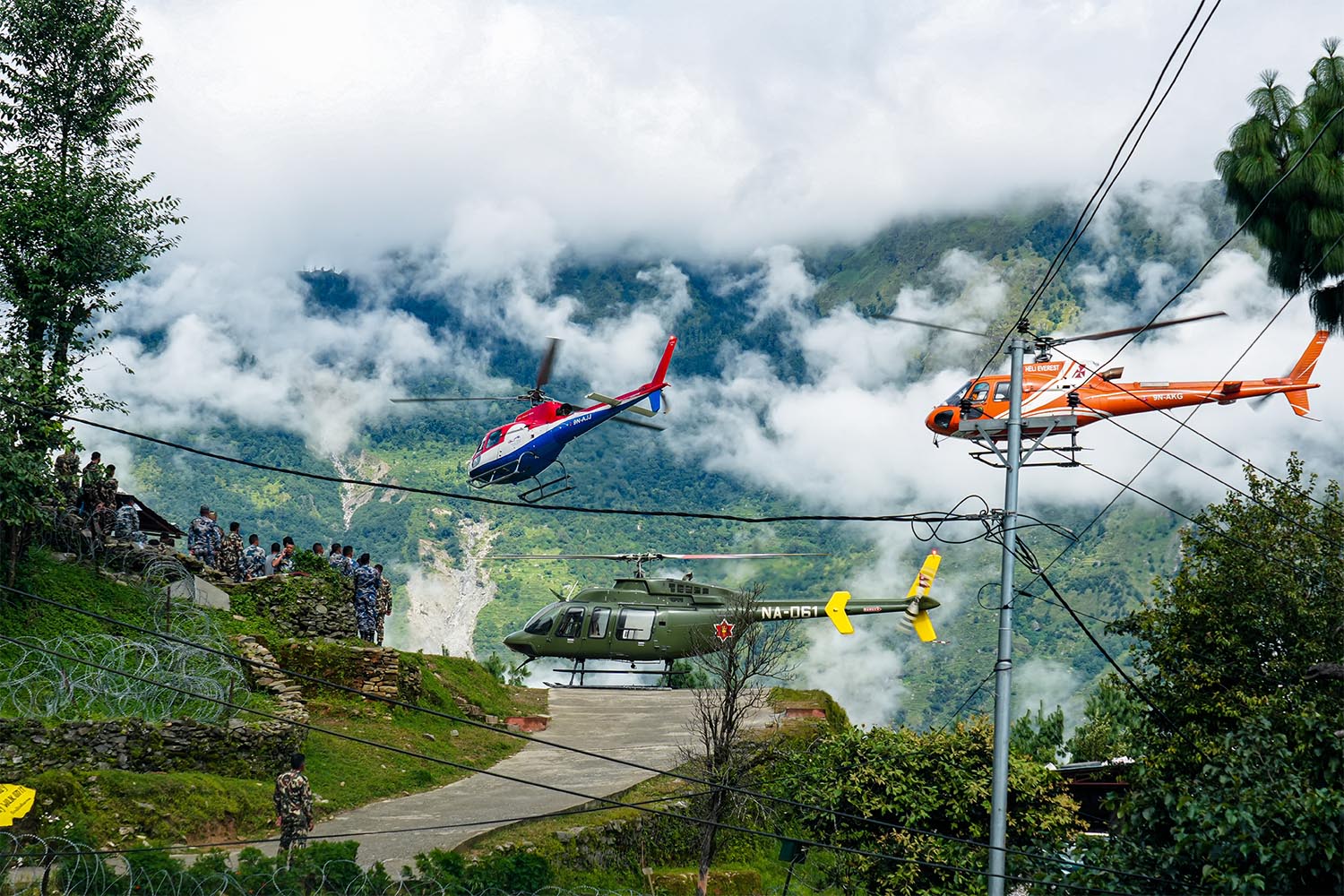
Helicopters mobilsed at rescue and relief operations after the August floods. Shutterstock
According to the ADB report, Nepal’s inflation was marginally lower in the last fiscal year, averaging 3.1 percent, with food inflation at 1.1 percent and non-food inflation at 4.2 percent, driven mainly by transportation, and restaurant and accommodation services.
Inflation is expected to rise in the current fiscal year 2026-27 as the impact of the flash floods constrains supplies of food and other essential goods and increases logistics costs. At the same time, reconstruction and rehabilitation are likely to boost demand for construction materials, transport, and labour, supported by expansionary fiscal policy and ample liquidity, the multilateral funding agency said.
Higher global fuel prices resulting from the West Asia conflict are expected to add to cost pressures. The inflation forecast for the current fiscal year has therefore been revised upward to 5.3 percent, the ADB said.
The fiscal deficit was estimated at 3 percent of GDP in the last fiscal year and is projected to widen in 2026-27 owing to increased spending on post-flood reconstruction and rehabilitation. The deficit has been forecast at 4.7 percent of GDP in the current fiscal year, up from the pre-disaster projection of 3.4 percent.
Public debt rose to an estimated 44.9 percent of GDP in the last fiscal year from 43.7 percent in the previous fiscal year 2024-25, while debt-servicing costs eased to 5.9 percent of GDP from 6.3 percent. Public debt is expected to increase further as additional resources are mobilised for reconstruction and recovery. Despite higher financing needs, Nepal remains at low risk of debt distress, the ADB said.
Nepal’s external position strengthened considerably in 2025-26, supported by robust remittance inflows and higher exports. Remittances more than offset the trade deficit, leading to a current account surplus equivalent to 14 percent of GDP and an overall balance-of-payments surplus of 15.6 percent of GDP in 2025-26.
Foreign exchange reserves reached a record level, equivalent to more than 19 months of imports. Remittances are expected to remain strong in the current fiscal year, although tourism receipts could weaken temporarily as the flood-damaged roads and infrastructure disrupt arrivals.
Nepal’s tourism sector suffered preliminary economic losses of Rs52.67 billion from the August 26 floods and subsequent landslides, including the August 30 landslide at Krishnabhir along the Prithvi Highway, according to another report prepared by the Nepal Tourism Board. The closure of the crucial highway disrupted transport and supplies to Kathmandu and left about 150 tourist buses serving the Pokhara-Kathmandu route idle for 18 days.
Direct losses from the floods were estimated at Rs30 billion, with the remainder classified as induced losses in three districts—Rasuwa, Nuwakot and Dhading, said Sahadev Dhamala, coordinator of the rapid response team of the board, the country’s tourism promotional body.
The report categorises the losses into direct and induced losses. The induced losses were calculated based on a six-month projection, taking into account tourism income generated by the country over the past two years. The calculation also includes estimated rehabilitation and compensation costs, Dhamala said.
Tourism entrepreneurs are hopeful that arrivals may improve from October.
The ADB’s outlook for 2027 says arrivals are expected to improve modestly as tourism rebounds, strengthening the services balance.
Minister for Energy, Water Resources and Irrigation Biraj Bhakta Shrestha told Parliament on Wednesday that the floods damaged hydropower, irrigation and river-control projects, among other infrastructure, and that it will cost about Rs400 billion to restore them.
The ADB report said electricity exports are also unlikely to contribute to export growth in the current fiscal year due to the damage to hydropower infrastructure.
Nepal’s total installed electricity generation capacity is 4,296 megawatts. The floods forced more than 430 megawatts of electricity out of the grid, equivalent to about 10 percent of the country’s installed generation capacity.
At the same time, stronger domestic demand and reconstruction-related activity are expected to increase imports, narrowing the current account surplus, although the external position should remain comfortable, the ADB report said.
Nepal’s GDP growth moderated in the last fiscal year, which ended on July 16, 2026. Agriculture expanded by only 1.6 percent, as delayed monsoon rains and the October 2025 floods reduced paddy production, while industry growth accelerated to 5.7 percent, driven primarily by additions to hydroelectric generation capacity.
Services growth remained resilient at 4.2 percent, despite disruptions at key West Asia transit hubs during the peak spring climbing season and lingering uncertainty arising from the conflict in the region.
Economist Chandra Mani Adhikari said the ADB forecast is realistic. He, however, added that growth could pick up if reconstruction activities gather pace, as demand for cement, steel and iron rods, food, fuel and transport services is likely to increase significantly
“We have seen this kind of quick growth after the 2015 earthquake. It’s growth, but not sustainable growth,” Adhikari told the Post.
The government has targeted annual economic growth of 6 percent.
Nepal’s economic growth has frequently been disrupted by natural disasters and political unrest. The country has faced several severe disasters in recent years, including the November 2022 Doti earthquake, the destructive October 2023 Bajhang earthquake, and massive monsoon-triggered floods and landslides in 2024 and 2026 that displaced thousands of people and caused widespread casualties.
In September 2025, large-scale anti-corruption protests and demonstrations erupted across Nepal, predominantly organised by members of Gen Z. The protests upended the political order, leading to new parliamentary elections and a new political dispensation.
Sangam Prasain is Business Editor at The Kathmandu Post, covering tourism, agriculture, mountaineering, aviation, infrastructure and other economic affairs. He joined The Kathmandu Post in October 2009.




 15.69°C Kathmandu