



 14.81°C Kathmandu
Sat, Oct 24, 2026
Money
Late monsoon slows Nepal’s paddy transplantation, but experts say there’s no need to worry
Paddy transplantation has reached just 32.4 percent of the country’s 1.37 million hectares, well behind last year’s pace, though officials and experts say the season can still recover by July-end.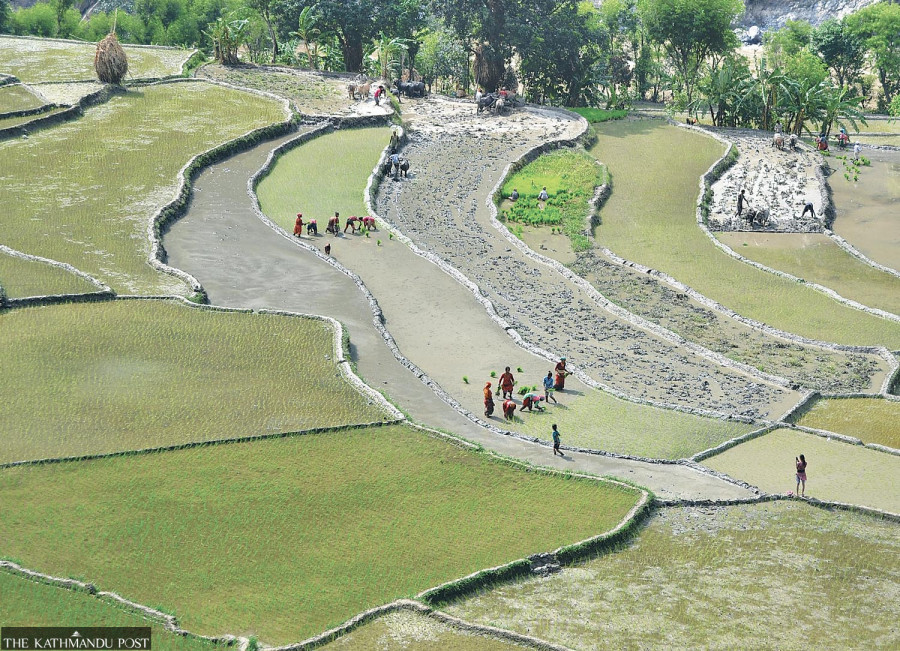
bookmark
Sangam Prasain
Published at : July 6, 2026
Updated at : July 7, 2026 07:09
Kathmandu
The delayed and sluggish advance of the southwest monsoon has begun taking a visible toll on Nepal’s agriculture, with fresh government data showing that paddy transplantation has been completed on only 32.38 percent of the country’s cultivated area as of Monday.
The figure marks a significant slowdown compared to the same period last year, when 45 percent of paddy fields had already been transplanted. Delayed transplantation leaves young seedlings vulnerable to peak pest infestations and unfavourable weather, slowing plant growth and ultimately reducing productivity.
According to the latest data from the Department of Agriculture under the Ministry of Agriculture, paddy has so far been transplanted on 443,595 hectares out of the country’s total 1.37 million hectares of land designated for paddy cultivation during the monsoon season.
Despite the slower pace, government officials and agricultural experts say there is no immediate cause for alarm.
“We don’t have to worry yet,” said Rajendra Koirala, spokesperson for the Department of Agriculture. “Concern will arise only if transplantation continues to lag from the first week of August. The monsoon has only recently begun spreading gradually from east to west.”
Paddy transplantation schedules vary across Nepal depending on rainfall patterns and topography. In the upper hills, transplantation is generally completed by mid-June. In the Tarai—the country’s food basket—it usually begins in early July and can continue until early September, depending on water availability.
The Tarai accounts for 71 percent of Nepal’s total rice cultivation area, followed by the hills with 25 percent and the mountains with 4 percent.
Last year, below-average rainfall delayed transplantation in Madhesh Province, affecting both production and productivity.
Officials say the slow onset of this year’s monsoon has left vast stretches of farmland dry and lacking adequate soil moisture, forcing farmers to postpone transplantation while waiting for sustained rainfall.
The monsoon officially entered Nepal on June 19, six days later than its normal arrival date of June 13.
Regional forecasts by South Asian meteorologists suggest Nepal is likely to receive below-normal monsoon rainfall this year, ending three consecutive years of above-average precipitation.
Monsoon rains are critical for Nepal’s Rs6.6 trillion economy, providing nearly 80 percent of the water needed for agriculture while replenishing reservoirs and groundwater reserves.
With nearly half of the country’s farmland lacking irrigation facilities, agriculture remains heavily dependent on rainfall between June and September. The monsoon is therefore regarded as a key macroeconomic factor, closely watched by policymakers, investors and consumers.
Agriculture contributes about 24 percent of Nepal’s gross domestic product and provides employment to more than 60 percent of the population. As rural incomes largely depend on agricultural output, the strength of the monsoon has a direct impact on household spending and overall economic activity.
Experts warn that a combination of below-normal rainfall, fertiliser shortages and high fuel prices could place additional strain on Nepal’s already fragile economy, posing a challenge for the new Rastriya Swatantra Party-led government, which has pledged to achieve annual economic growth of 7 percent and raise per capita income to at least $3,000.
The government has also committed to expanding the economy to nearly Rs100 trillion within the next five to seven years while creating jobs and improving public service delivery.
Rajendra Uprety, a rice expert, also believes it is too early to predict the season’s outcome.
“So far, although rainfall has been irregular in eastern Nepal, transplantation has progressed relatively well because of irrigation and groundwater pumping facilities,” he said.
“We should be concerned only if transplantation remains weak in Koshi, Madhesh and Lumbini provinces, which together account for nearly one million hectares of paddy land. At the current pace, we expect transplantation to be completed by the end of July, although it is running slightly behind schedule.”
A provincial breakdown shows that Sudurpashchim has made the most progress so far.
According to the department, paddy has been transplanted on 89,742 hectares out of the province’s total cultivation area of 154,950 hectares, representing 57.9 percent completion.
Even so, the province remains behind last year’s performance, when transplantation had reached 82.8 percent by the same period.
Gandaki province ranks second, with transplantation completed on 38,389 hectares, or 41 percent of its total 93,606 hectares of paddy fields.
Karnali province follows closely, with transplantation completed on 17,549 hectares, or 40.5 percent of its total 43,290 hectares under paddy cultivation. During the same period last year, transplantation had reached 55.6 percent in Gandaki and 71.7 percent in Karnali.
In Lumbini province, where paddy is cultivated on 301,372 hectares, transplantation has been completed on only 112,509 hectares, equivalent to 37.3 percent of the total area. By the same time last year, the province had achieved 52.1 percent transplantation.
Bagmati province has also recorded slower progress. Of its total 114,524 hectares of paddy land, only 38,026 hectares, or 33.2 percent, have been transplanted, compared to 51.9 percent during the same period last year.
Koshi province has completed transplantation on 87,033 hectares, or 31.5 percent of its total 276,387 hectares of paddy fields. This is slightly ahead of last year’s 29.5 percent at the same stage.
The weakest performance has been recorded in Madhesh province, Nepal’s largest rice-producing region.
Despite having the country’s largest paddy cultivation area—385,933 hectares—only 60,346 hectares had been transplanted by the first week of July. This represents just 15.6 percent of the total cultivated area, the lowest among all seven provinces.
During the corresponding period last year, Madhesh had completed 25.1 percent of its paddy transplantation.
Sangam Prasain
Sangam Prasain is Business Editor at The Kathmandu Post, covering tourism, agriculture, mountaineering, aviation, infrastructure and other economic affairs. He joined The Kathmandu Post in October 2009.



Most Read from Money

Why does an hour long flight to Dhangadhi cost more than a flight to New Delhi?
Nepal travel agents threaten to stop selling Thailand trips over visa rules
Malaysia rejects Nepal’s demand to open recruitment to all manpower agencies

No school, but a graduation cap for women dairy farmers
Nepal arrests four medical service providers as Malaysia recruitment row deepens
Editor's Picks




E-PAPER | October 24, 2026

×